Saturday, June 30, 2012

Brush, Baby, Brush!

Over the years, a great number of animals have passed through my life. Because I find them at least as interesting as people (sometimes more so...) I get to know what I can about them. And like certain people, some make a lasting impression. It's not always the fancy ones, either...


Where we live, in northwestern Washington, we have grown accustomed to seeing many of the same types of animals much of the time. Some remain here year-round, some come and go with the seasons, and some appear, then disappear, from time to time for whatever reason. Of the latter, we often never know where they come from nor where they go, but simply enjoy them while they're here. This has been true for the Chinese Pheasant, California Quail, Barred Owl, Opossum, Chipmunk. Bobcat, and Black Bear - all of which appeared for a short time, then disappeared. We know they are still in this area, so maybe they'll grace us with their presence again one day.


So it is with the Western Brush Rabbit, which suddenly appeared in our yard around 3 years ago. These small "cottontails" are found along the western coastal regions and thrive in thickets of wild roses, blackberries, willows, elderberries and other low growing vines, shrubs and vegetation. These locations are perfect for building runways and tunnels under and through the vegetation. Since our property contains many large trees and is surrounded by woods and brush, it seems a perfect habitat for them.


Smaller than other cottontails (11-14" long), this bunny has a reddish brown mottled body, white belly, and grey under its tail instead of white. Being small and living on the forest fringe allows it to quietly blend in with its surroundings; large eyes and upright, sensitive ears enable it to see and hear dangers that might lurk about. Often, they will freeze and remain perfectly still so as not to be noticed.


The soles of their feet are well furred which helps dampen the shock of rapid hopping; long toes are webbed which keeps them from spreading apart as they jump. They are never far from protective vegetation and will bolt for cover if they hear a warning cry from a bird, chipmunk or squirrel. When being pursued, they run in a zigzag pattern and can run up to 20 to 25 miles per hour. Predators include coyotes, hawks, raccoons, crows, snakes along with domestic cats and dogs. And, of course, human beings...


Mainly active in the early mornings and evenings, they do venture out during the day, quietly "grazing" in the woods and open fields. They feed regularly on grasses, but they also enjoy sedges, clovers, plantains, berries, forbs, buds, bark and leaves of woody plants such as salal and Douglas fir. They enjoy new raspberry canes and parts of the wild roses. They can damage garden crops and flowers, but we keep our raised vegetable garden fenced and flower damage has been minimal. Usually, we see them in the grassy areas nibbling the clover, but in the late winter I notice all of my grape hyacinth leaves being neatly trimmed off. These little guys do not hibernate, and so remain active all year long. In the winter, they feed on more woody materials and we only see occasional signs of their visits to our yard.


Recently, my husband discovered a tiny baby bunny as he was mowing our back lawn. Startled, the baby hopped across the grass, onto a sidewalk, then huddled next to a concrete curb. Hearing a call, I came running to see. What a tiny thing this was - about three inches long! Because of its size, we carefully lifted it into a bucket with a towel for bedding while I called a local wildlife center for advice. They asked the usual questions: "Does it appear injured? Does it have fur? Are its eyes open and clear? Does it have its teeth yet? " TEETH yet? I didn't know.... Gently I picked it up (It just fit in the palm of my hand) and carefully poked at its little mouth. It took me a try or two, but then I got its mouth open and YES, it did have its teeth. "OK" came the voice on the phone. "It's good to go - turn it loose close to some brush." I did as I was told, but I did wonder what the chance of survival is for one so very small.


In our area, Brush Rabbits breed from February through August; females may have two to three litters a year. The mother digs a shallow cavity or burrow, lines it with grasses and fur, and then makes a plug from dried vegetation. She covers the nest with this plug or blanket of grass before leaving the nest. The babies are born blind, hairless, and helpless, with 2 to 4 bunnies in a litter. A mother rabbit feeds her kits with her rich milk once in the morning and once in the evening. She is very territorial around her young and spends the rest of the day away from the nest so she doesn't attract predators to the nesting site. The kits' eyes open on around the 10th day; they mature in 4 to 5 months and breed the following spring. Although rabbits have a high reproductive rate, three out of four do not survive the next breeding season.


The day after we found the baby bunny, the sharp-shinned hawk made a visit to the yard, as it does on occasion.


I did not see it catch anything, but it was definitely looking.


An adult rabbit grazes each afternoon, but there's been no more sign of the little one. We may never know its fate, but it is well equipped for its way of life and we hope for the best. If I could speak its language, or it could understand mine, I would remind it that those of its kind were named as they were for a reason. "Stay near the brush, little one - and good luck."


(I'm happy to report that since I wrote this the mama bunny has been sighted with the wee one along side. They have both cavorted, nibbled, frozen, and raced about. They remain near the edge of the brush...)

Thursday, June 14, 2012

Dad's Discipline

Nothing could ever wilt me like that look from my father. A kind and gentle man, he was not one to lift a finger to discipline his children. He didn't need to - that look said it all.


Although I never knew the specifics, I remember him telling me the reason for this. His own father, my grandfather, disciplined his seven children the same way. That was because, as a child in 1800's Germany, he was treated much rougher. When he misbehaved, or was even perceived to do so, his father took him to the cellar and beat him unmercifully with a leather belt. The lessons took, but in a different way than his father might have expected - my grandfather vowed to never lay a hand on his own children. Apparently, he never did - thus, my father didn't either. My dad said that his dad rarely even raised his voice, but what he said, and how he looked, was enough to make a lasting impression. My dad learned that method well, because all three of us knew the look and responded accordingly. I'm certainly grateful that the cycle of abuse ended with his father...


 Raised in a family business, I was around my parents most of the time and I'm sure underfoot a lot. Both my parents were patient and loving, but I always knew when enough was enough. If pushed to the limit, Mom would spank; Dad spoke sternly and gave the look. I only remember one time, when I was around three or four, when Dad lost his cool with me. He was doing some sort of work on the stairs that led to the attic where my two older sisters slept. I kept stepping up and down on them, right smack-dab in the middle of where he was working. He spoke to me several times, but I ignored him and continued with my little game. Finally, in exasperation, he slapped me on the rear. I burst into tears, my dignity injured much more than my hiney, I'm sure. In a gentle voice, he explained that I needed to do what I was told to do - a lesson I never forgot!


I did, and still do, have great respect for my father. As I look back on my growing-up years, it's easy to see why; he always treated me with respect, even as he disciplined me. Most of the time, both of my parents took the time to explain why what I was doing was not what they expected of me. They concentrated on my actions, not on me as a person, and I think this made all the difference. As I matured, I grew to realize that I did not agree with all of their expectations, but I still respected them and how they felt. My father and I had many heated discussions through the years, and sometimes we simply had to agree to disagree. That, also, has served me well, for I learned that one can love and respect another, but not agree with them on all things.


I am - as my father was, and his father before him - a product of my upbringing and the times. One of my favorite sweatshirts bears the saying: Women who behave rarely make history. Perhaps this is the rebel in me - I was always expected to "behave", but I was also a tomboy and had a stubborn mind of my own. My dad knew this and, although he might not completely agree with this saying, he understood that not all rules are fair. He also knew that we need not always follow along blindly simply because society has certain expectations. Each of us has the right to think, to question, and to strive to be our own person, as we also consider others and the greater needs of society.


I always knew that my father loved me, even when he said "No." Strict, kind, determined, always a gentleman - that was my dad. I carry a part of him with me still, and often when I'm faced with a decision I hear the echo of his voice: "Be a good girl - do the right thing..." Of course, it may depend on just how you define "good" and it isn't always easy to know what the "right" thing is, but I keep trying to aim in that direction. It all boils down to respect, I think; you raised me well, Dad.


Moreover, we have all had human fathers who disciplined us and we respected them for it. How much more should we submit to the Father of our spirits and live! Our fathers disciplined us for a little while as they thought best; but God disciplines us for our good, that we may share in his holiness. No discipline seems pleasant at the time, but painful. Later on, however, it produces a harvest of righteousness and peace for those who have been trained by it.          Hebrews 12:9-11


(It was one heck of a good dance, Dad...)

Thursday, May 31, 2012

Beach Exploration: Sea Stars

There is nothing very 'normal' about nature.”
Loren Eiseley

Not everyone knows what a sea star is, although everyone knows about starfish. Today's biologists and naturalists prefer the name sea star because these creatures are definitely not fish. Whatever you choose to call them, they are truly incredible beings.


These echinoderms ("spiny-skins") are finely adapted and perfectly structured to live where they do. Like snails and many other marine invertebrates, all sea stars begin life as tiny bits of free-swimming zooplankton which in no way resemble the adults. As they grow and mature, their bodies eventually take on the shape of their species and they migrate to the ocean floor where they spend the rest of their days.


Occurring in a variety of sizes and colors, they are all built similarly; instead of bones, their internal skeleton is made up of hundreds of thousands to millions of small calcium carbonate bits infused with tissue that are made into a living 3-dimensional box which forms the body of the sea star. These hard bone-like pieces (ossicles) often project through their skin forming the "spiny" part of their bodies. Because of this stiff internal structure, most are not terribly flexible, although they can slooowly bend and move enough to change position and get around as much as they usually need to. They definitely operate on "sea star time".


With their arms or rays extending out from a central disc, most have a body plan based on the number 5. We usually picture sea stars as having 5 arms, but some have 6, 10, or more.


Having an amazing ability to regenerate, if any of their arms are lost, they are able to grow them back - as long as at least a part of the central disc is intact. Because of this ability, they are of great interest to researchers within the medical community. Wouldn't it be wonderful if a human could grow back a missing limb?


On the underside of a sea star, long rows of tube feet extend down the length of each arm. They have literally thousands of these small suction cups and are able to control each and every one of them!


Basically, they use a rather sophisticated water hydraulic system which enables them to pump water into and out of each of these "feet" to extend and retract them as they wish.


This system serves them well, as they are able to open clams and other prey much easier than we could using only our bare hands. They don't need much of an opening for lunch, either. A gap of a few millimeters is all that's needed for them to extend their soft, bag-like stomach into the succulent clam and digest it.


The largest - and fastest-moving - species in the world occurs here in the Pacific Northwest. The Sunflower sea star can eventually reach 39 inches across and have 24 or so arms!


First, it develops five arms, adds one more directly opposite those, and then continues to add arms in sets of two, one on either side of the sixth arm, until they've reached their final number.


Because their ossicles are further apart, their bodies are relatively soft and flexible. Voracious carnivores, Sunflower sea stars devour clams, snails, abalone, sea cucumbers and even other sea stars. They are so very vicious, in fact, that other sea life scatters in all directions at their approach.


During one of our beach explorations, we tried an experiment by putting a cockle near a Sunflower star in shallow water. Nothing happened while we watched, but usually the cockle will "pole vault" away quickly, using its long, flexible foot to propel it.


Most of us only see sea stars in marine aquaria or on rocky shores during low tides.


It has recently been discovered that these remarkable creatures are able to withstand the heat and drying effects of  low tides by "bulking up" with cold water when the tides are high. Then, if they are left high and dry during a low tide, they are fairly well-prepared. It appears this only works when the water is colder than the air, however, so how well this strategy will continue to work in our ever-warming world is anyone's guess. It is more important than ever to remember that everything is connected...


"Tug on anything at all and you'll find it connected
to everything else in the universe."

Saturday, May 26, 2012

Remembrance

Give sorrow words;
the grief that does not speak
Whispers the o’er-fraught heart
and bids it break.
William Shakespeare


The first time I noticed was probably the first year it was done, although I can't be sure about that. We had already walked most of the route when we stopped at a fenced observation point to view a lovely waterfall surging rapidly through a narrow, sheer-walled chasm. We stood there for some time, as we always do, soaking in the breath-taking beauty. Turning to head back up the few rock steps to the trail, something caught my eye. There, at the base of a rocky outcrop at the very back of this narrow viewing spot, were some wilted flowers and several votive candles. These had been placed there recently; we wondered and talked about it briefly on our way back to the car.


On Vancouver Island, British Columbia, this short hike, around the Little Qualicum River and Falls is one of our favorites. Because we are there off-season, there are very few others on the trail and we are able to experience the peace and quiet of the place mostly by ourselves. The following year, in that very same spot, we again found a candle and some dead flowers. Again, I wondered about this and thought it must be a small memorial of some sort.


Another year, the memorial had shifted and changed. Instead of candles and flowers in an out-of-the-way place, a lovely pot full of spring flowers had been set on a large, moss-covered rock - just outside the fence - on the very edge of the gorge. This time it could not be missed as the brilliant purple crocus, primrose, hyacinth, and bright yellow daffodils stood out against the dark forest background. The pot sported a bright yellow wrap and with tulip buds not yet open, was bound to last for some time yet. The sight of it touched my heart and caused me, once more, to think of loss and what a deceased person means to those left behind.


Several more years passed and we either did not take that hike, or I forgot to look, and the memory of that spot faded. This year, with the death of my sister still fresh on my mind, I did look. At first I saw no sign, but then, on the same moss-covered rock where the pot had been were some carnation stems with blooms long dead and faded. More lay strewn on the ground below. I have no idea what the story behind this particular yearly ritual is, but it is obvious that someone was much cared for, is still missed and remembered.


Memorial days, when the graves of heroes were decorated with flowers and garlands, are ancient customs originating in Greece 2,500 years ago. During our Civil War, both the United States and the Confederate States of America had Memorial days. By the late 1800s, many communities celebrated this day and, after World War I, observances began to honor those who had died in all of America's wars. Originally known as Decoration Day, it became an official federal holiday in 1971 and now falls on the last Monday of May. Officially, this day honors men and women who died while serving in the American military. Many Americans still observe the day by visiting cemeteries or memorials, holding family gatherings, and participating in parades.


Memorials, however, as that special little spot in the forest shows, go beyond those in the military. Many of us have lost dear friends and/or family members this year. Death, as we know, is a part of living. That knowledge, and the ache inside, does not make it any easier for those of us left behind. But we also know that life does go on; hope springs eternal. REMEMBER - for it is cleansing and healing to do so.


 What we have once enjoyed we can never lose.
All that we love deeply becomes a part of us.
~ Helen Keller


...took bread, and when he had given thanks, he broke it and said, "This is my body, which is for you; do this in remembrance of me." In the same way, after supper he took the cup, saying, "This is the new covenant in my blood; do this, whenever you drink it, in remembrance of me." 1 Corinthians 11:23-25

Sunday, May 20, 2012

Beach Exploration: Snails

“In the end we will conserve only what we love.
We will love only what we understand.
We will understand only what we are taught.”
Baba Dioum

It was one of those days that we, in the Pacific Northwest, spend our winters dreaming of - a bright, clear, sunny day. Overhead, brilliant blue sky with a few white wispy clouds whispered that spring had finally arrived. In the distance, the still snow-covered peaks of the Olympic Mountains formed a spectacular backdrop for heavily-treed lower hills on the far side of the mighty Hood Canal. Before us stretched the shoreline - and the reason we had come.


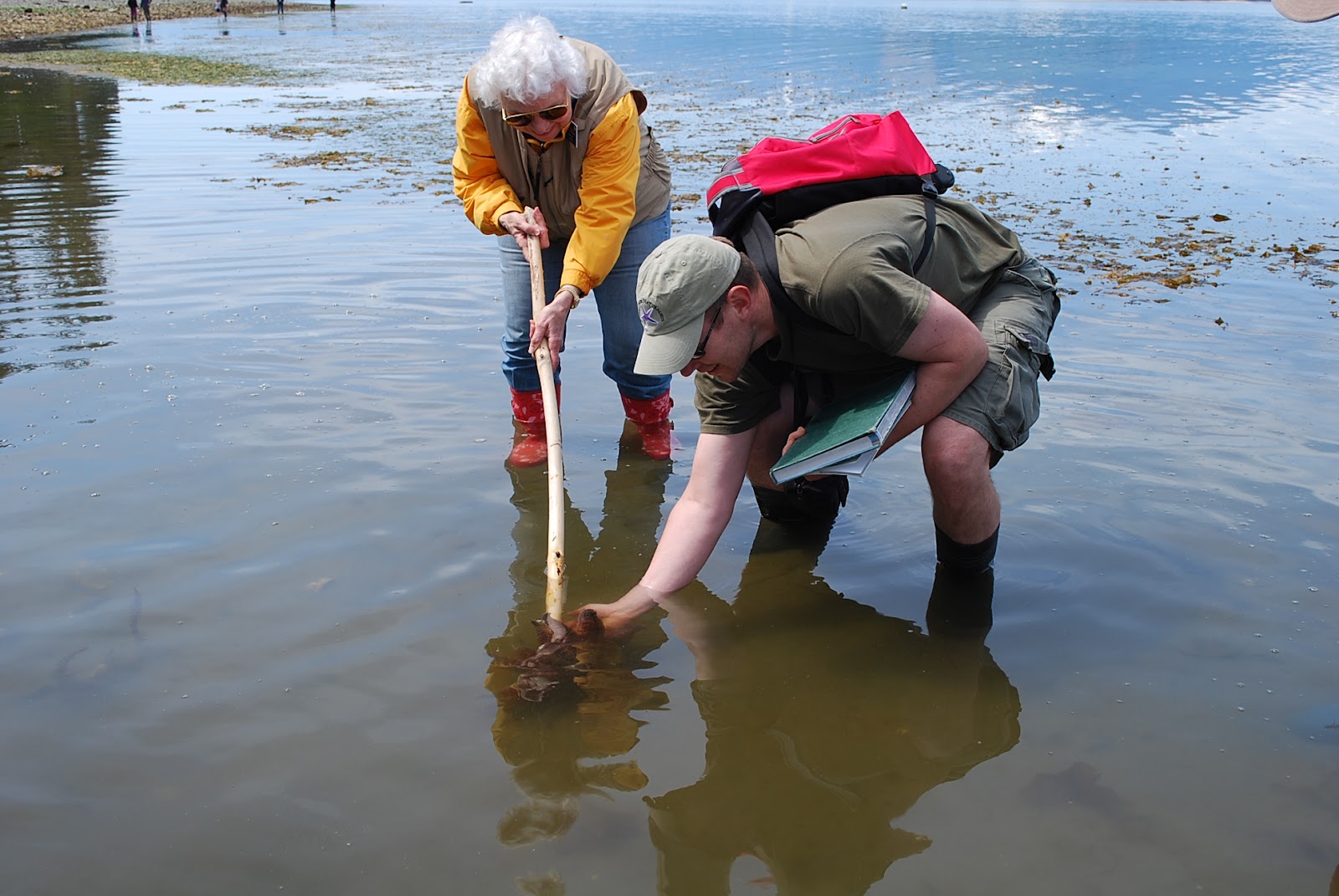
Growing up and spending my young adult years inland, I never imagined living near, or spending much time on, an ocean beach. Yet here I was, not far from home on one of many excursions along the myriad shorelines of the Puget Sound area. On this day, our group of volunteer beach naturalists had come to Scenic Beach State Park to refresh our knowledge and sharpen our skills for the summer ahead. Much of our time and effort is spent on local beaches helping others to learn about and appreciate the near shore habitats and their plants and animals.


It's difficult to explain how much joy and satisfaction can come from spending time with others who love the natural world, enjoy continually learning, and relish mucking about in rocks, mud, and water seeking creatures to observe and identify. Our goal, ultimately, is to inspire others to become more knowledgeable and thus respect and help to preserve these precious resources.


There is a part of me that has never grown up which I hold on to with all that's in me. Children mostly view the world through fresh, unsullied eyes. For them it is a vast place, full of interesting things - many of which they as yet know nothing about. Turn them loose on a beach of any kind and I can just about guarantee what they will do; I do many of those same things myself.


Observing the surroundings, they look for something to DO. Depending on the type of beach, time of year, weather, age and personality of the child, and whether or not they've been there before, they - each in their own individual way - begin to explore and become acquainted with this particular place and time.


Pointing, poking, prying, digging, chasing, grabbing, wading, splashing, and kicking, they wander their way through the maze of the known and unknown, often losing track of time. I totally understand...


To nurture the child within all of us, I find it interesting to approach a beach exploration aimed at the most basic levels of observation, curiosity and discovery. It is best to use all of one's senses: hearing, seeing, smelling, touching, and sometimes even tasting.


RESPECT is paramount. Usually, we humans are the noisiest and it's hard to listen when you're making noise. But does that really matter; can any of the animals on the beach hear us?


Well, ears or not, they can feel the vibrations of our noise.


When we are quiet, talking in hushed tones or not at all, we hear and see better.


If we close our eyes and listen, it's surprising what can be heard - the waves lap the shore, the seagulls squawk, and the clams squirt. If you turn over a rock, you can often hear the critters that are hiding under it as they splash and skittle for cover.


Can you hear that teeny tiny crab -


or the splash of that Gunnel?


Learning about nature requires excellent observation skills. Here are two shells we found. Obviously, they were both made by a snail, but what lives in them now?


Only one way to find out...


A Hermit Crab has moved into the shell on the right; a snail still occupies the other one, as its "trap-door" (operculum) is clearly visible. This flat piece of shell, which the snail can pull shut, serves to both protect its soft body and hold in moisture if it is left high and dry with the ebbing tide.


Animals that live in the tide zone need some way to withstand the drying effects of being uncovered during low tides. To survive, they need to be able hide under rocks and seaweed, burrow down into the wet sand, or be equipped in some way to retain water.


Snails are among the best-equipped.


They begin life, as many ocean invertebrates do, as tiny creatures that swim and bear no resemblance whatsoever to the adults of their species. As they mature, they are able to take calcium out of the water to form a shell, adding on to it as they grow larger to accommodate their soft bodies.


The Moon Snail, with its huge, fleshy foot and shell up to four or five inches across, is the largest in our area. By taking in sea water, it can enlarge its foot up to 4 times the size of its shell! It lives in sandy or muddy areas and if it dies or is killed, the large, white, round shell is easy to spot.


The living snail is not easily seen; it half-buries itself and plows through the sand "undercover". The egg cases are easy to spot, once you know what they are. The snail produces a glue-like mucus which it uses, along with grains of sand, to form a thin, tube-like structure around its entire body (foot and shell). Laying its eggs inside of this sand collar, it digs down into the sand and ducks under, leaving the collar with its precious cargo to the tides.


When conditions are right, the tiny snails hatch and take their place among the plankton until they are large enough to begin their shells. Millions hatch, but few survive to become adults.


Those that do, have a unique way to dine. As they plow through the sand, they search for clams. Finding one, they use their extremely rough tongue (radula) to literally lick their way through the shell to reach the succulent meal inside. The beach becomes strewn with the evidence of their prowess.


The beach is a magical place - when we learn the what, how, and why of the incredible things that live there, we gain a much greater understanding of just what this world would be missing if they were not here.


And God said, "Let the waters bring forth swarms of living creatures... So God created the great sea monsters and every living creature that moves, of every kind, with which the waters swarm... And God saw that it was good. God blessed them, saying, "Be fruitful and multiply and fill the waters in the seas..."

Genesis 1: 20-23

For more posts about Incredible Sealife, click below: