Showing posts with label Ocean. Show all posts

Friday, February 14, 2014

Proper Handling of Gifts


What is the proper way to treat a lovely gift that you have been given? Would it depend on the value of the gift, who the giver is, or whether or not you plan to pass it on to others? What if your health, your life - and that of others - depended on it?

Shoppers worldwide are using approximately 500 billion single-use plastic bags per year, which is about a million bags every minute across the globe, or 150 bags a year for every person on earth.  If you joined the bags end to end they would circle the globe 4,200 times.
Plastics do not decompose, but merely break up into smaller pieces, although some do break down into polymers and toxic chemicals. It can take anywhere between 20-1000 years for a plastic bag to break up. The #1 man made thing that sailors see in our oceans are plastic bags.
More than a billion people around the world do not have access to safe drinking water, but most countries that buy bottled water do have the luxury of quality tap water.
Each year, 53 billion gallons of bottled water are consumed globally - Americans drink 8.6 billion gallons of those.  17 million barrels (340 million gallons) of oil are used yearly to produce bottled water.
Plastic water bottles take 450 years to break down; only 1 in 5 bottles is recycled. - the other 4 contribute to the 3 million pounds of plastic water bottles added to landfills each year. Some of those end up in the ocean.
Across the world, 13-15,000 pieces of plastic are dumped into the oceans every day and there are believed to now be 46,000 pieces of plastic in every square mile of ocean.
There are 5 ocean gyres in the world where plastic gathers due to current circulation. These gyres contain millions of pieces of plastic and our wildlife feed in these grounds.
At least two thirds of the world’s fish stocks are suffering from plastic ingestion,  
approximately 1 million sea birds die from ingesting plastic,
 
and 100,000 marine creatures a year die from plastic entanglement - these are the ones that are found.
 
Scientists have identified 200 areas in our oceans declared as ‘dead zones’ where no life organisms can now grow.
Is this how we treat gifts given in love?  
 
The heavens are the LORD's heavens,
but the earth he has given to human beings. 
Psalm 115:16
When I look at your heavens, the work of your fingers,
the moon and the stars that you have established,
what are human beings that you are mindful of them,
mortals that you care for them?
Yet you have made them a little lower than God,
and crowned them with glory and honor.
You have given them dominion
over the works of your hands;
you have put all things under their feet,
all sheep and oxen,
and also the beasts of the field,
the birds of the air, and the fish of the sea,
whatever passes along the paths of the seas.
O LORD, our lord,
how majestic is your name in all the earth! 
Psalm 8: 3-9

Friday, October 19, 2012

Beach Exploration: Driftwood


"The three great elemental sounds in nature are
the sound of rain,
the sound of wind in a primeval wood,
and the sound of the outer ocean on a beach."
Henry Beston

After a nearly unprecedented 8 weeks without a drop of rain, the weather has finally turned sodden again in our corner of the world. Trying to finish up gardening chores, I've found the ground in most areas dry as far down as I've dug. Many garden plants and vegetables suffered during this drought and needed to be watered, but native species (although now heaving a collective sigh of relief) will do just fine. They have, after all, lived here for eons and are well-adapted to the soggy winters/summer droughts of the Pacific Northwest. Some of the deciduous trees that are bone dry have given up early, simply dropping their leaves without a lasting show of autumn color.


The huge conifers are drooping and many of the cedars are "flagging" prolifically.


It is perfectly normal for them to do this on occasion, but these stately giants of the tree world require rich, damp soil to thrive and hot, dry weather may stress them enough that some of their needles turn a rich orangish-brown and drop. The return of the rains will undoubtedly perk them all up again.
 

Although our local beaches vary considerably, they are never far from fresh water runoff and lush vegetation - usually in the form of large conifers.


And so it is not surprising that driftwood is common, whether carried by water from somewhere else and washed up on shore or crashing down from the many high banks as endless erosion takes its toll.


Either way, it is at the mercy of the sea and its endless ebbing and flowing. With time, all wood here is "sanded" down to its essence with all trace of leaves, bark, and branches scoured away.

 
Some driftwood fits its name and drifts along with the seas - for who knows how long - picking up all kinds of passengers. Some use logs as a resting place or hook a ride for a bit;


others are in it for the long haul, attaching themselves permanently to the wood.

 
Some of this wood has been purposefully transported here by humans for constructing piers and various other structures.


Depending on the type of wood and the severity of the coastal waves, some of these can remain in place for many, many years.


Humans have never been able to resist using this wood, which nature has already cut, limbed, and stacked.


Depending on where they lived and what the land offered, various Indian tribes have used this readily-available resource for fire, shelter, tools, utensils, art objects, and boats.


There are stories of early-day pioneers collecting and lugging this wood to what they deemed a suitable home site on which to build a simple shelter.

"Every time we walk along a beach
some ancient urge disturbs us
so that we find ourselves shedding shoes and garments
or scavenging among seaweed and whitened timbers
like the homesick refugees of a long war."
Loren Eiseley


The lure is still there - as evidenced by the "play" structures, pieces of art, and campfire remnants still found on any beach with a reasonable amount of driftwood.


With time, isopods, shipworms, and bacteria decompose the wood and gradually turn it into nutrients that are returned to the food web of the sea. Nature, ever the master recycler, never wastes a thing. 


No matter the season, or weather, we return to the beach - to relax, walk, listen, observe, contemplate... for it is here that we are renewed, cleansed, reminded of our place in the greater scheme of life. Storms are bound to come - we may be battered and worn down, our size and shape may change, but we will also become hardened and polished. Like driftwood, we toss about on the seas of life, following the ebb and flow, until we wash up on some steady shore - rough edges removed, outer facade stripped away. If our inner grain runs straight, strong, and true, we will be primed and ready for whatever "new use" we can be put to. Are you ready?


"If you want to build a ship,
don't drum up people together to collect wood
and don't assign them tasks and work,
but rather teach them
to long for the endless immensity of the sea."
Antoine de Saint-Exupery


For other BEACH EXPLORATIONS,  please click below:
SAND
SEA STARS
SNAILS


Friday, July 13, 2012

Beach Exploration: Sand


“To myself I am only a child playing on the beach,
while vast oceans of truth
lie undiscovered before me.”
Isaac Newton
It is apparent, even from some distance, that the trees here are survivors. Prevailing winds and storms take their toll along any shoreline and on this tip of land, jutting into the Strait of Juan de Fuca just where it flows south into Puget Sound, they are relentless. Only a few hearty birds frequent the tree tops here.


We were camping at Fort Worden State Park in Port Townsend, WA.


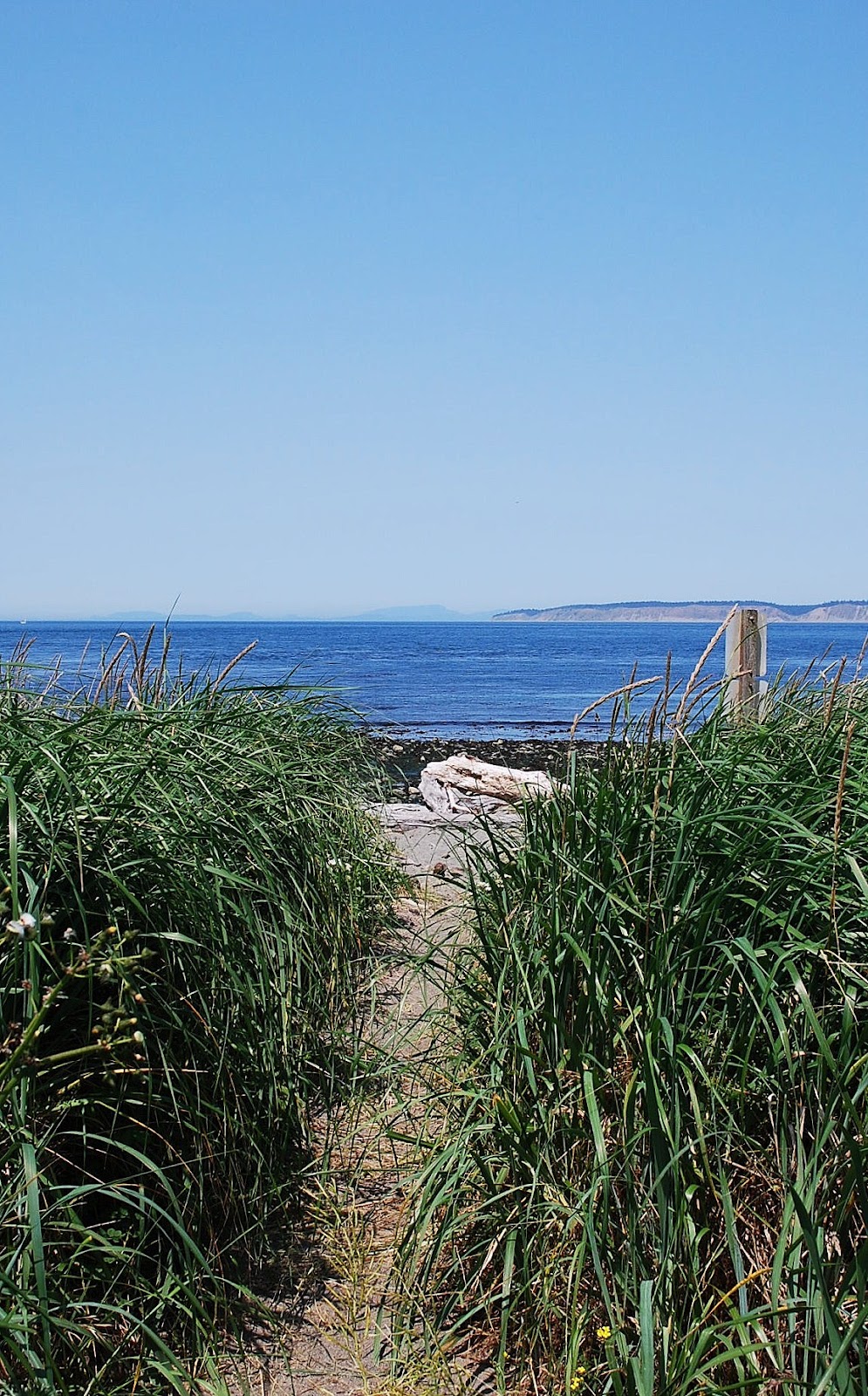
That afternoon we would walk the beach, taking a route that passes through sand dunes filled with beach grasses, shrubs, and flowers.


Here, nestled down among the dunes and taller plants, a number of flowers thrive.


No matter how common or plain these may appear, I always stop and take a closer look at lovely, delicate blooms.


The tide was ebbing as we began our walk, and we were soon completely absorbed in the sights, sounds, and solitude of the shore.


It is a wily thing, lulling and luring us into its spell...


Water is a remarkable force, even as it quietly seeps through the sand on its way down to the sea.


I imagine I am flying high above the earth looking down and the view is similar - the flowing of streams and rivers carving their paths through the land.


There are flood plains, deltas, large outcroppings of rock; are not the processes and results the same?


Looking up to the bluffs, we see countless eons of deposits that were laid down in remarkable patterns.


Wind and water continue their relentless assault, slowly wearing down and carrying away each particle.


At the top, all things teeter on the edge, waiting their turn to return to the sea in an endless cycle.


Others have been here - we see the signs of their passing...


Most leave a brief imprint which will soon be gone, washed away with the sand and all that lies on it.


Some - the daring or foolhardy - seek a more lasting impression. I think most impressions are fleeting at best, and the deepest ones are not necessarily the ones we set out to make.


Many live here on the edge between the land and the sea, able to withstand the extremes.


Some tether themselves tightly to the land, adapting and adjusting their parts for the long haul.


Some are able to come and go, using the tides to their advantage.


Others, who must remain in or near the water, have developed unique ways to protect themselves when the tide is out. 


The beach is littered with those that have been flung onto the land, whatever the reason - many will survive to be carried out once more when the tide turns.


Many will not...

We treasure our time on the beach
and savor every small gift:

The shell - form and function
perfectly matched.
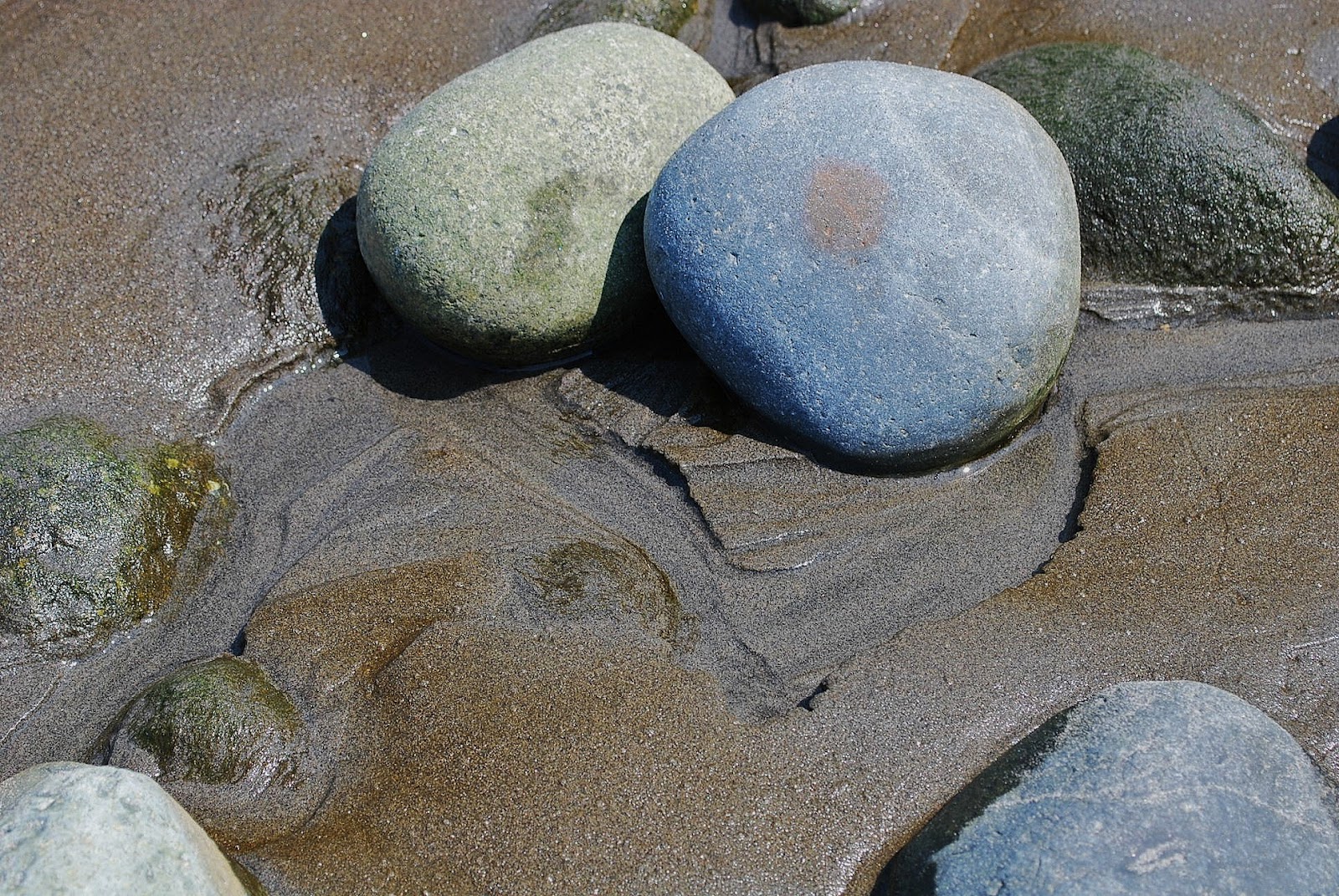
The rock - solid and strong,
but even it can be broken and changed.
The beach glass - worn smooth and polished
through time and abrasion.


Yet again I am reminded...

"The sea does not reward
those who are too anxious,
too greedy, or too impatient.
One should lie empty, open, choiceless as a beach
- waiting for a gift from the sea."
Anne Morrow Lindbergh