Showing posts with label Rivers. Show all posts

Saturday, November 26, 2016

Struggling Upstream


Photo by John Williams
Surrounded by the hush of the forest - firs, cedars, and maples closing in with all their muted glory - I was once again struck by the fragility, yet the stubbornness, of life. Below us in the stream the salmon struggled, their once-glorious bodies battered, tattered, and covered with white splotches of fungus. Theirs was a trip of a lifetime, a one-time journey upstream to preserve their species; a trek marked by danger and tragedy as they wended their way past fishermen, boulders, logs, predators, through culverts, over or around dams and fish ladders.


Many would not survive the ordeal. Those who did would, if successful, produce progeny that might face even greater challenges on their return journey to the sea. It was a risk they all had to take – to choose otherwise would mark the end of their kind.


Salmon are driven by instinct, a highly-sensitive sense of smell, and an uncanny ability to detect the pattern of the Earth's magnetic field at the mouth of their native river. They are one of the few fish that can adjust to differences in salinity, spending part of their lives in both salt and fresh water. Adults live in the ocean where they feed and grow for six months to seven years, depending on the species. At maturity, they return to the stream where they were hatched and literally fight their way upstream to the ideal gravel beds for laying their eggs.


During this time, the adults stop eating and their bodies undergo many changes to help them attract a mate and ward off competitors. After the precious eggs have been laid, fertilized, and gently covered, the adults finally give in to the starvation and damage of their bodies and die. But that is not the end of their story – far from it. Some of the dying or dead fish provide food for other animals; their decomposed bodies return valuable nutrients to the water and soil of the surrounding forest.


Photo by Laura Finch
The newly-hatched fish continue to feed on the yolk sac attached to their bellies. Some kinds stay in the gravel for several weeks before swimming up into the open water of the stream, where they feed on plankton and other tiny aquatic organisms. Some spend one to two years in fresh water before beginning the long journey downstream and heading out to sea. As the current carries the young salmon tail-first to the ocean, their bodies undergo physical and chemical changes to enable them to survive in salt water. It truly is an incredible, never-ending circle of life.


Photo by Laura Finch
God provides us with many teachers and there is much we can learn from the salmon. We need to become keenly aware of our instincts and learn to trust in them; as we develop our finely-tuned sense of self and a sense of place, know that those are inexorably linked. We should set our goals and persevere until they are reached, no matter how tough the going may be. If we value the wisdom and knowledge of older people who have amassed a wealth of information, experience, and acumen, we will find it is worth making the time to listen to and learn from them. To live sustainably, so that there is enough for everyone, we need to become fully conscious of our use of the many natural resources this planet provides – carefully buying, using, and recycling; there should be little that we waste or throw away. We must trust that others will carry on after us.


There is a time for everything, and a season for every activity under the heavens:ferences for Ecclesiastes 3:1

a time to be born and a time to die, a time to plant and a time to uproot,

a time to kill and a time to heal, a time to tear down and a time to build,

a time to weep and a time to laugh, a time to mourn and a time to dance,

a time to scatter stones and a time to gather them,

a time to embrace and a time to refrain from embracing…   
~ Ecclesiastes 3:1-5


It is the season of renewal, joy, and hope -

CELEBRATE!

Friday, July 13, 2012

Beach Exploration: Sand


“To myself I am only a child playing on the beach,
while vast oceans of truth
lie undiscovered before me.”
Isaac Newton
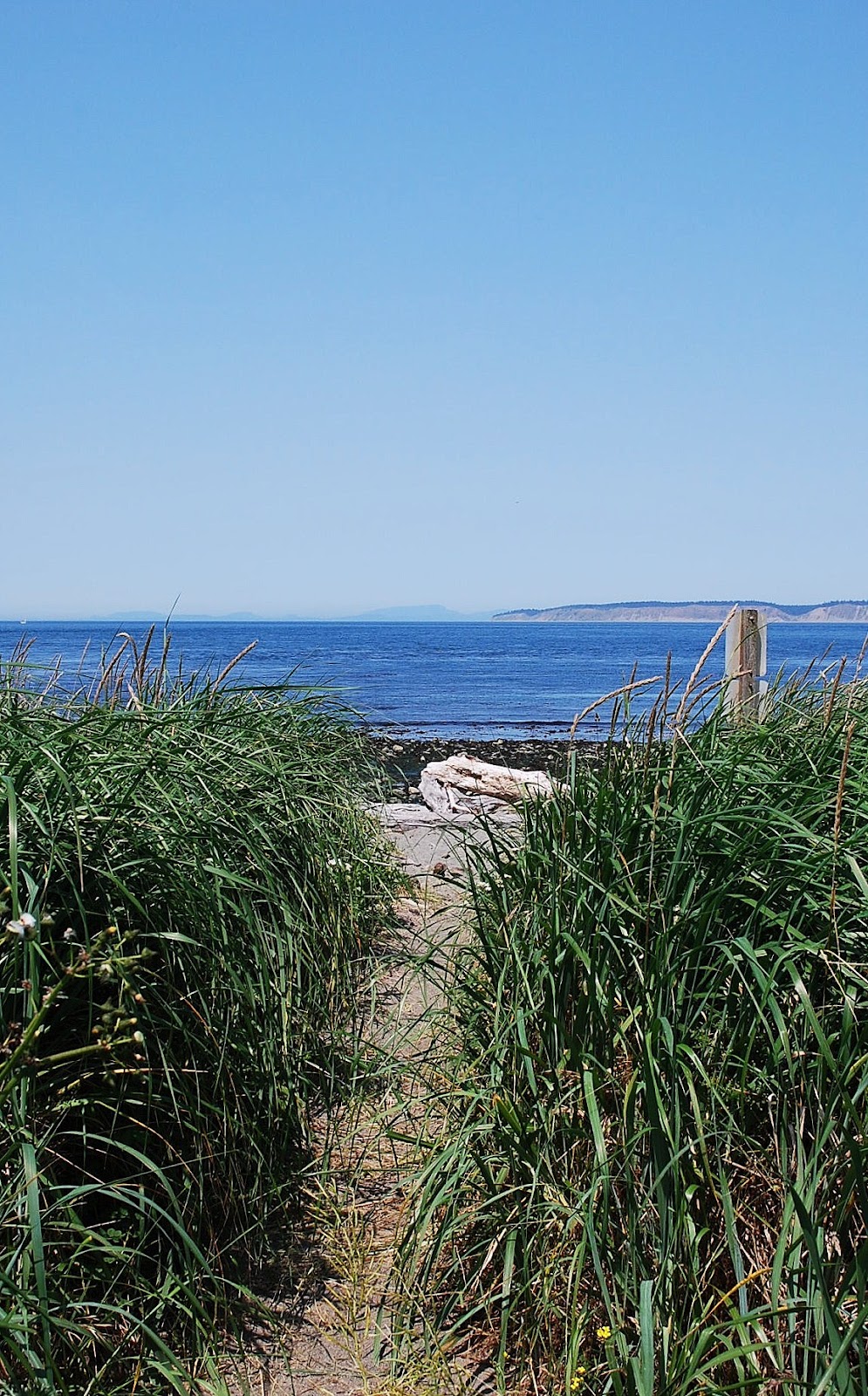
It is apparent, even from some distance, that the trees here are survivors. Prevailing winds and storms take their toll along any shoreline and on this tip of land, jutting into the Strait of Juan de Fuca just where it flows south into Puget Sound, they are relentless. Only a few hearty birds frequent the tree tops here.


We were camping at Fort Worden State Park in Port Townsend, WA.


That afternoon we would walk the beach, taking a route that passes through sand dunes filled with beach grasses, shrubs, and flowers.


Here, nestled down among the dunes and taller plants, a number of flowers thrive.


No matter how common or plain these may appear, I always stop and take a closer look at lovely, delicate blooms.


The tide was ebbing as we began our walk, and we were soon completely absorbed in the sights, sounds, and solitude of the shore.


It is a wily thing, lulling and luring us into its spell...


Water is a remarkable force, even as it quietly seeps through the sand on its way down to the sea.


I imagine I am flying high above the earth looking down and the view is similar - the flowing of streams and rivers carving their paths through the land.


There are flood plains, deltas, large outcroppings of rock; are not the processes and results the same?


Looking up to the bluffs, we see countless eons of deposits that were laid down in remarkable patterns.


Wind and water continue their relentless assault, slowly wearing down and carrying away each particle.


At the top, all things teeter on the edge, waiting their turn to return to the sea in an endless cycle.


Others have been here - we see the signs of their passing...


Most leave a brief imprint which will soon be gone, washed away with the sand and all that lies on it.


Some - the daring or foolhardy - seek a more lasting impression. I think most impressions are fleeting at best, and the deepest ones are not necessarily the ones we set out to make.


Many live here on the edge between the land and the sea, able to withstand the extremes.


Some tether themselves tightly to the land, adapting and adjusting their parts for the long haul.


Some are able to come and go, using the tides to their advantage.


Others, who must remain in or near the water, have developed unique ways to protect themselves when the tide is out. 


The beach is littered with those that have been flung onto the land, whatever the reason - many will survive to be carried out once more when the tide turns.


Many will not...

We treasure our time on the beach
and savor every small gift:

The shell - form and function
perfectly matched.
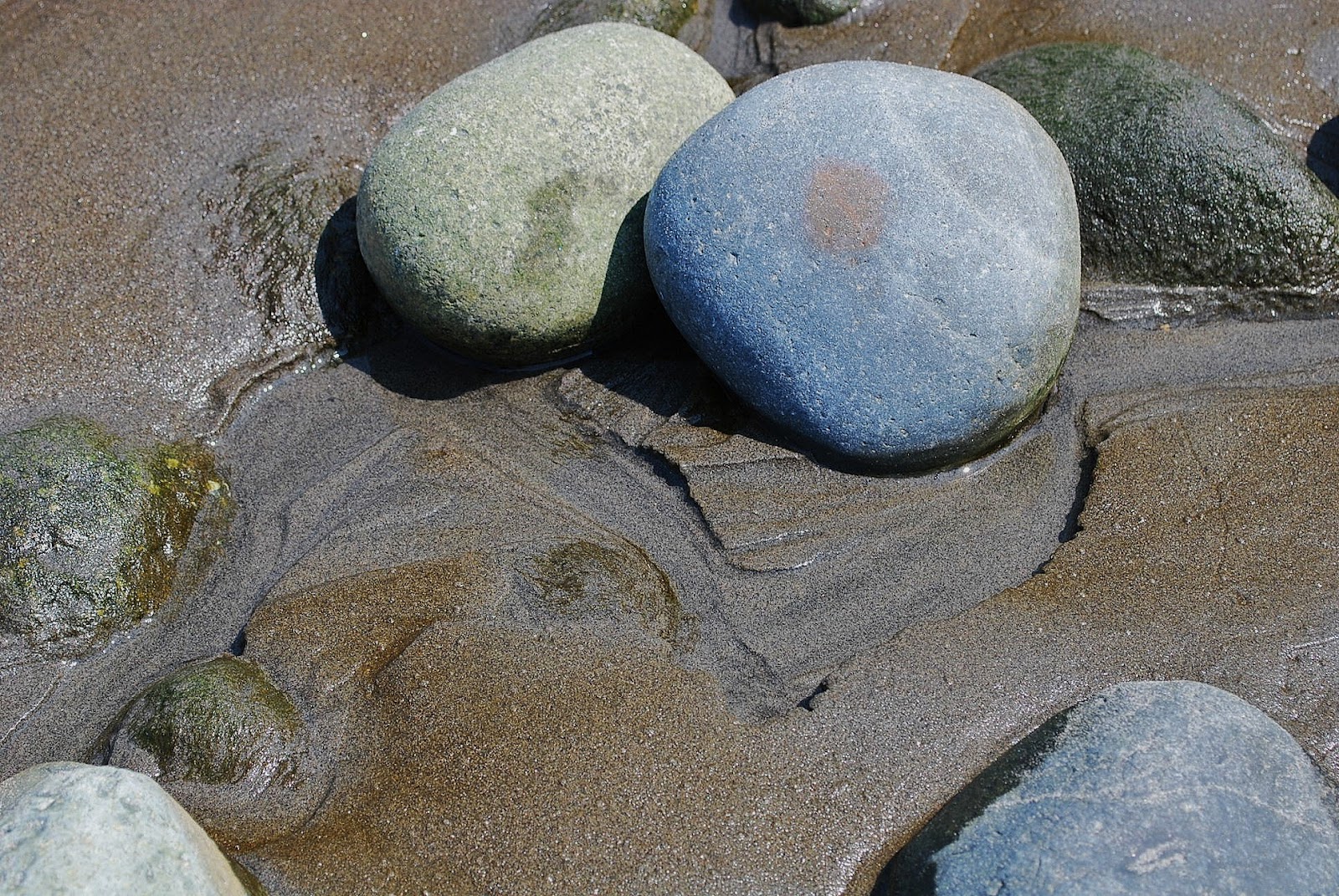
The rock - solid and strong,
but even it can be broken and changed.
The beach glass - worn smooth and polished
through time and abrasion.


Yet again I am reminded...

"The sea does not reward
those who are too anxious,
too greedy, or too impatient.
One should lie empty, open, choiceless as a beach
- waiting for a gift from the sea."
Anne Morrow Lindbergh

Sunday, March 25, 2012

Rain Runs Down


Splashing against window
flowing from top to bottom
rain runs down
each splash running into another
forming a sheet, coating the glass


Falling onto pavement
single drops mean nothing, almost,
yet run together
forming rivulets and puddles
flooding ditches and dips in the road


Flowing ever downhill
each trickle becomes a stream
rambling along and gathering speed
for the journey ahead, for the giving of itself
bringing needed sustenance to all that thirsts


Now gathering strength
streams wind into each other
becoming a river
flowing smoothly, running swiftly
on the endless journey, going on without end


Racing with force
in time, rivers merge into seas
surging with power
these waters now joined
ebb and flow, changing whatever they touch


Eons of melding
touched by air, wind, and sun
once again changing
soft mist rises up, slowly dissipates
to become separate drops and returns as rain


Imagine if we
would remember those droplets when
rain runs down
and that small, seemingly insignificant, acts
merge together to become the seas of change