Showing posts with label Death. Show all posts

Saturday, March 1, 2014

While You're Away...


"I make the most of all that comes
and the least of all that goes."
Sara Teasdale


Driving about, during the times when deciduous trees have lost their leaves, I am always attracted to empty birds' nests in trees. I certainly would take notice of - and great interest in - them any time of the year, but they usually are not so easily seen. This is quite intentional on the birds' part, but once they're done with them, what does it matter?

 
For me, as in many things, it leads to interesting thoughts: Where are those particular birds now? Did they successfully raise their young and how many survived? Will they return to the same nest next spring or build a new one? Will I notice that they've returned or recognize them and will I even care by then? After my thinking has run its course on the birds, it turns inward. The birds may not wonder at all about me, but just what will I have done in the time they've been away? It is a thought worth pursuing...
 
 
We all suffer some degree of loss in our lifetimes. Relationships change, friends leave, spouses wander, parents and siblings die. The older we get, the more loss we have experienced, and that can become a burdensome thing. For those who believe in some sort of afterlife, there is at least the hint of a promise of reconnection. If the loss was caused by some kind of unresolved differences, there may be a chance of reconciliation - if not in this life, then in the next. If the loss was a person we cared deeply for, perhaps we will be together again someday. No more tears, pain, loneliness, or suffering - all will be well in the hereafter. The trouble is, no one can tell us when that will be and the waiting can be interminable.
 
 
While there are a number of different belief systems, those that offer no hereafter surely have ways of dealing with loss, but reuniting after this life would not be one of them. For those who have no belief in an afterlife, what's done is done. In some ways this might seem better, for putting one's life on hold in the hope for a better future "someday" could certainly lead to stagnation and dead ends - no pun intended. A great many poets and others who have ways with words have stated that the past is over and done with and the future is not guaranteed. All we really have is today - here and now. But if we are dealing with loss, how does this help?
 
 
I return to my thoughts of the empty birds' nests. To those birds I would say this: "While you've been away, I have remained the same in some ways and changed in others. I have grown, learned, and reached out beyond myself. I have made mistakes, stumbled, fallen, and picked myself up. I have remembered the past, but not remained mired there. I have anticipated the future and moved forward, knowing I may never reach it. I have endeavored to help others, share what I have, see life through their eyes. I have not wasted my life, but have lived it - loved, laughed, sung, danced, and enjoyed those around me. I think of you and remember all that you taught me; my life is richer because you were here."
 
 
If I would say that to birds, how much more could I say to those I've lost? The telling does not need to be in words, only in the living of our lives. Whether you believe we'll meet again or not, imagine it is so. LIVE your life - in honor of, or in spite of, those you've lost.  For in the end, this is what truly matters.
 

Why, you do not even know what will happen tomorrow.
What is your life?
You are a mist that appears for a little while
and then vanishes.
James 4:14

Sunday, November 3, 2013

November Musing - Part 1

There comes a time when autumn asks, 
"What have you been doing all summer?"
It is never expected - not really, anyway.
Early last summer as I walked by our kitchen window, I glimpsed a dark, blocky shape out of the corner of my eye. We were having some old concrete work replaced out back and it occurred to me that the workers might have propped up a large piece of plywood there. What? Going back to the window, I looked out to see a large black bear standing on its back legs and licking sunflower seeds out of our post bird feeder. Quietly, I summoned my husband and we watched while the bear continued to eat.
 
Temporarily satisfied, he sat down next to the feeder to reflect on what he had done.... well, probably not.
He did seem fairly content, however, until I opened the door and yelled at him, clapping my hands loudly. Begrudgingly, he got up and slowly ambled across the yard, glancing back at me from time to time.

Before he got far, however, he plopped himself down as if seriously contemplating whether or not it really was time to leave.

 
That's when my husband picked up his pellet gun & bounced a pellet off the bear's hind end. No longer feeling comfortable or safe, the bruin took off for the woods - where maybe he could feel both.

 
After the death of my sister nearly two years ago, my brother-in-law remained in their home alone. It's often recommended that the remaining spouse not make any hasty decisions about moving; allowing for the grieving process and establishing a "new norm" takes time. But he was dealing with a progressing dementia and time was definitely not on his side. He was adamant that he was fine and not moving anywhere!

 
His three adult daughters, with vastly different personalities, lived in three different states - none nearby. Somehow, visiting home care was arranged long-distance and life went on after a fashion. He took his daily walks, visited with neighbors, received and made phone calls, and managed to tolerate the daily intrusions of his caregivers, none of whom he'd previously known. He ate his prepared dinners and spent the evenings alone. One daughter, who seemed to be in the best position to do so, suggested that he move near her where she could monitor his care. He wouldn't budge - not even for a visit -  and over the course of a year, and a number of flights for her, all her persuasions led to naught.

No longer having her mother to turn to, this niece would call me when she needed to vent or bounce around her next idea on how to deal with her dad. Mostly I listened, but sometimes I did have suggestions and together we commiserated on a troubling, difficult situation. I had watched my husband attempt to handle the care of his aging parents from long-distance when both suffered from Alzheimer's and refused to move, so I know how difficult this can be. It is worrisome, frustrating, and heartbreaking.  You do what you can, but in the end are left drained and guilt-ridden. I did not want this for my niece and her dad, if at all possible, so tried to be there for her when she needed me.  

Finally, with yet another change in his caregivers, increasing social isolation, and some changes in his behavior which caused more concern, she flew to visit him yet again with one more proposition: he could come to visit her for a month and stay in one of the assisted living facilities he had previously visited and liked. At the end of that month, he could stay or go back home - the decision would be his. We both knew this was risky, for there was no way she could force him to stay, but he finally consented to give it a try.  Her tremendous compassion and patience paid off at last.
 
As it turned out, he liked his new place, made friends immediately, and felt at home there. After that year of mourning his loss, he now realized just how lonely and isolated he'd become. He was finally ready to admit and somewhat accept his failing memory. He decided to move on and enjoy having some family nearby - one daughter, two grown grand-daughters, and his one and only precious great-grandson. 
 
 
After our early summer visit by the large bear, we removed all our bird feeders so that he'd have nothing to come for. It seemed to work and we tried to figure out ways to suspend a couple of the feeders beyond what any bear could reach. Finally, we put two feeders back up - one attached high up on the side of a large, metal outbuilding, and one suspended far up a tree on the outer end of a branch. We did not expect any bear to reach either of these, but late one night a smaller bear came by and tore down the feeder hanging from the tree. We're still not sure how he did that, but he also grabbed a suet feeder hanging high outside a window and carried it off some distance from the house. We've not put either back up. The one remains on the side of the metal building - so far. No matter how hard we try, some things are beyond our control.
 
 
Since my brother-in-law's move, things have changed and life still goes on. It is a bonus for us that he now lives somewhat closer. Some of his own belongings have been transported to his new home and he remembers most of them. His family visits often, yet gives him breathing space and "independence" as much as is possible. He shuffles his important papers and writings numerous times, misplaces and loses things, and thinks they have been stolen. He likes where he lives and the people he's met there - most of the time. He still thinks the city and state he's moved to are strange and says they've always been so - we no longer argue that point. Some things are just not worth discussion any more.
 
 
Sometimes turmoil leads to cohesion. This niece and I have grown closer as a result of family upheaval. She still calls to talk, for all is not settled yet. His previous home has not yet been emptied and put up for sale, which is a concern. There are some financial and legal matters to put in order and two sisters for her to deal with - all of it long-distance. There is the slow, steady decline in her much-loved dad, the only parent she has left. I cannot begin to fill that space in her heart or answer all of her concerns.  I never expected to be in this position, but then no one ever does. I can only give her one thing - time on this end of the line. Time and love, for in the end those are what matter the most.

"Time is too slow for those who wait, too swift for those who fear, too long for those who grieve, too short for those who rejoice, but for those who love, time is eternity." ~ Henry Van Dyke
 
To be continued here:


Friday, July 12, 2013

Whatizzit? 4 Answer

This turned out to be quite a puzzle, didn't it?  The enlargement shows the lower left corner of a paper wasp's nest with the light on the autumn leaves behind.
 
I like the reference to dark and light, known and unknown, solid ground, flight, and faith in the quotation, all of which seemed to relate to the photograph. I added my own few rhyming words to the clue.


For more on the paper wasps and what I gleaned from this particular nest when I found it, already done serving its purpose and beginning to fall apart, please click here: Leavings
 
The beginning quote is called Faith and is by Patrick Overton. A teacher, scholar, poet, playwright, author, lyricist, speaker, and visual artist, Overton has devoted his entire adult life to exploring human communication, designing and building organizational systems that enhance the development of the human community, and creating innovative resource networks to help people in rural and small communities nurture the invisible culture of Rural Genius.
 
For more information on Patrick Overton:
 

Friday, October 26, 2012

Leavings

Leavings pl. n. something remaining, scraps, residue, refuse, etc.

Crisp days of raking leaves - HA! Memories of those take me back to our years of living in Montana and Idaho where great dry masses of fallen leaves were as most of us think. I reveled in the swish and crunch of walking through them, loved raking them and being buried within the huge piles.
 
Here, fall can be a gooey, messy time of year. All those beautifully-colored leaves do eventually fall and with our perpetual rains they form a slick, heavy, sodden mass on the ground, which few bother to even try to rake up. Cheery fall colors and glowing fields of pumpkins and corn stalks slowly give way to wet, rotted leavings - some of which are internal. Unlike spring, with its bright cheerful awakenings, fall is a time of farewells for many of us. Farewell to summer, for sure, but also ever-shortening daylight, colder temperatures, thoughts and activities that often slow down and turn inward...
 
 
So, I was not too surprised when I glimpsed the nest and found it ragged and deserted. All my "good intentions" regarding it during the summer came rushing back. Discovering it fully-formed and humming with activity during our glorious late summer days, I checked on it each time I passed.
 
But I was busy with gardening, coming from or going to the mail box, running those countless errands like we all do. I fully intended to study it carefully, meant to photograph it and its inhabitants in detail, pretty much failed to get any of that accomplished...
 
But it was still there, gracefully hanging from the branch as it had from its beginning. This time, I took the time to study it closely and what an intricate work of art it was!

Sometime last spring, a fertile queen paper wasp emerged from hibernation and began the process of turning raw wood into this sturdy paper home. She used her mandibles to scrape bits of wood fiber from fences, logs, or even cardboard.
 
She then broke the wood fibers down in her mouth, using saliva and water to weaken them. Flying to her chosen nest site - the thin branch of this Kousa Dogwood - she added the soft paper pulp to it for support. As the wet cellulose fibers dried, they became the strong paper buttress from which she would suspend her nest.

The nest itself was comprised of hexagonal cells in which the young developed. The queen protected the brood cells by building a paper envelope, or cover, around them. She raised the first generation of workers on her own.


After they emerged, those workers collected food while she switched to only laying eggs. The larvae were probably fed pre-chewed caterpillars, while the adults fed on nectar.  The nest expanded as the colony grew in number, with new generations of workers constructing new cells as needed, until it reached its final size. Many nests are typically small, usually a few dozen workers, but may contain as many as 100.


As fall approaches, colonies produce males and new queens, which leave the nest to mate. After mating, the new queens burrow into the ground where they spend the winter. All workers, the males, and the old queen perish around November, leaving any young behind in the nest to also die. Old nests degrade naturally over the winter months, so each spring new ones must be constructed by the new queens as the process begins anew.

 
I tore open one of the still-sealed cells and shook out a fully-formed dead wasp. Evidently, it had not matured enough when everyone else left the nest - or the temperatures dropped low enough to kill it. A few other cells remained sealed but most were empty, so it seemed that a lot of wasps were produced in this nest.

 
It has been nearly a year now since my second-oldest sister entered the hospital with a severe case of pneumonia. None of us imagined she would be gone before Christmas. They say it takes a full year, at least, to begin to adjust to such losses, but who are "they" and what is a year when I'd known her for nearly 70? This sister was 14 when I was born, left for college when I was 4, married and moved away when I was 7. With the age difference and distance, it might seem that we'd have nothing in common, but that would be wrong. We shared a love of sewing, cooking, reading, the outdoors, the arts, and American Indian history and culture. She was the one who showed and explained to me all the parts of a living grasshopper and how to fish for trout in a cold mountain stream. She and her family came back to visit every summer and the memories of those times are priceless. We kept in touch - not as often as we should have, probably - with letters, phone calls, and occasionally emails. She was the one who always said "Oh, I intended to call you before now, but I just didn't get around to it..." Yeah, I know how that goes.
 

A cold wind rustled the trees and a light rain began. I tossed the ripped-open wasp's nest into the woods and smiled. True, I never did study and photograph it while it was at its peak of activity, but its remnants were still beautiful and intricate. Perhaps I'll get another chance - for I'm remembering that new queen tucked safely away just waiting for spring.

 
"Don't cry because it's over.
Smile because it happened."
Dr. Seuss
 
Other fall meanderings:

Saturday, May 26, 2012

Remembrance

Give sorrow words;
the grief that does not speak
Whispers the o’er-fraught heart
and bids it break.
William Shakespeare


The first time I noticed was probably the first year it was done, although I can't be sure about that. We had already walked most of the route when we stopped at a fenced observation point to view a lovely waterfall surging rapidly through a narrow, sheer-walled chasm. We stood there for some time, as we always do, soaking in the breath-taking beauty. Turning to head back up the few rock steps to the trail, something caught my eye. There, at the base of a rocky outcrop at the very back of this narrow viewing spot, were some wilted flowers and several votive candles. These had been placed there recently; we wondered and talked about it briefly on our way back to the car.


On Vancouver Island, British Columbia, this short hike, around the Little Qualicum River and Falls is one of our favorites. Because we are there off-season, there are very few others on the trail and we are able to experience the peace and quiet of the place mostly by ourselves. The following year, in that very same spot, we again found a candle and some dead flowers. Again, I wondered about this and thought it must be a small memorial of some sort.


Another year, the memorial had shifted and changed. Instead of candles and flowers in an out-of-the-way place, a lovely pot full of spring flowers had been set on a large, moss-covered rock - just outside the fence - on the very edge of the gorge. This time it could not be missed as the brilliant purple crocus, primrose, hyacinth, and bright yellow daffodils stood out against the dark forest background. The pot sported a bright yellow wrap and with tulip buds not yet open, was bound to last for some time yet. The sight of it touched my heart and caused me, once more, to think of loss and what a deceased person means to those left behind.


Several more years passed and we either did not take that hike, or I forgot to look, and the memory of that spot faded. This year, with the death of my sister still fresh on my mind, I did look. At first I saw no sign, but then, on the same moss-covered rock where the pot had been were some carnation stems with blooms long dead and faded. More lay strewn on the ground below. I have no idea what the story behind this particular yearly ritual is, but it is obvious that someone was much cared for, is still missed and remembered.


Memorial days, when the graves of heroes were decorated with flowers and garlands, are ancient customs originating in Greece 2,500 years ago. During our Civil War, both the United States and the Confederate States of America had Memorial days. By the late 1800s, many communities celebrated this day and, after World War I, observances began to honor those who had died in all of America's wars. Originally known as Decoration Day, it became an official federal holiday in 1971 and now falls on the last Monday of May. Officially, this day honors men and women who died while serving in the American military. Many Americans still observe the day by visiting cemeteries or memorials, holding family gatherings, and participating in parades.


Memorials, however, as that special little spot in the forest shows, go beyond those in the military. Many of us have lost dear friends and/or family members this year. Death, as we know, is a part of living. That knowledge, and the ache inside, does not make it any easier for those of us left behind. But we also know that life does go on; hope springs eternal. REMEMBER - for it is cleansing and healing to do so.


 What we have once enjoyed we can never lose.
All that we love deeply becomes a part of us.
~ Helen Keller


...took bread, and when he had given thanks, he broke it and said, "This is my body, which is for you; do this in remembrance of me." In the same way, after supper he took the cup, saying, "This is the new covenant in my blood; do this, whenever you drink it, in remembrance of me." 1 Corinthians 11:23-25

Wednesday, February 29, 2012

Bittersweet Ice


We lost my second sister in December, just before Christmas. Her death affected me deeply and made for a difficult transition between the usual joy of the season and grief. My eldest sister flew to spend the holidays with us as usual, and step by step we embraced each day together, treasuring the time as never before, knowing full well that a part of each of us was now missing.


We are, and always have been, a scattered family. Now flung across six states, we do what we can to maintain contact and some degree of connectedness to each other. Because of this, the holiday season, and the weather, my brother-in-law and three nieces wisely decided to put off a family gathering to remember my sister until late January. It had been ten years since our family had all been together and I yearned for this connection now, as never before. Death can do that to a person.


Determined to make it to New Mexico no matter what, we built an extra day or two into our travel plans, just in case. The weekend before we were to leave, a major storm began to gather strength somewhere far out in the Pacific. This is not all that unusual, as most of our storms approach from the southwest, carrying relatively warm, moist air. Western Washington is well-known for its rainy climate and this is why. But if one of these heavy, wet, air masses should collide with a frigid one moving down from Canada, the result can be a wallop of a storm with high winds, snow, ice and all that goes with it. The day before we were to leave, this is exactly what happened.


Living where we do, there are several ways to get to SeaTac Airport, which lies midway between Seattle and Tacoma. You can "drive around" by way of Tacoma (and its well-known Tacoma Narrows Bridge) or take a ferry from Bremerton or Bainbridge Island into the heart of downtown Seattle and secure a ride from there. When the small bus company that "drives around" cancelled all runs due to icy conditions, we decided to risk driving to a ferry in our heavy duty vehicle. At 5:30 AM, with a friend in tow to drive the truck back home, we did just that - slowly and carefully, to be sure, but we made it. Downtown Seattle was glazed and deserted with nary a cab in sight. But we had booked a ride with a company that guaranteed to get us there, and before long a huge black SUV approached the curb and loaded us in. Another slow, careful drive delivered us to the airport.


OF COURSE we had checked everything out via the Internet before leaving home, and everything was in "GO" status! Once at the airport, however, it was obvious that this was not exactly the case. The place was crowded with long lines of people trying to re-book cancelled flights, which seemed to be most of them. Ours was one of the few not cancelled, so we checked our bags, secured boarding passes, and whizzed through the practically empty security station.


I have never come to rely on a cell phone - my husband and I possess one between us and rarely use it. For this momentous occasion, however, with seven of us flying and two of us driving across hundreds of miles, these little miracles of communication became invaluable. Thirty minutes before boarding, they cancelled our flight. We re-booked for a flight two hours later, which was also cancelled. We booked a third flight for the next morning and somehow managed to reserve a room at a nearby motel. Looking back, I'm not sure how this happened, as all the airport motels had been booked solid since the storm wreaked its havoc. Serendipity, I guess, but we were extremely grateful and decided to have lunch before retrieving our bags.


Bellies full, bags claimed, motel courtesy van caught, and snug in our room, a flurry of phone calls and emails got everyone up-to-date on each other's whereabouts. Everyone (except us) expected that day had arrived, was resting, visiting, and would gather for a family dinner out that night. We would tip-toe through snow and ice to a Denny's across the parking lot, but anticipated a family dinner the next night. Tired, but content, we enjoyed a quiet evening.


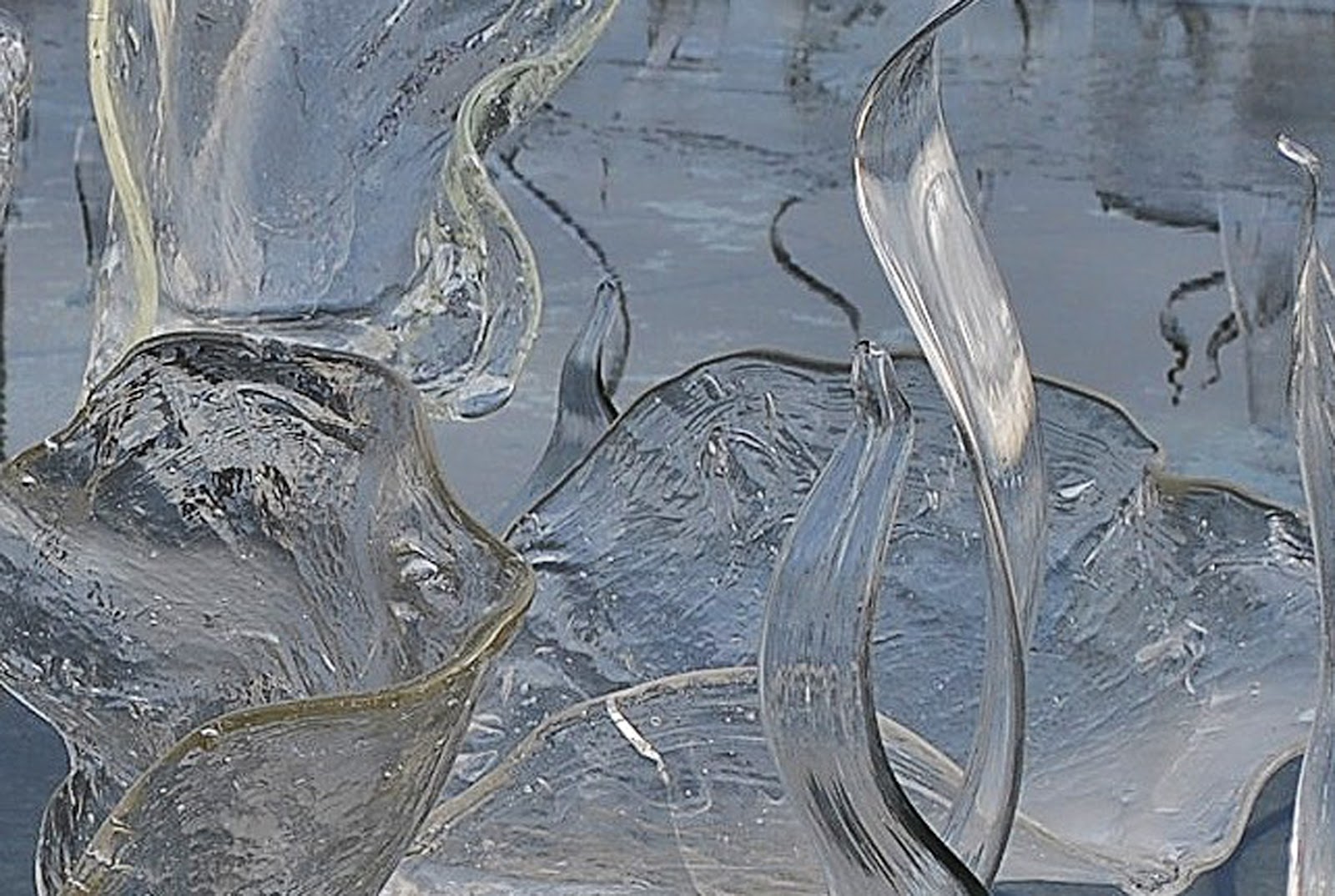
I had to slip back outside to try to capture the wonderland spread before us in this mundane, big city parking lot. This storm, unwanted and retched as it was, had coated everything in a thick, transparent layer of ice.


I lingered far longer than I planned, totally entranced by the beauty of crystalline branches, buds, leaves - each reflecting the lights, other icicles, and their own color from within.


I thought of my missing sister - how she would have loved this! Soon, we would gather with her family, honor her memory, and maybe then this ache in my heart would lessen...


Transfixed, delighted, and exuberant, I arrived back in the room to be greeted with yet another email - morning flight cancelled. An hour on the Internet revealed what we had feared - all flights booked.


I called my niece and we tried, between us, to figure something out. "You could take the train to Portland and fly out of there..." No, the train is not running due to downed trees and branches on the tracks; anyway, all flights out of Portland are booked... "You could try for Saturday morning...." "No way could we get there in time for the service...we've tried everything we know of, we just can't make it." Finally, we just cried together - time, space, memory and grief running together in long streaks down my face.


The next morning began no better: the 3:30 AM wake up call that we had requested, and then cancelled, was not cancelled and woke us up; my sister called at 4:00 - she had not talked to my niece and thought we'd be on our way to the morning flight. We slept a bit more, then roused ourselves to the sound of planes taking off - evidently the ice had begun to melt...


Now I was feeling cheated and really angry. Back to the airport we went, this time to catch the Airporter back home. They can cancelled all morning runs, but would begin at noon. As we waited, visiting with other would-be passengers, there were huge blasts which reverberated through that end of the terminal. Looking up, we could see ice on the skylights and what appeared to be cracks. Police cordoned off the area, fearing falling glass, although we did not see any. Ice melting off of a higher roof had let loose; we later learned that seventeen windows had been broken. By the time the bus arrived, 45 of us were clamoring to board - luckily, they'd sent two buses.


Tired and out of sorts, we settled in for the two-hour ride. Wiping a small opening in the condensation on the window, I viewed a world that was foggy, white and wet, reminding me of a drippy version of Dr. Zhivago. After about an hour, traffic slowed to a crawl and the driver announced that, due to falling ice, the Tacoma Narrows Bridge was closed - for an indeterminate time. Our driver thought quickly and took an exit to a McDonald's, so that we could all grab a bite to eat, use the restroom, and not be stalled in traffic. We waited... still no news on when the bridge would open. The only thing to do was to return to Seattle, take a different ferry across Puget Sound to reach our highway so that all the passengers could be delivered to where they needed to go. Of course, by the time we hit Seattle, it was going-home time on a Friday night!


Traffic was bumper-to-bumper and I felt disheartened and totally drained; it would be after eight in the evening by the time we finally got home. Suddenly, our cell phone rang - it was my sister calling me from the family dinner. We talked a bit, then she held the phone out so that everyone - brother-in-law, nieces, great nieces and nephews could yell "Hello- wish you were here!" Well, I certainly did too, but in that dark, cramped bus heading to nowhere, even with more tears running down my face, I felt loved and included. Across time, distance, and weather - that's what families are for.


Glass sculptures pictured here are from Fluent Steps by Martin Blank