Showing posts with label Learning. Show all posts

Tuesday, January 1, 2019

What We Think We Hear


It started out innocently enough. A well-intentioned comment was unfortunately misconstrued and WHAM! Hurt feelings. It happens to all of us.


Compared to my daily attire I was somewhat dressed up, wearing a newly-purchased burgundy red skirt with navy blue top and matching tights. I was pleased with this outfit and feeling a bit cocky, I guess. Then my husband made his remark: “Wow, you look like the Queen of England!” To which I quickly replied: “I do NOT!” Then I further explained that, although I had nothing against the Queen, I was not a stuffy, dumpy, little old lady, as I perceived her to be. Talk about insults. “No, that’s not what I meant.” he continued. “I mean, that skirt is a rich royal color, like what a queen might wear. It looks good on you—I meant it as a compliment.” Oh…


It’s not the first time my thoughts have jumped out of my mouth prematurely. I’m sure it won’t be the last. It seems to be a basic problem with human communication: what you think you say about what you think is not at all what the other person hears and thinks you said, because they are thinking their own thoughts. Thinking is a wonderful thing, most of the time, but it can and does mislead us. Accurately hearing what the other person is saying, if we are even listening, is critical. Because I am such a visual person, I know that I immediately picture in my mind what it is the other person is saying. I also know that I’m sometimes totally wrong. It helps to clarify by repeating what you think the person said before adding your own reply.


To complicate matters, everyone is different when it come to speaking one’s mind. Some of us are more articulate than others; some write their thoughts better than speaking them. Then there are those who think others can just read their minds…


With another new year beginning, many are making resolutions to improve themselves or their lives—or at least considering making those. More recently, it’s become popular to choose a word for the year, with the intention of focusing on that as a way of improving oneself. I don’t do well with resolutions, but I do like to set a goal or two for the year. Although I reach those with varying degrees of success, it gives me something to aim for. I also like choosing a word or statement and in past years have chosen listen, focus, and one step at a time as my word(s) for the year. This year, I’m taking my words from the 1989 book The 7 Habits of Highly Effective People, by Dr. Stephen Covey. In it, he stated:
"If I were to summarize in one sentence the single most important principle I have learned in the field of interpersonal relations, it would be this: Seek first to understand, then to be understood."


I think I have my work cut out for me, but that's good because I like challenges. Whatever method you choose, I hope that you also will seek some way to improve your life in the coming year. Secretly, I really would like to appear as dignified as the Queen of England. How about you?
 
 
Do you see someone who speaks in haste? There is more hope for a fool than for them.    ~ Proverbs 29:20 

 
“For my thoughts are not your thoughts,
    neither are your ways my ways,”
declares the Lord.
 As the heavens are higher than the earth,
    so are my ways higher than your ways
    and my thoughts than your thoughts.”      
~ Isaiah 55: 8 - 9

Saturday, November 26, 2016

Struggling Upstream


Photo by John Williams
Surrounded by the hush of the forest - firs, cedars, and maples closing in with all their muted glory - I was once again struck by the fragility, yet the stubbornness, of life. Below us in the stream the salmon struggled, their once-glorious bodies battered, tattered, and covered with white splotches of fungus. Theirs was a trip of a lifetime, a one-time journey upstream to preserve their species; a trek marked by danger and tragedy as they wended their way past fishermen, boulders, logs, predators, through culverts, over or around dams and fish ladders.


Many would not survive the ordeal. Those who did would, if successful, produce progeny that might face even greater challenges on their return journey to the sea. It was a risk they all had to take – to choose otherwise would mark the end of their kind.


Salmon are driven by instinct, a highly-sensitive sense of smell, and an uncanny ability to detect the pattern of the Earth's magnetic field at the mouth of their native river. They are one of the few fish that can adjust to differences in salinity, spending part of their lives in both salt and fresh water. Adults live in the ocean where they feed and grow for six months to seven years, depending on the species. At maturity, they return to the stream where they were hatched and literally fight their way upstream to the ideal gravel beds for laying their eggs.


During this time, the adults stop eating and their bodies undergo many changes to help them attract a mate and ward off competitors. After the precious eggs have been laid, fertilized, and gently covered, the adults finally give in to the starvation and damage of their bodies and die. But that is not the end of their story – far from it. Some of the dying or dead fish provide food for other animals; their decomposed bodies return valuable nutrients to the water and soil of the surrounding forest.


Photo by Laura Finch
The newly-hatched fish continue to feed on the yolk sac attached to their bellies. Some kinds stay in the gravel for several weeks before swimming up into the open water of the stream, where they feed on plankton and other tiny aquatic organisms. Some spend one to two years in fresh water before beginning the long journey downstream and heading out to sea. As the current carries the young salmon tail-first to the ocean, their bodies undergo physical and chemical changes to enable them to survive in salt water. It truly is an incredible, never-ending circle of life.


Photo by Laura Finch
God provides us with many teachers and there is much we can learn from the salmon. We need to become keenly aware of our instincts and learn to trust in them; as we develop our finely-tuned sense of self and a sense of place, know that those are inexorably linked. We should set our goals and persevere until they are reached, no matter how tough the going may be. If we value the wisdom and knowledge of older people who have amassed a wealth of information, experience, and acumen, we will find it is worth making the time to listen to and learn from them. To live sustainably, so that there is enough for everyone, we need to become fully conscious of our use of the many natural resources this planet provides – carefully buying, using, and recycling; there should be little that we waste or throw away. We must trust that others will carry on after us.


There is a time for everything, and a season for every activity under the heavens:ferences for Ecclesiastes 3:1

a time to be born and a time to die, a time to plant and a time to uproot,

a time to kill and a time to heal, a time to tear down and a time to build,

a time to weep and a time to laugh, a time to mourn and a time to dance,

a time to scatter stones and a time to gather them,

a time to embrace and a time to refrain from embracing…   
~ Ecclesiastes 3:1-5


It is the season of renewal, joy, and hope -

CELEBRATE!

Wednesday, August 21, 2013

Caring - Feathered or Not

 
"I don't want to make a bird out of a pine cone!" Arriving for the morning's nature study, this rambunctious ten-year-old boy had seen the projects of the six to eight- year-olds strewn about on the table and grass. Those children had chosen a cone, colored and glued on paper wings and bills, and then formed a nest of twigs, grass, moss, dog fur, and - in some cases - mud for it to "nest" in. He did not want to do what the younger kids had done. Of course not.

 "Don't worry," I assured him, "we won't be making any birds." He and his age-mates gathered around as I brought out the various birds' nests that I have collected over the years. Passing them around the circle, I explained how each bird carefully constructs a nest for its young using whatever materials are available that suits it. We had looked at pictures of birds likely to be found in our area and talked about where those nests might be built. Some are high up in trees, made of small branches and added on to year after year; some are found in holes which the birds peck into dead trees, hollowing out a space just big enough for the nest and nestlings. Others are built in low shrubs or on the ground in such a way that they are camouflaged from all but the most observant.  Indeed - the lives of their young depend on it.


"I don't want to make a bird... or a mud nest, either." He was adamant and the others looked as if they might agree. "You don't have to - that's what the younger kids did. You're all older, so we'll do something different - out in the woods." The eyes rolled and the questions started, but I learned long ago that enthusiasm and mystique only add to a learning experience, so plowed on. "You'll see - you'll be constructing something..."


The overall theme of the week was "Under Construction" with a sub-theme each day. We would be delving into how a community shares, cares, worships, and celebrates. My intent was to tie these into nature studies.


We had looked into how ants share within their anthill and on this day were learning how hard birds work to care for their young - even before any eggs are laid. And we humans? It definitely takes effort, and sometimes sacrifices, to care for each other. We talked about the ways in which we can show that we do care for others.


Each child chose a rock and then we were off to the woods. A short ways in they were given their challenge: to pretend their rock was a bird, explore and choose what they thought was a good spot for a nest, construct the nest using whatever they could find, and make sure that their "bird" fit in the nest. Oh - and one more thing. They were each given a simple pair of tongs to use during some of the construction. Birds don't have hands with fingers and thumbs, you know.


Later, as I related this experience to the mom of that particular boy, she told me of his reaction to this activity. He came out of the woods, sought her out, and exclaimed: "Mom, come see the nest that I made!" While I care deeply about all of the children that I interact with, it's not always easy to get through to them. I have to say - that one statement pretty much made my day!

 
Even the sparrow finds a home,
and the swallow a nest for herself,
where she may lay her young,
at your altars, O LORD of hosts,
my King and my God.
Psalms 84: 3
 
 
Selling their possessions and goods,
they gave to anyone as he had need.
Acts 2:45

Thursday, May 31, 2012

Beach Exploration: Sea Stars

“There is nothing very 'normal' about nature.”
Loren Eiseley

Not everyone knows what a sea star is, although everyone knows about starfish. Today's biologists and naturalists prefer the name sea star because these creatures are definitely not fish. Whatever you choose to call them, they are truly incredible beings.


These echinoderms ("spiny-skins") are finely adapted and perfectly structured to live where they do. Like snails and many other marine invertebrates, all sea stars begin life as tiny bits of free-swimming zooplankton which in no way resemble the adults. As they grow and mature, their bodies eventually take on the shape of their species and they migrate to the ocean floor where they spend the rest of their days.


Occurring in a variety of sizes and colors, they are all built similarly; instead of bones, their internal skeleton is made up of hundreds of thousands to millions of small calcium carbonate bits infused with tissue that are made into a living 3-dimensional box which forms the body of the sea star. These hard bone-like pieces (ossicles) often project through their skin forming the "spiny" part of their bodies. Because of this stiff internal structure, most are not terribly flexible, although they can slooowly bend and move enough to change position and get around as much as they usually need to. They definitely operate on "sea star time".


With their arms or rays extending out from a central disc, most have a body plan based on the number 5. We usually picture sea stars as having 5 arms, but some have 6, 10, or more.


Having an amazing ability to regenerate, if any of their arms are lost, they are able to grow them back - as long as at least a part of the central disc is intact. Because of this ability, they are of great interest to researchers within the medical community. Wouldn't it be wonderful if a human could grow back a missing limb?


On the underside of a sea star, long rows of tube feet extend down the length of each arm. They have literally thousands of these small suction cups and are able to control each and every one of them!


Basically, they use a rather sophisticated water hydraulic system which enables them to pump water into and out of each of these "feet" to extend and retract them as they wish.


This system serves them well, as they are able to open clams and other prey much easier than we could using only our bare hands. They don't need much of an opening for lunch, either. A gap of a few millimeters is all that's needed for them to extend their soft, bag-like stomach into the succulent clam and digest it.


The largest - and fastest-moving - species in the world occurs here in the Pacific Northwest. The Sunflower sea star can eventually reach 39 inches across and have 24 or so arms!


First, it develops five arms, adds one more directly opposite those, and then continues to add arms in sets of two, one on either side of the sixth arm, until they've reached their final number.


Because their ossicles are further apart, their bodies are relatively soft and flexible. Voracious carnivores, Sunflower sea stars devour clams, snails, abalone, sea cucumbers and even other sea stars. They are so very vicious, in fact, that other sea life scatters in all directions at their approach.


During one of our beach explorations, we tried an experiment by putting a cockle near a Sunflower star in shallow water. Nothing happened while we watched, but usually the cockle will "pole vault" away quickly, using its long, flexible foot to propel it.


Most of us only see sea stars in marine aquaria or on rocky shores during low tides.


It has recently been discovered that these remarkable creatures are able to withstand the heat and drying effects of  low tides by "bulking up" with cold water when the tides are high. Then, if they are left high and dry during a low tide, they are fairly well-prepared. It appears this only works when the water is colder than the air, however, so how well this strategy will continue to work in our ever-warming world is anyone's guess. It is more important than ever to remember that everything is connected...


"Tug on anything at all and you'll find it connected
to everything else in the universe."

Sunday, May 20, 2012

Beach Exploration: Snails

“In the end we will conserve only what we love.
We will love only what we understand.
We will understand only what we are taught.”
Baba Dioum

It was one of those days that we, in the Pacific Northwest, spend our winters dreaming of - a bright, clear, sunny day. Overhead, brilliant blue sky with a few white wispy clouds whispered that spring had finally arrived. In the distance, the still snow-covered peaks of the Olympic Mountains formed a spectacular backdrop for heavily-treed lower hills on the far side of the mighty Hood Canal. Before us stretched the shoreline - and the reason we had come.


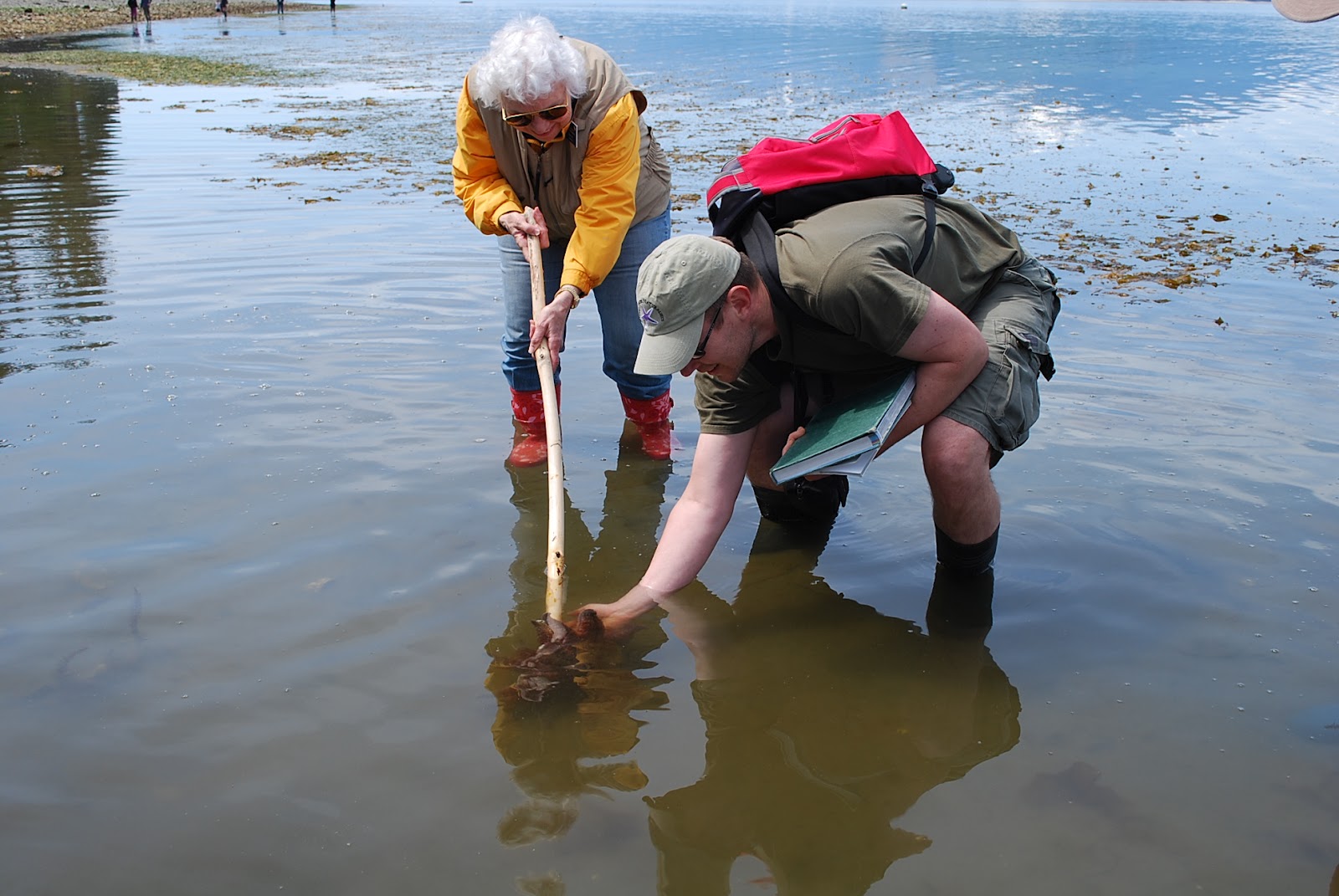
Growing up and spending my young adult years inland, I never imagined living near, or spending much time on, an ocean beach. Yet here I was, not far from home on one of many excursions along the myriad shorelines of the Puget Sound area. On this day, our group of volunteer beach naturalists had come to Scenic Beach State Park to refresh our knowledge and sharpen our skills for the summer ahead. Much of our time and effort is spent on local beaches helping others to learn about and appreciate the near shore habitats and their plants and animals.


It's difficult to explain how much joy and satisfaction can come from spending time with others who love the natural world, enjoy continually learning, and relish mucking about in rocks, mud, and water seeking creatures to observe and identify. Our goal, ultimately, is to inspire others to become more knowledgeable and thus respect and help to preserve these precious resources.


There is a part of me that has never grown up which I hold on to with all that's in me. Children mostly view the world through fresh, unsullied eyes. For them it is a vast place, full of interesting things - many of which they as yet know nothing about. Turn them loose on a beach of any kind and I can just about guarantee what they will do; I do many of those same things myself.


Observing the surroundings, they look for something to DO. Depending on the type of beach, time of year, weather, age and personality of the child, and whether or not they've been there before, they - each in their own individual way - begin to explore and become acquainted with this particular place and time.


Pointing, poking, prying, digging, chasing, grabbing, wading, splashing, and kicking, they wander their way through the maze of the known and unknown, often losing track of time. I totally understand...


To nurture the child within all of us, I find it interesting to approach a beach exploration aimed at the most basic levels of observation, curiosity and discovery. It is best to use all of one's senses: hearing, seeing, smelling, touching, and sometimes even tasting.


RESPECT is paramount. Usually, we humans are the noisiest and it's hard to listen when you're making noise. But does that really matter; can any of the animals on the beach hear us?


Well, ears or not, they can feel the vibrations of our noise.


When we are quiet, talking in hushed tones or not at all, we hear and see better.


If we close our eyes and listen, it's surprising what can be heard - the waves lap the shore, the seagulls squawk, and the clams squirt. If you turn over a rock, you can often hear the critters that are hiding under it as they splash and skittle for cover.


Can you hear that teeny tiny crab -


or the splash of that Gunnel?


Learning about nature requires excellent observation skills. Here are two shells we found. Obviously, they were both made by a snail, but what lives in them now?


Only one way to find out...


A Hermit Crab has moved into the shell on the right; a snail still occupies the other one, as its "trap-door" (operculum) is clearly visible. This flat piece of shell, which the snail can pull shut, serves to both protect its soft body and hold in moisture if it is left high and dry with the ebbing tide.


Animals that live in the tide zone need some way to withstand the drying effects of being uncovered during low tides. To survive, they need to be able hide under rocks and seaweed, burrow down into the wet sand, or be equipped in some way to retain water.


Snails are among the best-equipped.


They begin life, as many ocean invertebrates do, as tiny creatures that swim and bear no resemblance whatsoever to the adults of their species. As they mature, they are able to take calcium out of the water to form a shell, adding on to it as they grow larger to accommodate their soft bodies.


The Moon Snail, with its huge, fleshy foot and shell up to four or five inches across, is the largest in our area. By taking in sea water, it can enlarge its foot up to 4 times the size of its shell! It lives in sandy or muddy areas and if it dies or is killed, the large, white, round shell is easy to spot.


The living snail is not easily seen; it half-buries itself and plows through the sand "undercover". The egg cases are easy to spot, once you know what they are. The snail produces a glue-like mucus which it uses, along with grains of sand, to form a thin, tube-like structure around its entire body (foot and shell). Laying its eggs inside of this sand collar, it digs down into the sand and ducks under, leaving the collar with its precious cargo to the tides.


When conditions are right, the tiny snails hatch and take their place among the plankton until they are large enough to begin their shells. Millions hatch, but few survive to become adults.


Those that do, have a unique way to dine. As they plow through the sand, they search for clams. Finding one, they use their extremely rough tongue (radula) to literally lick their way through the shell to reach the succulent meal inside. The beach becomes strewn with the evidence of their prowess.


The beach is a magical place - when we learn the what, how, and why of the incredible things that live there, we gain a much greater understanding of just what this world would be missing if they were not here.


And God said, "Let the waters bring forth swarms of living creatures... So God created the great sea monsters and every living creature that moves, of every kind, with which the waters swarm... And God saw that it was good. God blessed them, saying, "Be fruitful and multiply and fill the waters in the seas..."

Genesis 1: 20-23

For more posts about Incredible Sealife, click below: