Showing posts with label Mountains. Show all posts

Tuesday, June 4, 2013

Beach Exploration: Rock

 
"Earth and Sky, Woods and Field,
Lakes and Rivers,
the mountains and the seas,
are excellent schoolmasters,
and teach some of us
more than we can ever learn from books."
Sir John Lubbock
 

Each beach is different, one from the other, but in a singular way they are the same. Where water meets land the shore is covered by sediment - sand, gravel or larger rock fragments. Sometimes mud. Here, amid loud roar of incoming waves and quiet hiss of outgoing tides, signs of the earth's vast history may be found - if one knows how to read them.

 
I do not know how I may seem to others,
but to myself I am only a small child
wandering upon the vast shores of knowledge,
every now and then finding
a small bright pebble to be contented with.”
Plato
 
 
It begins with awareness, and then careful observation. Rocks and water have been here for longer than we can comprehend and the tug-of-war between them is ongoing and endless.


The tiniest grains of sand were once mighty boulders, which themselves were once part of the bones of the earth.


Dynamic and restless, this sphere shakes, buckles, and changes through the action of tremors, eruptions, and tumultuous weather.  Heat and pressure from inside shift and move huge chunks of rock upward, forming plateaus and mountains.


On the surface, wind and water are relentless, slowly wearing away the rock and moving it to other places. What began in the fiery bowels of the earth is worn down and its pieces eventually re-formed into layers of new rock.


With enough layers, enough weight, and enough time, much of the surface rock will be pushed back down into the earth where heat and pressure re-form it yet again.


Often, when this new rock finally emerges to the surface again, evidence of the mixing of different rock pieces is evident.


In the end, all is recycled - for the rock and the water have always been here, although the form may change countless times.
 
River stones remain, while water flows away.”
Romanian Saying


They are here still, although we may pay no attention to their form or function. And here - at the very edge of the water and the land - life clings to both.


“When all the water has gone,
only the largest stones
will still remain in the riverbed.”
African Saying
 
 
"Water is fluid, soft and yielding.
But water will wear away rock,
which is rigid and cannot yield.
As a rule, whatever is fluid, soft and yielding
will overcome whatever is rigid and hard.
This is another paradox: what is soft is strong."
Lao-Tzu
 
 
"A mountain is composed of tiny grains of earth.
The ocean is made up of tiny drops of water.
Even so, life is but an endless series of little details,
actions, speeches, and thoughts.
And the consequences whether good or bad
of even the least of them are far-reaching."
Sivananda
 

Truly, we are all connected...

Tuesday, September 18, 2012

Wildfires

 
During most of the day and a half it took us to drive home, the surrounding hills and valleys were clouded with smoke.  For the most part, distant mountains were not visible at all and the sun played hide and seek. Although we never did see actual flames, we knew the extent of the burning: 30 separate fires in Montana, 33 in Idaho, 16 in Washington. One might have thought the entire west was on fire.
 
It was bound to happen, of course. With much of the country experiencing a long, hot, dry summer, thousands, if not millions, of acres of dead and dying trees throughout the west due to insect infestations, and years of well-meaning fire suppression, it is all a huge tinder box just ripe for burning.
 
 
Fire has been a part of earth's natural systems for eons. While we may see nothing but devastation, many ecosystems, such as prairie and conifer forests, have evolved with fire as a natural and necessary contributor to the vitality and renewal of habitats. Many plants have developed traits that allow them to regenerate after a fire. Some store energy in their roots for recovery and regrowth afterward; some are killed outright, but over years have accumulated long-lived seeds in the soil which are stimulated by fire to germinate and grow.
In some cases, it is the heat of the fire that breaks down or cracks an impervious seed coat, allowing the seed to absorb water and grow when the rains start. Smoke or charred wood sometimes produces a biochemical effect on a seed that facilitates germination. Some evergreen cones remain tightly closed on the tree for years (sometimes for the life of the tree) unless they are stimulated by the heat of a fire to slowly open and release their seeds. Spectacular spring displays of wildflowers and verdant carpets of seedling trees often appear the year following a fire.
Just as numerous wildfires move through the west, we are each, in our own way and time, inundated with troubles. Loss of a job or loved one, money or relationship/family problems, separation, divorce, illness, disability, aging, and looming death take their toll. The damage can be staggering; some of us will ultimately survive longer than others, but in the end we all will succumb. Until then, most of us will survive and somehow muddle through. We were created with the ability to adapt and are more resilient than we may think, but during difficult times, especially, we need to be there for each other. It is what we are meant to do.
Remember the burned fields and forests - after the worst has passed, new growth does appear and life goes on. Much will have changed and some places may never look the same within our lifetimes, but the land has been swept clean and nourished. Time passes, and with it the old ways of seeing and being. Damage has been done, but that does not mean that there won't be a new beginning - and new beginnings can be stunning.
 
For misery does not come from the earth,
nor does trouble sprout from the ground,
but human beings are born to trouble
just as sparks fly upward.
"As for me, I would seek God,
and to God I would commit my cause.
He does great things and unsearchable,
marvelous things without number."
Job 5:6-9


Tuesday, August 21, 2012

The Mountain - Sounds of Silence

When we stopped, the silence was absolute.

Walking, the only sounds were the soft footfalls of our boots on the path and the tap, tap of our walking sticks.


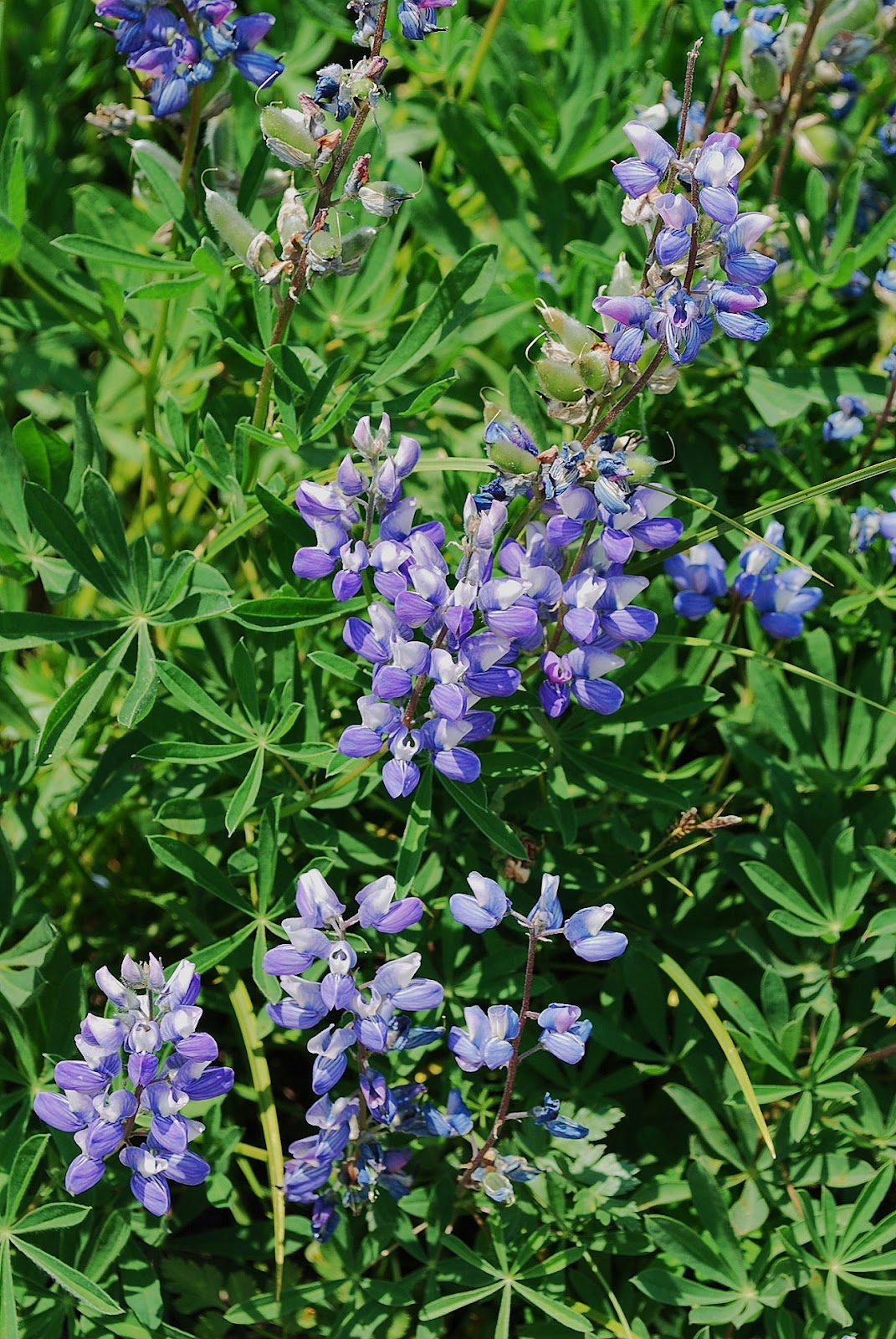
Covering the open, grassy hillside - both above and below us - swayed an array of wildflowers...
blue
yellow
red
pink
purple
 white

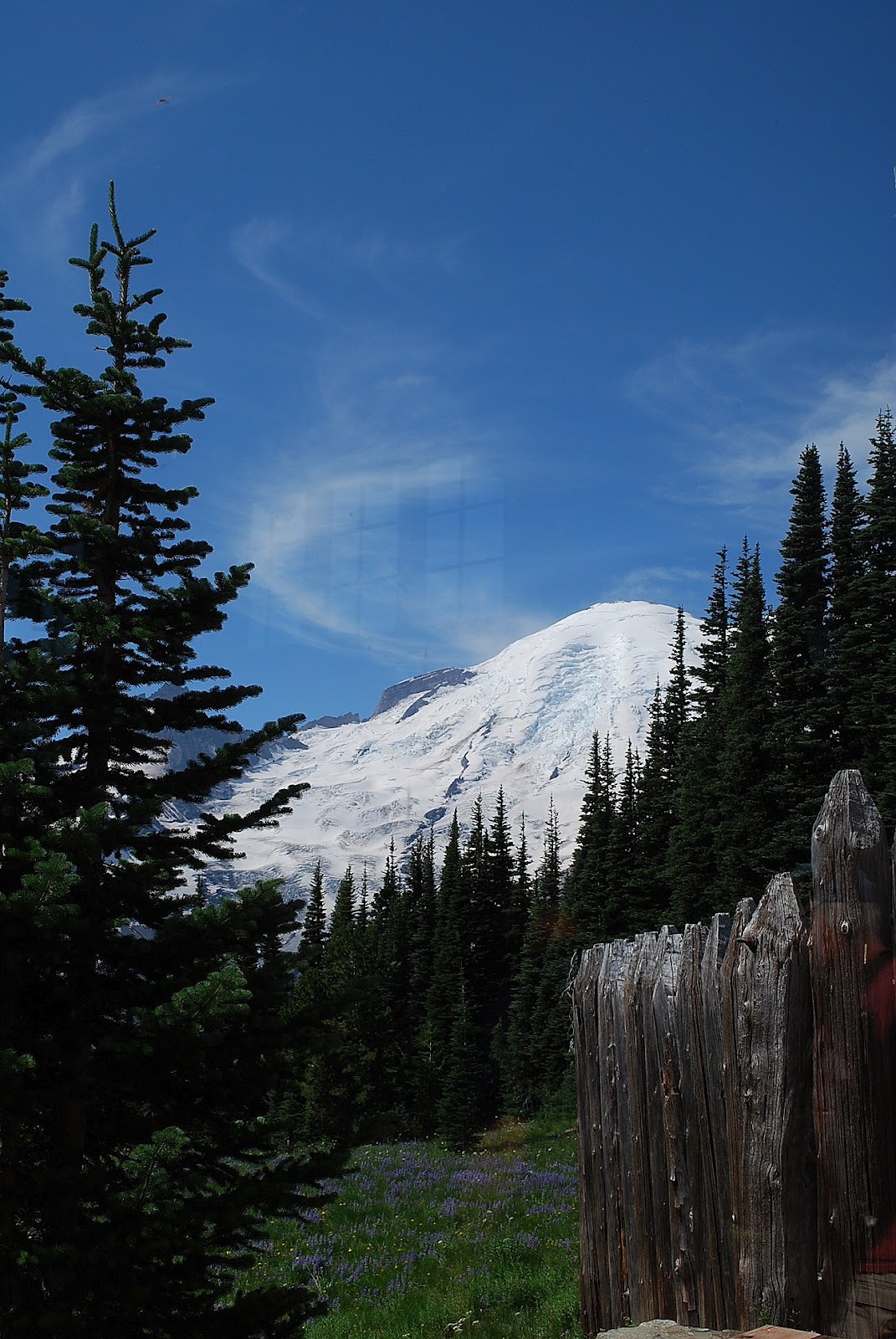
Up the hill, a few pointed firs and the stark, bleached remains of large dead trees scattered across the open landscape. These, reflecting a long-ago fire and many, many years of severe weather.

Far below, the White River flowed briskly downward, row after row of rugged peaks forming a receding backdrop.

Behind us, and seemingly close enough to touch, the mighty Mount Rainier dominated all. Ascending to 14,410 feet above sea level, this huge monolith stands as an icon in the western Washington landscape.

An active volcano, it is the most glaciated peak in the contiguous U.S., and spawns six major rivers.

Subalpine wildflower meadows ring this icy volcano while ancient forest cloaks its lower slopes. It is a magnificent sight to behold and truly a work of art, but it has not always been such.

Formed through eons of change within the earth's crust, today's Rainier is the product of uplift, erosion, volcanic action, and time.


The early lava deposits are estimated to be more than 840,000 years old.


The summit is topped by two volcanic craters, each more than 1,000 feet in diameter. Geothermal heat from within keeps parts of both crater rims free of snow and ice and has formed the world's largest volcanic glacier cave network within the ice-filled craters, with nearly 2 miles of passages.


Mt. Rainier is considered one of the most dangerous volcanoes in the world. Because of its large amount of glacial ice, it could potentially produce massive lahars (volcanic mudflows) that would threaten the whole Puyallup River valley.

Northwest American Indians knew this mountain long before European explorers reached the Pacific.


Yakama, Puyallup, Nisqually, Cowlitz and Klickitat fished and hunted in the lowlands surrounding the mountain; hunting parties followed game up the slopes as the winter snows retreated. 


For generations they revered and knew it as Takhoma, Talol, Tahoma, Ta-co-bet and several other names.


Many of the names mean 'The mountain that was god', 'big mountain', 'snowy peak', 'mother of waters' or 'place where the waters begin.'


The city of Tacoma takes its name from one of the original native names for Rainier. Indeed, this ancient volcano can be seen throughout the greater Puget Sound area and on an exceptionally clear day is visible from Portland, Oregon to Victoria, British Columbia.

The outward appearance of this geologic wonder belies the tremendous power and fury that lie below. It is a reminder that constant change is a given, things are not always what they seem, and that appearances can be deceiving. In one way or another, all of us here live in the shadow of what is - in a superlative sense - The Mountain.

He said, "Go out and stand on the mountain before the LORD, for the LORD is about to pass by." Now there was a great wind, so strong that it was splitting mountains and breaking rocks in pieces before the LORD, but the LORD was not in the wind; and after the wind an earthquake, but the LORD was not in the earthquake; and after the earthquake a fire, but the LORD was not in the fire; and after the fire a sound of sheer silence.  
1 Kings 19:11-12

God is our refuge and strength,
a very present help in trouble.
Therefore we will not fear, though the
earth should change,
though the mountains shake in the
heart of the sea...
Psalm 46: 1-2


Memories of Rainier
August 2012