Sunday, August 22, 2010

Tents and a Bucket


It had been a summer of darkness and light. First, the worms. We thought that by removing all the Styrofoam-like egg cases from tree branches and lopping off twigs with the early webs we’d gained a leg up on their summer’s advance. We thought wrong.

(Dark section of this tree's trunk is solid caterpillers.)

Soon we were surrounded, as the native woods endured the first round of attack and the familiar canopy of shade began to disappear. Having stripped the giant Alders, these voracious tent caterpillars moved on to new territory. For days, standing in silence at the edge of the yard, we heard the dropping of small bodies, or their droppings - we never knew for sure which - like the pitter-patter of a gentle rain. Seeing cherries standing out like rounded bright red sore thumbs on a nearly leafless tree and gorgeous full-blown roses on naked stems, I knew we were defeated. My husband swept the porch numerous times each day and resorted to spray, but it was a case of simply letting nature run its course. Our yard became noticeable sunnier.

Then, the moths. After a brief respite during a staggered pupation period, a new wave appeared.

Each evening brought a flurry of drab, furry brown bodies beating themselves to death on every lighted window, door and skylight in sight. And so, an equally bright idea formed in the back of my husband’s mind and he set out to fight fire with fire, so to speak. He concocted a moth trap with a metal shop light clamped to a wooden lath, which in turn was clamped to a white plastic bucket full of soapy water. Worked like a charm! Left on all night long, the light did its job of attracting the moths, so that by morning he was dumping a good-sized army of dead moths. We did not win the war, mind you, just leveled the playing field a bit.
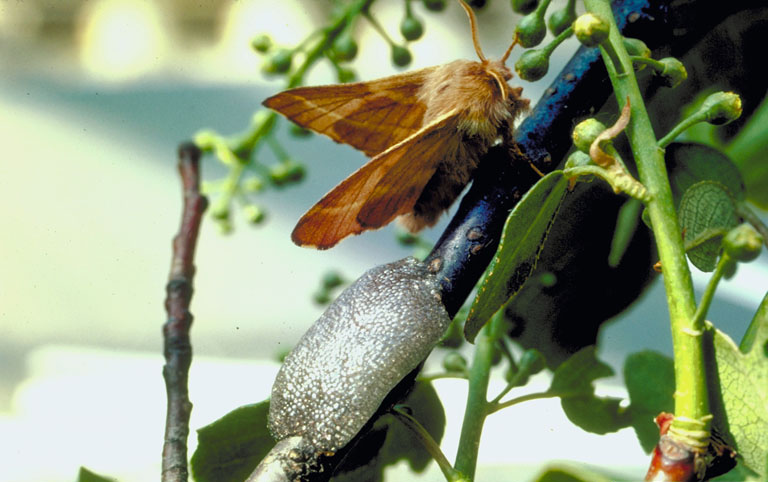
Lymantria

Enter, the frog. A small tree frog lives in an ivied basket on the porch railing near our kitchen window. It comes and goes as it pleases and I like to think it is the same one each year, although it probably is not. Since the moth trap was on the end of this railing, we noticed the frog leaving its basket and lurking about as we watched the mass mothicide each evening. We observed one night as he scaled upward - his delicate, splayed toes, outstretched legs, and rotund little body silhouetted against the backlit white bucket. Reaching the top, he crept along the narrow edge and wedged himself into the small space between the clamp and the lath. I worried that he might leap at a moth, flinging himself into the frothy water below, but he was wiser than that. He waited patiently, casually picking off the odd moth that ascended up the lath by foot, wings vibrating. In the darkness of night, this frog was now highly vulnerable, waiting alone under a bright light to fill its belly. But it was an opportunist, took its chances and depended, at least for the time being, on this light for its livelihood.


 I think this is dangerous, risky business for a frog. How could he do that? On the other hand, life is a dangerous, risky business. How could he not?

But everything exposed by the light becomes visible,
for it is light that makes everything visible.
This is why it is said:
“Wake up, O sleeper, rise from the dead.
and Christ will shine on you.”

Be very careful, then, how you live -
not as unwise but as wise,
making the most of every opportunity,
because the days are evil.
Therefore do not be foolish,
but understand what the Lord’s will is.
Ephesians 5:13 - 17

You are my lamp, O Lord;
the Lord turns my darkness into light.
With your help I can advance against a troop;
with my God I can scale a wall.
2 Samuel 22:29 - 30

Moth picture file from Wikimedia Commons

Tuesday, August 17, 2010

Smelt Run

Today I walk among gulls;
Hundreds speckle the beach.
I have never seen so many
Nor felt so ignored.
Feel their frenzy as they
Pace, run, take to the wing
As each wave crashes;
Land in a wing beat or two behind it.
Silver flashes as they nip
- quick flip -
Swallow whole, head first.
Ritual repeated again and again.

Little bickering,
Scant chasing or squawking.
Today they have
a tolerance
For each other.

But not for the ravens,
Who try to
bully and bluff;
Who watch,
quickly snatch leftovers,
Fly off to trees
on the high bank.

There they eat in solitude,
Mock with loud,
rattling cry.

They live on the fringe,
Grab what they can.   
                          
For the first time
I watch waders dip their nets,
Carry them brimful and wriggling,
To drop high on the shore.
As the waders turn their backs,
The gulls eat their fill
Until, exhausted by gluttony,
They rest on sand and preen.
Just beyond the surf bobbing dark,
Round shapes glide slowly back and forth,
Disappear, resurface some distance away.
Seals do not need the gulls’ permission.
"This evening we were visited by Comowool the Clatsop Chief and 12 men women and children of his nation... The Chief and his party had brought for sail a Sea Otter skin, some hats, stergeon and a species of small fish which now begin to run, and are taken in great quantities in the Columbia R. about 40 miles above us by means of skimming or scooping nets... I find them best when cooked in Indian stile, which is by roasting a number of them together on a wooden spit without any previous preparation whatever. They are so fat they require no additional sauce, and I think them superior to any fish I ever taste, even more delicate and luscious than the white fish of the lakes which hae heretofore formed my standaart of excellence among the fishes."
From the Journals of
Captain Meriwether Lewis & William Clark
February 25, 1806

Smelt drawing from the Journals of
Captain Meriwether Lewis & William Clark

Sepia Photo
The Smelt Fisher, Trinidad Yurok
1923 Edward Curtis

Sunday, August 15, 2010

Lizards on a String

Paul Hirst (Phirst)

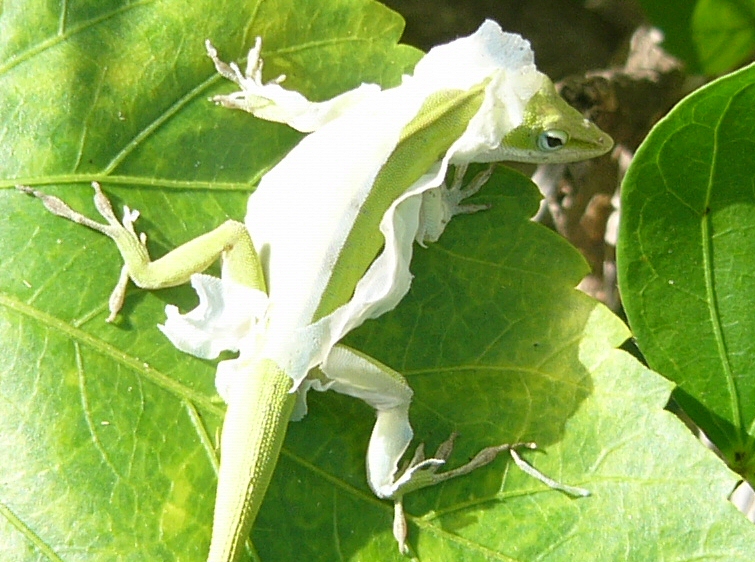
Osama 1, the terrorist, sedately snoozes away under warm light in the space he’s staked out for himself. On occasion, when the mood strikes and without warning, he turns nasty. A flare of the throat, bobbing of the head and sudden rapid leaps are enough to strike fear into anyone nearby.

Jefferson Heard

That would be Osama 2, the coward. When Osama 1 is out of sorts, he simply retreats into a cave and hides out for awhile. His hiding can last from a few hours to days. Sometimes, only food or water are enough to lure him back out into open territory.

HawkeyeLonewolf

These two are small Anole lizards that live with us. We’ve had them for over 4 years now, acquiring them by default. Originally, I bought them to live in one of several terrariums that I had my students at school set up. I did not teach there the next year, and since no one would take responsibility for the lizards, I ended up keeping them. They require little care; during our infrequent travels our trusty “lizard sitter”, Danielle, gives them her own special brand of TLC.
Dinnerstick

As a young girl attending the Montana State Fair, I’d find vendors selling these - each tethered by a string tied around its neck, attached to a safety pin, and displayed on felt-covered boards. The idea was to pin them to your shirt and wear them as “living ornaments”. Several years I came home with one of these little treasures. I loved animals (any animal) and knew of nowhere else to get one, and felt sorry for them, seeing the need to rescue them from those dratted display boards. More than a jewel for me, as soon as I got mine home, off came the string and in he went to his own little new home - usually a large jar outfitted with twigs, grass and water. I’d gladly catch bugs to feed him and spend hours watching him change from green to brown and back again, then lull him into a trance by holding him on his back and stroking his belly. Things did not always go well with them, though. I watched one die a long, agonizing death while it rubbed its belly and turned a deep blackish color - the result, we thought maybe, of eating bugs that had been sprayed. (My parents owned commercial greenhouses and used sprays then that would never be allowed now.) Another one got loose, only to show up dead in a load of clothes that my mother removed from the washer. “Well, at least he died a clean death.” she said.

Sfrefs

We’ve enjoyed these two. Both males, although looking exactly alike, they have very unique personalities. You cannot tell them apart by the way they look, you have to watch carefully how they act. In fact, I did not even bother to name them until after 9-11, when the name Osama reared its head. Osama 1 is usually very laid back. When I spray water in for them to drink, he closes his eyes, acts disinterested, and lets it drip off the end of his snout. When dinner is served (live crickets and other bugs) he acts like he couldn’t care less. Osama 2, on the other hand, is very high strung. The water spray drives him nuts - he races around the cage as if I’d sprayed him with acid. He attacks dinner as if there were no tomorrow. Strange bedfellows, these two.

Saperaud

Then there’s the way they act towards each other. Although terrorism and cowardice are occasional, total avoidance of each other is the usual behavior. However, when the temperature drops too low for their welfare, they gravitate towards each other. One will actually climb on the back of the other, hugging him tightly, to conserve and share what warmth there is. When they need to, they do band together - if only for sheer survival.

Are we so different?

lanare Sevi

("Anole lizards were once all the rage at amusement parks. People would win these guys on the fairgrounds, then wear them as "living jewelry." A harness with a short string was attached to the lizard, and people pinned the string on their outfits. It was a bizarre and inhumane practice.

Sometimes these slender lizards are sold as chameleons, but they aren't related to true chameleons. Anoles gained the moniker because they may also change color, though not as brilliantly as most chameleons.

There are 200 species of Anole lizards. The green Anole is the only species native to the United States and the one seen most often in pet stores." Steve Dale, My Pet World - 11/13/2000 - SunSentinel)

Four things on earth are small,
     yet they are extremely wise:

...a lizard can be caught with the hand,
     yet it is found in kings’ palaces.
              Proverbs 30:24 and 28

Two are better than one,
     because they have a good return for their work:

Also, if two lie down together, they will keep warm.
     But how can one keep warm alone?
Though one may be overpowered,
     two can defend themselves.
A cord of three strands is not quickly broken.
        Ecclesiastes 4:9, 11 and 12

picture files from Wikimedia Commons

Friday, August 13, 2010

Orphan Annie


I’d only intended to find a shortcut through town, avoid the traffic, maybe save some time. As often happens, however, my good intentions came to naught - I ended up stuck anyway, waiting to make a left hand turn into heavy traffic. Coming out of a back road , the intersection had no traffic light, so I was stuck for a bit. So much for saving time.

If I hadn’t been delayed, I probably never would have looked down at the roadway beside my car. As it was, I did, and so I noticed it lying there all dusty and ragged. Something about it intrigued me, so - no other cars being behind me - I backed up a little, opened the door and grabbed it. “How nice.” I thought. “One of those realistic-looking silk plants. Must have fallen out of someone’s car or been dropped by one of those companies that furnish businesses with a lot of fake plants for atmosphere.” It wasn’t very large and was missing a pot, but I figured I could make use of it somehow, so tossed it onto the floor in the back seat.


Eventually, I found a break in the traffic, made the turn and went on my way. I had other stops to make, so it was some time before I returned home. By then the car was sweltering inside as it was summer and a beautiful, sunny day. Iced tea sounded like a great idea.

It wasn’t until the next day that I remembered the silk plant. Bringing it into the kitchen and rinsing it off in the sink I discovered something strange. It was not silk. It had no pot and no roots - looking as though someone had just whacked it off at pot level - but it was a living thing. I caught myself wondering “why?” and “how?” I had no idea what kind of plant it was nor if it could survive such treatment, but it was not totally gone, so I decided not to toss it. I re-cut the bottom with a sharp clean knife and set the it in a glass of water. Many weeks passed and the darn thing just sort of hung on. It didn’t root, but neither did it die. I felt it deserved a chance, so I played the waiting game with it.


One day, I did notice some pale, fragile strands in the glass. Gradually, the number and size of them increased and the day came when I carefully planted my “Orphan Annie” in a pot with real soil. It continued to grow and thrive in the corner window of the kitchen where I could watch it and marvel at its nearly miraculous revival.


The ragged, dirty, sad silk that I chanced to find that summer day was a 10 inch weakling. Today, it stands a proud 84 or so inches tall and shows no signs of slowing down. I’ve since learned it is a Dracaena - well known for being tolerant of poor growing conditions - so I take no credit for its growth. All that I did was give it a chance and wait to see. I did so hope ...


Annie has shown me that sometimes that’s enough.


For if what faded away came with splendor,
what is permanent must have much more splendor.
Since we have such a hope, we are very bold,...
2 Corinthians 3.11-12

Monday, August 9, 2010

Reunion of the Heart

Re-union n. 1. the act of uniting again. 2. the state of being united again. 3. a gathering of relatives, friends, or associates at regular intervals or after separation: a family reunion.
Teen friends 1958

Meeting in 10th grade through our church youth group, Phyllis and I became best friends fast. I remember fun-filled youth events, slumber parties, crazy skits, and double dates. I have many photos of those times - our teenaged selves stare out from an old scrapbook, dressed in strapless, pouffy formals of the era, complete with corsages, dated hairdos, nervous young men at our sides. What fun we had!
Senior Ball 1959

During our Senior year - between changing boyfriends, borrowing each other’s belongings, catty little notes and snide remarks - a distance grew between us. One of her notes cut me to the quick and with bitterness I headed off to college taking my chances with an unknown roommate, rather than room with her. We put a “surface patch” on our friendship, joining the same sorority and living in the same house with many other girls. Although polite and respectful to one another, we were never close again.
Slumber Party 1959

Years later, as I sorted through old mementos in the family attic, I came across the note that Phyllis had written. Reading it again, hot tears ran down my face - not from anger, but from deep remorse. We had been so different, she and I - she so full of life, outgoing, bold, a risk-taker in many ways; I was reserved, shy, introspective and highly sensitive. We had been drawn together because of our differences. Her words hit home, her criticism totally justified. Ashamed and sad, I realized that we both had played a part in our estrangement and it no longer mattered. I wanted so badly to talk with her, but how does one mend such a rift after so many years and across so many miles?

Talkin' on the phone - 1959

After college, we’d gone our separate ways - to careers, marriages and far-flung locations. Phyllis moved to California to teach and, with another sorority sister, began a “round robin” letter-writing campaign every few years to help us all keep in touch. She married, moved to Alaska, taught in the bush for many years, and had two daughters before settling in Anchorage. I also married and taught school, moved to Colorado, Idaho, Texas, Idaho and finally settled in Washington state. Each time I read her letters, I thought of reconnecting with her - I just didn’t know how.
Senior Ball 1959

In 2000, a sorority reunion was planned. They’d had one other, but I’d been unable to attend. Looking forward to seeing everyone again, I resolved to make amends. I still did not know how - only that I must. When we were finally face-to-face again, the years slipped away. As we visited, I told her how much I had enjoyed her friendship and how sorry I was that we’d hurt each other. We’d long since forgotten what the tiff was all about, and began to simply enjoy each other’s company again. We now exchange Christmas cards and e-mails, have enjoyed two more reunions and have kept in touch. Next summer, many of us will meet for a 45th reunion and I anticipate it with no misgivings at all. Phyllis and I have much catching up to do!
Sorority Reunion

What pain we humans inflict on each other - most of it comes back to us. We cannot undo what we’ve said and done - we can only ask forgiveness and forgive in return. Life goes forward from there.

Get rid of all bitterness, rage and anger,
 brawling and slander, along with every form of malice.
Be kind and compassionate to one another,
 forgiving each other,
just as in Christ God forgave you.
Ephesians 4:31-32

Saturday, August 7, 2010

Long Range Forecast


Out back
The cantaloupe
Forms small, hard, green
Knots on the vine.

When I planted a garden
The end of June
It was still raining;
I resolved not to fret.

Perhaps I will wade
Through the wet grass,
Cut from the vine,
Throw on the compost.

Better yet, leave it
To grow as it will
Knowing there is not enough
Summer left for it to ripen.

I know raccoons,
Chipmunks and mice
Surely will wander through,
Discover this green feast.


I see evidence
They have tried again
To open buckets of birdseed
Out on the porch.

People in cities
May not know this quandary:
To reap what does not grow
Or to sacrifice to other creatures.

Tonight I will make stew
With store-bought goods,
Curl up on the couch,
Read a good book.

I bid good-bye,
Wrapped in an old quilt,
to Summer-that-never-was;
Dream ahead to next August.

With glorious sun,
Long dryer days,
Plump ruddy chipmunks,
Nibbled ripe cantaloupe.

Monday, August 2, 2010

Twisted for Survival

Joaquim Alves Gaspar

They seemed pretty insignificant, really - tiny pink polka dots of flowers scattered through the grass. Amazing they survived at all, much less bloomed, considering all the other wild grasses, clovers, and dandelions jostling for room and domination. Not to mention the dozens of RVs and countless feet treading there daily. I did not think much of the flowers, only noticed their bright pink color.

We had come on another camping trip to Fort Flagler State Park, on the tip of Marrowstone Island. The weather was “iffy”, as it so often is there, with foreboding clouds approaching from the northwest and strengthening breezes. Lying on the point as it does, this park is vulnerable to some terrific storms and accompanying winds. Much of the campground is open and exposed; the few shore pines that offer a measure of shelter are short and stunted. Although the environment there is somewhat harsh, numerous plant and animals species not only survive, but thrive.

We’d hiked up the steep hill to traverse the trail along a high bluff, passing numerous concrete bunkers left over from Fort Flagler’s heyday. We’d taken a trail new to us down into the housing area, then continued on trails that took us around the perimeter of the entire park, about five miles in all. A great many wildflowers poked up through the greenery and among them, here and there, were the little pink blooms.
Prof. Dr. Otto Wilhelm Thomé
Flora von Deutschland, Österreich und der Schweiz
1885, Gera, Germany

Later, I consulted a field guide to try to identify several of the more unusual plants and trees that we’d seen on our hike. Eventually, and quite by accident, my eyes again landed on those little pink flowers in the grass. I really doubted they’d even be in the book, but decided to see if they could be identified. Surprisingly, I narrowed them down to one of two species - the identifying factor being the seed pod. So into the grass I went, in search of a two-inch-long, sharply-pointed “stork’s bill”. I found several green ones and then what I was looking for - a fully ripe, dried one. Sure enough, just as the book said, the pod broke apart into five identical quarter-inch seeds, each with a hair-thin twisted tail attached. I decided to test what the book said.

Carrying my treasure into the trailer, I filled a small saucer with water and dropped the seeds in. As we watched, each of those cork-screwed tails slowly straightened out until each seed resembled a tiny arrow. Lifting them out and onto a dry paper towel, we watched in amazement as each of them dried and twisted back into the spiral corkscrew shape that it had when found. In fact, they squirmed and jerked with each twist!

Although introduced here, these tiny seeds of the Common Stork’s-Bill, or Filaree, come equipped to drive themselves into the soil as a way for this species to survive the rigors of a place such as Marrowstone Island. As the weather around them alternates between dry and wet, they alternately twist and straighten their long tails so that the arrow point of a seed finds its mark.


When you sow,
you do not plant the body that will be,
but just a seed, perhaps of wheat or of something else.
But God gives it a body as he has determined,
and to each kind of seed he gives its own body.
1 Corinthians 15:37 - 38

‘...You have made known to me the paths of life;
you will fill me with joy in your presence’
Acts 2:28

First and third picture files from Wikimedia Commons