Sunday, July 4, 2010

Not So Common

As days lengthen, I find it easier to wake at the first blush of dawn. A night owl by nature, I’m not one to leap out of bed at an early hour, but am roused for a moment or two before resuming my slumber. This summer, those wee hours have brought a pleasant surprise.
Birds begin their dawn chorus early; around 4 AM each day I’ve been awakened, then lulled back to sleep, by a loud, lyrical, if somewhat halting song of one which perches right outside our open bedroom window. The song is repeated endlessly, in the same tonal pattern, with pauses only long enough to hear the same song echoed in the distance. I’ve not felt moved to investigate at that hour, but have wondered aloud what kind of bird brings this song, which is vaguely familiar and strangely comforting.

A man works at a small deli cafe in downtown Bremerton where the service is always the same. Each guest is greeted with a smile, a pleasant voice, and a cheerful attitude. When it is your turn to order, you have this man’s undivided attention. Service is quick, efficient, and skillful, but never feels harried or rushed. It is not without mistakes, but those are corrected quickly and in good humor. It is obvious there are many repeat customers, all known by name and food preferences. I’m sure the work day there can be long and frustrating, as evidenced by the man’s occasional red face and puffed “Whew”, but business is booming. There is more than one way to feed people.

Our mail carrier still seems new to us, although she must have had our route for at least a couple of years now. Time flies - we had “Susie” for so long - and we still don’t know the current driver’s name. She knows us, though – waving when she sees us out, driving into and around our odd back drive to deliver large packages or bundles of mail, writing personal thank-you notes for Christmas goodies we leave for her. She’s rarely late and only misses on those few, impassable winter days. Regularity and trustworthiness are reassuring in a sometimes chaotic world.

Robyn is joy personified when she sings, her smile lighting up the church and encouraging others to join her in song. Dave, during his precious time home from sea, quietly and efficiently goes about clean-up tasks wherever needed - in the kitchen and elsewhere. Catrina shares abundantly - her love of scripture, history, literature, food, gifts, and time. Terry offers his gifts of humor and quiet determination while daily dealing with severe personal difficulties. Donna goes about her work behind the scenes with calm professionalism, cranking out whatever is requested and/or required. Michael willingly and conscientiously accepts the challenge of late-in-life fatherhood. Rebecca regularly sends cards whenever someone needs recognition or uplifting. Scott responds when needed and maintains a positive attitude no matter what. Martha goes with her own instincts and against the popular tide to learn to play the harp, willingly sharing her music with others. And Joshua, when required task and time seem long, repeats a quiet, graceful twirl with youthful dalliance. Common people, common actions - each lightens the load of life and warms the heart and soul.
And the bird that serenades me each dawn? My husband peeked – it’s the common Robin, singing loudly with uncommon joy.
Each one should use whatever gift he has received to serve others, faithfully administering God’s grace in its various forms...

For if the willingness is there, the gift is acceptable according to what one has, not according to what he does not have...

I will pray with my spirit, but I will also pray with my mind; I will sing with my spirit, but I will also sing with my mind.

1 Peter 4:10; 2 Corinthians 8:12; 1 Corinthians 14:15

Thursday, July 1, 2010

Muddied and Majestic

Alaska Raptor Center, Sitka, Alaska

“Regal” was not the way I would have described him that day, mucking about in the mud with the others. Nor did he appear noble or proud as he hopped about with his ungainly gait, vying to grab what he considered his share of the take. Instead, he appeared rather bedraggled, a bit vulnerable and obviously hungry. And, as is so often the case, the others took advantage of this opportunity to constantly natter at and harass him. In fact, they were unceasing and merciless in their belligerence, darting in as they dared to scold and attack. Undeterred, he stuck to his mission, finally grabbing his prize and silently lifting off to circle higher and higher. Still, he was followed by a streaming menagerie - swooping, lunging, attacking and squawking - that seemed to accompany him until he slowly faded from view. At what point they gave up, if ever, and finally left him to his peace, I did not know. Obviously, there is another side to majesty.

Liberty Bay in Poulsbo, Washington is extremely shallow and muddy. When the tide goes out, vast mud flats are revealed - the lower the tide, the more mud. Many underwater sea creatures become stranded at these times, left uncovered and unprotected. Some burrow down into the ooze or squiggle under rocks; others hide beneath damp seaweed. But many are simply marooned, left to the mercy of the sun, wind and ever-present carnivorous birds. Noisy gulls, crows, herons, and eagles swiftly move in to scavenge what they can while they can. And so it was the day I spotted the lone Bald Eagle.

In 1782, the Continental Congress adopted what was called the American Eagle as our national emblem, though not everyone agreed. Benjamin Franklin opposed the choice, as he favored the wild turkey for such an honor. One hundred years later, the ornithologist Arthur Cleveland Bent commented that the Eagle's carrion-eating habits and attacks on the smaller, weaker osprey “hardly inspire respect and certainly do not exemplify the best in American character.” To add further insult, many felt the large birds were simply “lazy”. True, they often are amazingly sedentary, remaining on the same perch for hours at a time. The reason? Competency and efficiency. Adult eagles are free to sit and conserve energy precisely because they can secure food at will - with deadly speed and aim. Skilled hunters, they are able to capture waterfowl in flight and rabbits and mice on the run. But they also eat carrion and are accomplished food thieves, as many an osprey has learned. It’s called survival.
I ponder this majestic bird and see there are two sides to the coin - just as there are to our American values, collective actions, or individual characters. We all have our muddled times in the mud of this world - times when we are less than regal and certainly not proud. And there are the times we spread our wings, sunlight delineating all that’s pure and good and promising in us - and soar.
For as lightning that comes from the east is visible even in the west, so will be the coming of the Son of Man. Wherever there is a carcass, there the vultures will gather.       Matthew 24:27 - 28

Even youths grow tired and weary,
        and young men stumble and fall;
but those who hope in the Lord
       will renew their strength.
They will soar on wings like eagles;
      they will run and not grow weary,
      they will walk and not be faint.
             Isaiah 40: 30 - 31

Tuesday, June 29, 2010

Signs of the Tide

Wild flowers and grasses
Cover upper sands
Like an impressionist's wash
Of burnt sienna, green, and ochre
Interspersed with rusty Sheep Sorrel,
Blue Lupine and Vetch.
Beach Peas and Dunegrass
Line the sandy trail
Enticing, leading to wide expanse of beach,
Deserted, except for a few crows.
Farther off, gulls wade the creek,
Where it meets the waves,
Searching for morsels.
Crows leave tracks
Clearly defined in dark, wet sand
Showing where they've dug
To un-earth Sand Worms.

Deer, it's clear, have traipsed to the tide line,
Then back to the woods.
We've never known why
For they creep in at dawn or dusk,
Perhaps for the taste of salt.

Once, a river otter was sighted
Bounding across the width of sand.
Seeing us, it scurried to the grass line,
Disappeared into thick reeds and brush.
Later, I found his run,
Followed it to marsh
And webbed prints in mud.
Smaller, zigzag tracks show
Where crab has run, to escape the sun
And smooth winding trails
Would be snails,
Ending where they dug in to wait.
Receding, the tide leaves behind
Wet piles of Bull and Sugar Kelp,
Feather Boas and Eelgrass
Crawling with amphipods, beach hoppers,
An occasional crab.
Waterlogged branches become stranded
Bearing their cargo
Of barnacles and sponges
Now left high and dry.
We follow the wrack line
Strewn with debris from the sea,
And all sorts of human endeavors.
Ahead, through the mist
Hovering above the flat stretch of sand
Two dark shapes emerge.
Large and wary,
One on a dark rock, one on a log,
As we approach they flee,
Circling far above
In ever-expanding spiral
Reluctant to leave,
Unwilling to return.
The rock's lumpy, rounded shape
Shows it to be a dead seal
Washed up some time ago,
Now mostly skin stretched over bones.
The vultures had their turn,
Now Golden Eagle eats its fill,
While two Bald Eagles
Watch from the trees.

The roar of waves competes
With roar of the wind,
And neither one wins.
But still they go on
In never-ending cycles
Like the sea's rising and falling.
And the race is on
Yet again
To see who can survive
A minus tide.

Deep calls to deep
In the roar of your waterfalls;
all your waves and breakers
have swept over me.
Psalm 42:7

The sea is his, for he made it,
And his hands formed the dry land.
Psalm 95:5

Thursday, June 24, 2010

Cedar Lessons

Mom, look at me!” My eyes traveled up and up, then locked on the small, partly obscured shape halfway up the tree. “I see you.” I shouted back. “You look really small.” “You too!” came the answer.

At the tender age of 5, our son had asked to climb the huge, old cedar tree in our back yard. My father had been highly protective, always warning me to be careful and I was determined not to raise our son that way. So I told him he could climb, reminded him to be careful (!), and watched him disappear into the greenery. I had no idea he would go so high. “Take your time coming down.” It seemed a very long time before he emerged, unscathed, at the bottom.

That was nearly 30 years ago and the tree was old then. I have no idea what age it is, but it still graces our yard, dwarfing everything below it. At 50 feet, it hasn’t nearly the 230 foot height such trees can reach. Surrounded by native ferns, star flowers, huckleberry, Oregon grape, mint, St. John’s Wort and the graves of 1 hamster, 1 guinea pig, 2 dogs, and numerous goldfish, baby geese and ducks, it has become a family shrine of sorts. I can’t imagine living here without it.

This is a Western Red Cedar, common in this part of the world, and could live up to 800 years. Although not a true cedar, this slow growing, naturally durable tree has been valued by humans over time. Producing long lengths of timber with true, straight grain, its heartwood has natural decay resistance. Free from pitch, its wood has superior insulation value, is lightweight, easy to work, easy to finish, weather and insect resistant, and flat-out beautiful. Long before our European ancestors arrived, bringing a thriving timber industry with them, it formed an integral part of the spiritual and practical life of local Native Americans.

Jerzy Strzelecki
Across the world, other huge, old evergreens live on - the majestic Cedars of Lebanon. True cedars, these ancient giants can grow up to 80 feet, spread from 30 to 50 feet, and live more than 1,000 years. These, too, have been highly prized since time immemorial. As early as 3,000 BC, Babylonia was importing wood for its temples. 4,700 years ago, Gilgamesh, the legendary king of Sumeria, stripped the land bare in southern Mesopotamia for timber to finish his magnificent city. Much later, King Solomon formed a trading alliance with King Hiram of Tyre to acquire all the cedar wood he needed to build his huge palace and temple in Jerusalem.
BlingBling10

Today, precious few of our old growth Western Red Cedars remain - likewise the venerable Cedars of Lebanon. If trees could speak, oh what stories these could tell! Still, the lessons are there. Perhaps we should begin to learn them - beginning with those in our own backyard.
Jerzy Strzelecki

Consider Assyria, once a cedar in Lebanon,
with beautiful branches overshadowing the forest;
it towered high, its top above the thick foliage.
The waters nourished it, deep springs made it grow tall;
their springs flowed all around its base
and sent their channels to all the trees of the field.
So it towered higher than all the trees of the field;
its boughs increased and its branches grew long,
spreading because of abundant waters.
All the birds of the air nested in its boughs,
all the beasts of the field
gave birth under its branches;
all the great nations lived in its shade.
It was majestic in beauty, with its spreading boughs,
for its roots went down to abundant waters.
Ezekiel 31:3-7

Cedars of Lebanon picture files from Wikimedia Commons 

Monday, June 21, 2010

Father Goose

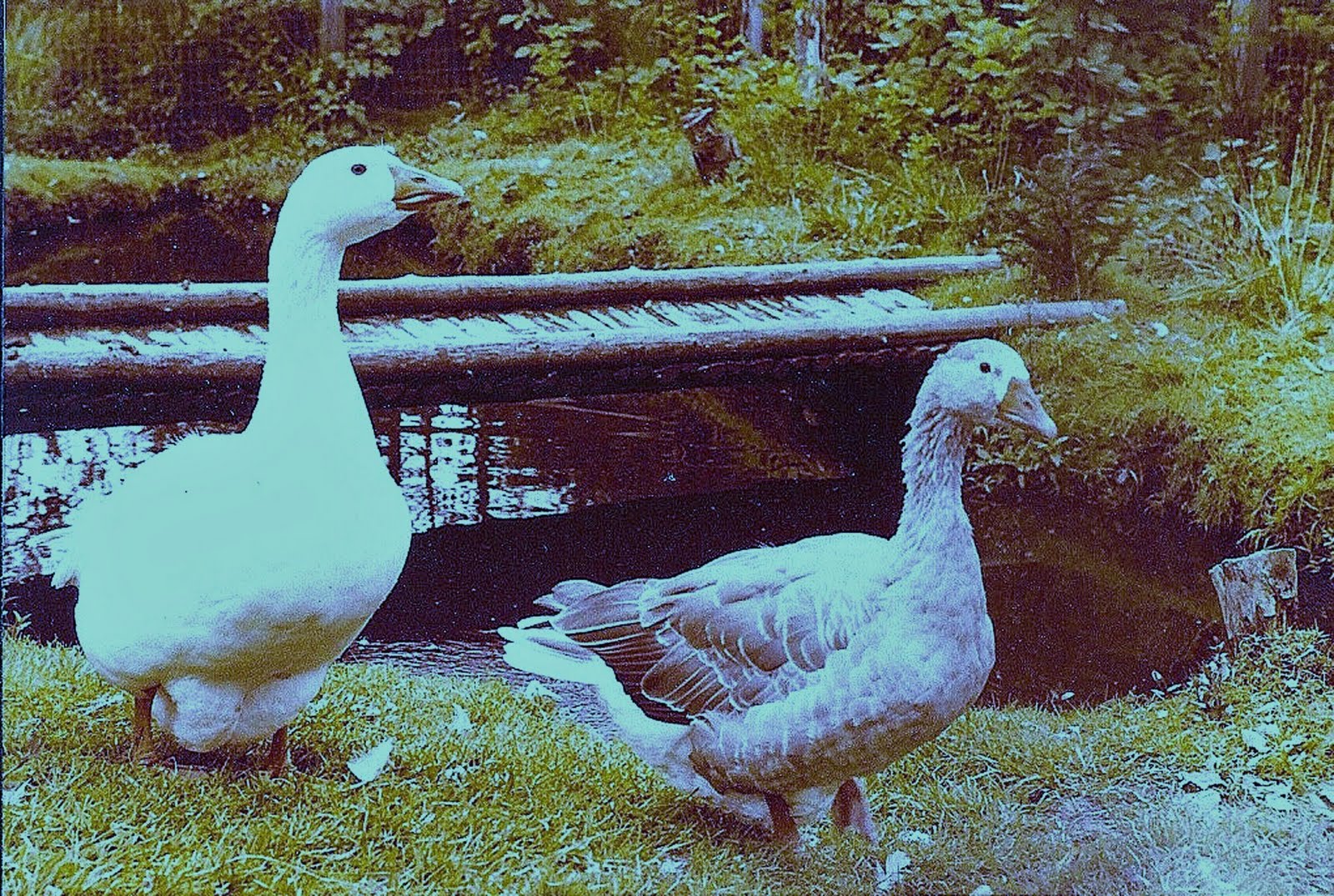
Pilgrim Geese pair - 1980

He came flying at the fence with all the bravado he could muster, wings flapping and squawking loudly. He had seen us earlier as we strolled about the yard, and hadn’t taken his eyes off us. Now, as we approached the fence, he could bear it no longer. “Wow!.” I thought. “He’s really mad and will kill them for sure.”

Geese are known to be good watch dogs, loudly announcing any stranger approaching their territory. Their noise can be annoying, but the ganders can be lethal. When threatened or angered they may readily attack, biting with hard, rigid beaks and flailing with strong wing “wrist” bones. More than once I have felt the string of these bones against my shins, so that I am leery now and watch any goose closely - especially if it is a gander.

While living on some acreage in Idaho, we decided it might be nice to have a few geese. We’d heard they don’t require a lot of care, readily grazing on grasses and needing only fresh water, shelter and grain or poultry mix to keep them fat and healthy. We acquired a pair - grey female, splendid white male. We enjoyed them immensely; thought they looked regal strolling about our front pasture, warning of any strange activity. But as he grew, the male became cantankerous - lunging at me and the dogs as we entered the field. Grabbing mouthfuls of fur, he so traumatized the dogs that they never again went near a goose. I learned never to enter that gate without stick in hand, just in case. As spring approached, the female laid a clutch of eggs and the gander became more aggressive than ever. One time, as my husband was filling their water bucket from the other side of the fence, the gander charged. Even with the full blast of the hose in his face, he very nearly went over the top of the fence and into my husband’s face. A force to reckon with, for sure!

We moved to Washington in April that year, leaving behind the geese and their future family. Our good neighbors back in Idaho promised to care for them until the young hatched, then transport them to her father’s farm. We heard all went well, since her father knew all about geese. As we settled in here, we decided to once more get a pair of geese, and had a few for many years. Most of the time we enjoyed them and the ganders, while feisty, were manageable and predictable. We had mixed luck with goslings, the females occasionally hatching their own, many times failing. There was also the problem of raccoons sneaking in and raiding their share in the night. Finally, I decided to try incubating some eggs in the house. And so, that is how I ended up with a small flock of tiny goslings on that lovely spring day, waddling and pipping behind me, thinking I was their mother.

That gander scared the life out of me, charging the fence and honking. I knew that he had never seen these young before, did not know they were his own and would surely end their young lives quickly. I backed away, thinking the goslings would follow - but was badly mistaken. They did not seem frightened at all, calmly nibbling at the tender grass and boldly tempting fate, I thought. The gander continued his tirade, following them all along the fence until, one at a time, they slipped through to his side. I was appalled, but obviously did not understand the way things were, because somehow that gander did know. He settled down, gently nibbling at each tiny, fluffy body and rounding them up until he had them all under his wings. Then, sedate and stately, he proudly led them off to the goose.
The lost were found and they were his forever more.

“I will be a Father to you,
and you will be my sons and daughters,
says the Lord Almighty”
2 Corinthians 7:18

Saturday, June 19, 2010

Roadrunner Farewell

The last prayer having been said, I reached into my pocket for the tiny bird. I handed it to my husband, who stepped forward and carefully placed it on the small box containing Pop’s ashes. There were smiles and surprised murmurs from the few guests; we thanked them for coming and helped Mom back to the car. It is never easy to say good-bye to a loved one, but our final gesture had been decided weeks before and we were at peace with it.

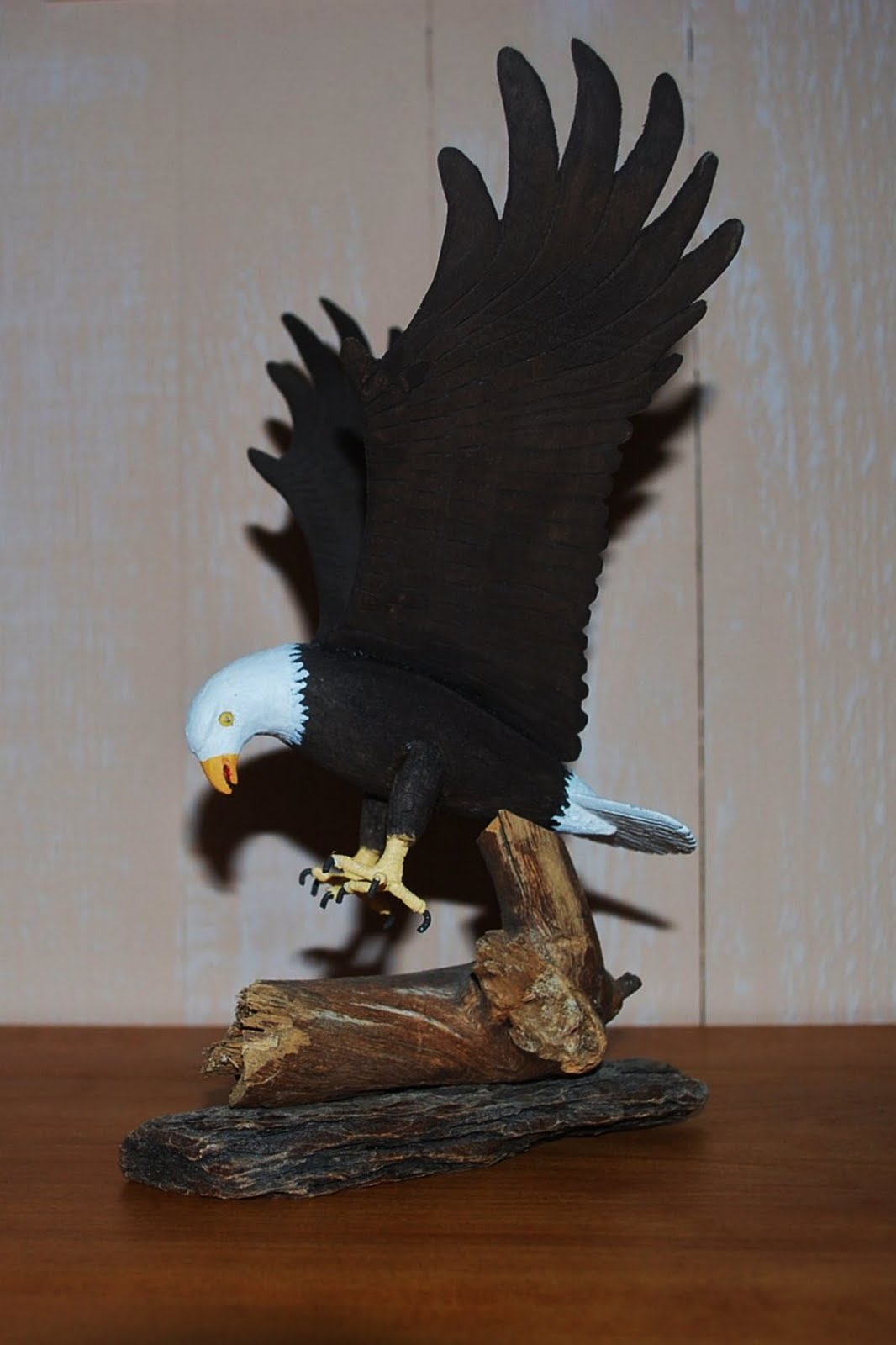
How does one sum up a father’s life? Surprisingly, the tiny wooden Roadrunner seemed to do just that for us. Carved in the later years of his life, it was but one of a whole cabinet-full of birds and animals. He and Mom had spent their many retired years thoroughly enjoying their life together. Taking pride in their home and yard, Pop enjoying watching the birds and squirrels. He built bird houses, feeders, and carved the Robin, Hummingbird, House Finch, Magpie and Meadow Lark. They drove their small motor home throughout the U.S., claiming it was best to see what our own country had to offer first. Pop kept a record with his carvings - Ibis, Cardinal, Blue Jay, Bald Eagle ... Each fall they headed down the Oregon coast - Loons, Gulls, Pelicans, Killdeer... Wintering in the Palm Springs area of California, he captured the Cactus Wren, California Quail, and yes, his beloved Roadrunner! They especially loved their own part of the world - spending time each summer camping and hiking in the Tetons of Wyoming. We joined them there as often as we could and have many fond memories of the times we shared together in this magnificent place. And so we have the carefully carved Chickadee, Mountain Bluebird, Stellar’s Jay, “Camp Robber”, Western Tanager and Red Winged Blackbird.

The earliest of Pop’s carvings are dated in the late 1930’s and ‘40s. In his young married years he worked as an engineer helping to build the Fort Peck Dam in Montana. My husband was born there. World War II and the Navy took them to New Jersey, after which they returned to Fort Peck, until a new job took them the New York, then a final move to Idaho Falls, Idaho, where they remained. Those early carvings are of a primitive style, but still show his exacting nature and attention to detail. After those, work, family, church, and his civic organizations took up most of his time, as we have no evidence of any more carving until his retirement. His fine woodworking took other forms however, with finishing projects in their home and lovely pieces of furniture.

I have no idea what Pop expected when I became his first, and only, daughter-in-law. Being one of 5 sons, with 2 sons of his own, he must have wondered a bit at this “earthy”, then 20-something, college tomboy his son brought home. But from the beginning, we had a special bond. His quiet, thoughtful wit, neat, precise ways, quirky sense of humor, and fantastic creativity with recycled materials struck a chord with me. He quickly learned my interests, and I his. We had mutual respect for each other and shared quiet conversations about his art and mine, the natural world around us, and always - birds. We learned so much from him and we miss him.
It was Pop’s fervent desire to leave this life with dignity in a quiet, respectful way - with no undue outside interference. He wanted no fuss, no frills, just a short service with immediate family. For 90 years he had lived his life this way and we sent him off as he wished. But a part of him remains - we see it in the strong, determined stance of a tiny wooden bird with a bright, devilish glint in its eye.

Listen to your father, who gave you life,
and do not despise your mother when she is old. 
Proverbs 23: 22

Children, obey your parents in the Lord, for this is right.
Honor your father and mother -
which is the first commandment with a promise -
“that it may go well with you
and that you may enjoy long life on the earth.” 
Ephesians 6: 1 - 3

Thursday, June 17, 2010

The Grower

My handprints mark the walk,
one of many between tall, wooden benches
abloom with carnations.
Poinsettias, mums and lilies marked other seasons.
In winter, the warm, damp, earthy smell.
Air conditioned coolness in summer.
Dad, in his work apron over white shirt and tie,
size 12 rubber boots,
moving up and down the wet walks
hand-watering the plants.
Me, splashing barefoot behind,
jumping over the hose,
dodging his playful spray.

Minute seeds sown;
fine soil screen-sifted over,
misted, and covered with glass.
Seedlings transplanted;
pencil holes poked in soil,
plants carefully placed and tucked in.
Geranium cuttings taken;
sharp knife severed stems,
dipped in rooting compound,
pushed into vermiculite.
Larger plants placed in orange clay pots;
handfuls of dark earth scooped in and tamped down
with a final thump of pot on bench.

Rich, the earth of love;
warm, the glow of caring,
nourishing, the sprinkle of encouragement.
Pruned back when necessary, we grew,
roots deep and firm,
to stand on our own in full bloom.

I still can see
those small handprints
impressed in cement.
That high, whole-arm wave
across rows of green
and the grower’s smile.
His large, calloused hands as gentle with me
as with his smallest of seedlings,
which I was.
Within any greenhouse, I find
Dad’s footsteps echo still.
His handprints mark my heart.


“I am the true vine, and my Father is the gardener. He cuts off every branch in me that bears no fruit, while every branch that does bear fruit he prunes so that it will be even more fruitful...”    John 15:1-2