Showing posts with label Metal Sculpture. Show all posts

Friday, November 9, 2012

ArtTrail #9: Fence Post Bandit

"The artist's world is limitless. 
It can be found anywhere,
far from where he lives
or a few feet away. 
It is always on his doorstep." 
Paul Strand

Cory Holmes, of Havre, Montana, is a Burlington Northern Santa Fe Railway conductor with a penchant for welding scrap metal into art. Many of his pieces, the majority of which he places himself,  mysteriously appear on fence posts around the country. Most of those can be found along the long, lonely highways  in a wide area of Montana, where he has become known as the Fence Post Bandit.

"Electric Man"

I've been hoarding scrap iron for better than four decades; never with a particular thought of selling it though. In fact, I don't believe I ever have sold any steel or iron as scrap. I don't just gather and collect any arbitrary metal; that would be both redundant and boring. I hand pick interesting forms, with unique shapes and histories.

"Model A Horse"

My scrap pile is between 60 and 80 tons at this point. Each piece of scrap played a part in the history of this nation: the springs and hardware from old buggies and farm wagons, the moldboard plows, cycle bar mowers, and horse drawn combines. There were old pieces and parts from oil rigs, pipelines, seismograph outfits and so on. I had railroad parts from hardware from the telegraphs, parts of steam locomotives and various sundry parts from tracks, switches, cabooses and box cars. There were spent military cartridges, helmets, bayonets and various hardware. Interesting stuff....but what does one do with it? Well I do sculptures. I have been doing metal sculptures for about twelve years, as far as the fence art sculptures go, I have been doing them about ten years now.


One day I was reading some farm journal and there was an article that said there were 35 million fence posts in Montana. I thought hmmmm, I wonder how they know that? Do they have fence post census takers? Not too long after I read the article I had to take a trip to Glendive and as I drove along the endless prairie I thought, gee, somebody ought to decorate around here and make this drive a little more interesting. So, I figured why not me? I'll just whip up some stuff and honk it on the top of fence post. And viola, fence art was born.

"Monster Face"
 
Now, ponder this for a moment. A farmer is seeding his field for the umpteenth time. Out of the corner of his eye he sees a strange apparition perched on a fence post his father set forty years ago as a teenager. "What the heck is that?" he thinks and parks his tractor trundles over and takes a look. He stares a while, scratches his head and goes back to farming. Pretty soon, over coffee at the grain elevator he asks his neighbor if he has seen any weird stuff on fence posts. Strangely, his neighbor says yes, he has a thing on one of his fence post too. What are they? No one knows. Who put them there? No clue. What do they mean? No idea. So they ponder the mystery. They talk about it. We have social interaction between neighbors; perhaps not a bad idea in this age of wireless anonymity.


In order to do sculptures I have to bend and shape and fabricate all this stuff. My specific method of making sculptures is called the direct metal technique. That means that I have to arrange, shape, forge, grind and polish all things by hand. It also means each one of my pieces is an original and a one of a kind. I use a number of different fabrication methods in making my sculptures and fence art, I use a coal forge and trip hammer when I have to do blacksmithing. I also weld with a combination of gasses, a method rapidly becoming obsolete but sometimes necessary to achieve a certain look or effect.

"Spikes and Springs"

I thought I would probably quit when I expended my original 50 or 60 tons of scrap iron but an interesting thing happened. Once people heard what I was doing they started bringing me more scrap. And some really interesting stuff too. I found a 200 lb camshaft from a locomotive someone had left in my truck, buckets of square nuts from the 1920s, and huge rivets from a disassembled bridge. The list goes on, and so does fence art production.

"Ode to Maud Muller"

Near as I can tell I have in the neighborhood of 700 pieces of fence art in 17 states and two Canadian provinces. In actuality I cannot be certain the people who I gave fence art to actually put them up as they said they would and claimed they did. I, however, have personally put them up in 11 states and two Canadian Provinces. I would have put a couple up in Hawaii as well but airline regulations make this almost impossible.


I never ask permission - of course, in a perfect world I would. I try to avoid the unpleasantness of explaining what manner of unbridled weirdness I am committing to some farmer's fence post. So almost without fail my fence arts are placed in pretty remote places.

"Longhorn Cow"

I like to put them on the skyline whenever possible because they are easier to see. The single most important part is the fencepost. It has to be a substantial post and unfortunately most post are not. Railroad tie fencepost are king. I try not to place them on brace post next to gates because I don’t want it to snag a farmer’s header on a combine or swather. I try not to place them in near proximity to houses unless somebody specifically asks me to. I have put a goodly number of fence art in national forest, but, to be honest they are difficult to see because of the trees. The upside is they don't get stolen nearly as often as the prairie variety.


Thievery can be a problem but it does not bother me as much as it confuses me. I don't understand why people take them but sometimes they do. I can only speculate that sometimes they are offended that someone put something up on a fence because they own the fence, or because it’s just too far out of their realm of normalness, or maybe because they took a shine to it and wanted it in their back yard.
 
"Hands and Tire Wrench"

I give anybody that wants a fence art, a fence art. But I prefer if they come and get it from me at my home, or wait until it’s convenient for me to deliver it. Yes I do sell my work. But not fence art, it's free.

"Fence Chicken"
Of all the reasons Cory gives for creating fence art: boredom, wanderlust, cheap mindless entertainment, lack of adult supervision, frustration with deadlines, disgust with 50% commission fees at art galleries, lack of parameters, love of the creative process, potential longevity, lack of expected political correctness, ultimate freedom of choice, shock value, an excuse to travel to unseen places and the challenge to convey an idea or concept in a brief moment, he says, "Mostly I guess I did it because it was really fun."
 
"What art offers is space - a certain breathing room for the spirit. "
John Updike

Cory's words here were taken from an interview that appeared on the Glacier Electric Cooperative, Inc. web site. Click HERE to read the complete article.

To view more of Cory's fantastic fence art:

Sunday, May 6, 2012

ArtTrail #7 - Cody Country, Wild West


As William F. Cody neared the end of his life, the things that he loved doing most were the same things he had enjoyed during youth - camping, horseback-riding, hunting, guiding, tending cattle, and spending time outdoors.


In northwest Wyoming, near Yellowstone National Park, he helped found the town that stills bears his name, and thus helped achieve his vision of creating a gateway for visitors worldwide to come and experience the still-wild West. Today, the man of the West continues to bring the world to the West, even as he did in his time.


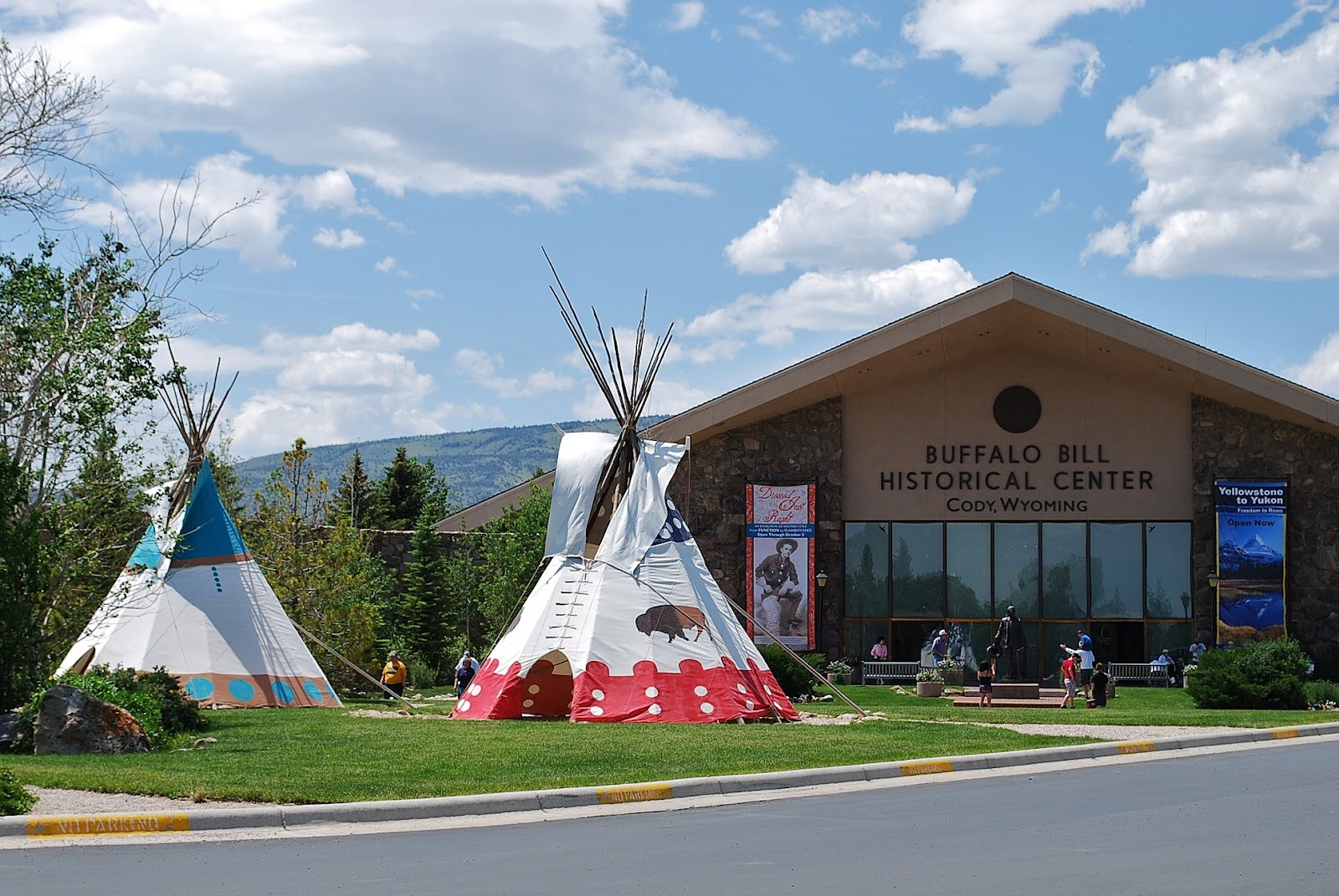
In Cody, Wyoming, the Buffalo Bill Historical Center certainly helps one to learn much about this now-famous man. But it also has quality, in-depth exhibits on other western subjects - the plains tribes, arts, culture, firearms, and natural history.

Buffalo Bill - Plainsman
Bob Scriver 
At the main entrance, you are greeted by this bronze sculpture depicting Buffalo Bill as a western hero and gentleman, wearing his Wild West show attire and holding a rifle.

Born in 1846 in a little town on the Mississippi River, Bill Cody, much as others of his day, acquired invaluable practical skills. He refined these and worked in a diverse range of occupations - as a teamster, Pony Express rider, wagon master, guide, soldier and cavalryman, and as an Army scout. These experiences helped define his character and through living, working, and learning, he became - and remained - a man of the West.

Bill Cody- Hard and Fast All the Way
Peter Fillerup
This 12’ high, 2,000 pound statue pays tribute to the 150th Anniversary of the Pony Express, as well as to local legend, Bill Cody, who as boy rode for the firm of Russell, Majors and Waddell.

Although Cody's experiences were not unique, few others of his time matched him in the range and diversity of his experiences. As the Indian tribes mourned the loss of the vast herds of buffalo, it was his special prowess at hunting those very animals that earned him the now-famous nickname and vaulted him from relative obscurity to lasting fame.


In 1883, Cody and several associates introduced "Buffalo Bill's Wild West," an innovative traveling outdoor spectacle featuring cowboys and Indians, sharpshooters, wild animals, and dramatic re-creations of scenes of frontier life. Buffalo Bill became a living, breathing icon and embodiment of America's western experience—a larger-than-life figure whose exploits and stories about settling the West captivated millions, not only in North America but also through Europe and, from there, to the rest of the world. Buffalo Bill performed before royalty, was feted by heads of state, became an object of adulation, posed for countless portraits and gave innumerable interviews, and even sat for an audience with the pope in the Vatican. The man of the West had become a man of the world.

Buffalo Bill - The Scout
Gertrude Vanderbilt Whitney

As seen from inside the Center, this monumental tribute to Buffalo Bill, dedicated in 1924, depicts the western figure as an army scout, peering down a trail signaling troops to follow.

Last of the Buffalo
Michael Coleman

The subject of much ancient lore throughout the world, and specifically in North American Indian tribes, the wolf is a symbol of the wildness of the West. Although an important part of the ecosystem for eons, today his presence causes mixed feelings. While many wildlife enthusiasts appreciate wolves, some ranchers feel at risk of losing livestock by preying packs.

Daddy Long Legs
T.D. Kelsey

This sculptor captured the animated and sometimes awkward movements of an adult moose. Here is an animal quite unlike any other - to be tittered at, respected, and admired - but always from a safe distance!

Prickly Pear
Charles Ringer

A drought-tolerant species, the nasty, yet beautiful, Prickly Pear cactus is common throughout the West. This imaginative steel sculptor found his inspiration for this sculpture in the Beartooth Mountains of Montana, not far from Cody. Originally made of shiny polished steel, the piece was exposed in the outdoors to rust into a warm red color.

Just down the street from the Center, we found the Mountain Trails Galleries with some more fabulous western sculptures:


Texas Two Step
Vic Payne

According to the sculptor: "This Texas cowpuncher has found himself in a heap of trouble and if the game warden chanced upon this scene today, it’d be a whole lot worse. A little Texas spirit was just enough to give this cowboy the idea to rope a whitetail buck that had been eluding him the past few hunting seasons. When the cowboy threw the lasso, the big Texas buck was none too happy, then those bobwhites blew up and the real rodeo began. Next time you see a cowboy, lariat at the ready, you might think about this old cowboy and his ‘Texas Two-step’."


Where Eagles Dare
Vic Payne

A mama bear is certainly nothing to fool with and if she happens to be a grizzly, all the more reason to steer clear.


These eagles are taking her on, though, and one certainly might wonder why.


The reason, of course, lies neatly tucked away in the bottom of the sculpture....


...then it becomes quite clear ...


Someone's young will eat today...


Someone's will go hungry -  that is the way of the wild.

For more information on the Buffalo Bill Historical Center:

Mountain Trails Galleries

Tuesday, April 24, 2012

ArtTrail #6 - Cody Country, Indians

Art is truly where you find it, and so much more can be gleaned from it than simply its visual appearance and impact. History, culture, ethics, and human justice are only a few of the thoughts stirred in my mind as we traveled through So. Montana and NW Wyoming around the edges of Yellowstone Park.


The Crow Indian nation once ranged from the Three Forks in Montana to the Black Hills of South Dakota, from the 500 mile long Musselshell River in central Montana to the Big Horn Mountains in northern Wyoming. The rivers tumbled cold and unobstructed with numerous species of fish, fresh water mussels, and crawdads.


Within these wild drainage basins lived the last survivors of the great Northern Buffalo herds - countless millions roamed north from the Yellowstone River to the Saskatchewan grasslands. When the Crow people lived in the area that is now Red Lodge, Montana, it was a place of worship, food and protection.

Chief Plenty Coups by Jonathon Johnson
Red Lodge, MT

Born in 1848, Plenty Coups (Aleek-chea-ahoosh, meaning "many achievements") was a man of war - and then a man of peace. Possessing vision, bravery, and leadership, he was made a chief of the Apsáalooke (Crow) tribe by age 28 and helped bridge a gap between two cultures. In 1884, he became one of the first Apsáalooke to own and settle on a farm, which was deeded to him through the federal Indian Allotment Act. On his 320-acre tract, he opened a general store, built a home, and worked the earth until his death in 1932 at age 84. At his request, 195 acres of his land was made into a public park. Upon his death, the Apsáalooke people voted to designate him as their last traditional tribal chief.

"The buffalo gone and freedom denied him, the Indian was visited by two equally hideous strangers, famine and tuberculosis. He could cope with neither. His pride broken, he felt himself an outcast, a beggar in his own country. It was now that Plenty Coups became the real leader of his people."
From the book Plenty-coups: Chief of the Crows
by Frank B. Linderman

"All my life I have tried to learn as the chickadee learns, by listening, profiting by the mistakes of others, that I may help my people. I hear the white man say there will be no more war. But this cannot be true. There will be other wars. Men have not changed, and whenever they quarrel they will fight as they have always done...

...We love our country because it is beautiful, because we were born here. Strangers will covet it and someday try to possess it as surely as the sun will come tomorrow. Then there must be war, unless we have grown to be cowards without love in our hearts for our native land. And whenever war comes between this country and another, your people will find my people pointing their guns with yours. If ever the hands of my people hold the rope that keeps this country's flag high in the air, it will never come down while an Absarokee (Crow) warrior lives." ~Chief Plenty Coups


For generations untold, Indian war parties and hunting parties regularly climbed over the pass between southern Montana and northern Wyoming. They moved through the basin in search of fight and food. Buffalo, elk, deer and other migratory animals swarmed in vast numbers throughout the valley and far out onto the plains and rolling, treeless open country with the red soil and sweeping green hills.


In the mid-19th century, the Nez Perce people splintered into two groups, with one side accepting coerced relocation to a reservation and the other refusing to give up their fertile land in eastern Washington. Following the Big Hole battle of 1877 near Lost Trail Pass on the Montana-Idaho border, Chief Joseph and his band of 800 men, women, and children began an epic struggle. This country helped hide them as they slogged through Sunlight Basin and over Dead Indian Summit in their attempted 1,800-mile escape from the pursuing 2,000 strong U.S. Cavalry.

Dead Indian Summit
Chief Jospeph Scenic Highway, MT

The Nez Perce fought a cunning strategic retreat, including 13 battles, toward refuge in Canada. On October 5, 1877, Chief Joseph surrendered to units of the U.S. Cavalry near Chinook in the north of what is now Montana - a mere 40 miles from the border. This surrender marked the last great battle between the U.S. government and an Indian nation.

"Hear me, my chiefs, I am tired.
My heart is sick and sad.
From where the sun now stands, I will fight no more forever."
~Chief Joseph


Experiencing this spectacular land gives one a deeper understanding of the plight of the early Native Americans. The flight path is reproduced by the Nez Perce National Historic Trail. One part of that, the Chief Joseph Scenic Highway, goes across the canyon of the Clarks Fork of the Yellowstone River, Wyoming’s only designated Wild and Scenic River. With winding switchbacks to the top of Dead Indian Summit, this drive is absolutely breathtaking. The 220-degree view from this point is among the most dramatic in the West and is a major attraction along this Byway. There are various legends for the origin of "Dead Indian"; with skirmishes between early prospectors or the U.S. Army and a party of Indians in 1878, one of the Indians died and was left at the summit.


Not far from there, in Cody, Wyoming, we viewed a number of other outstanding bronze sculptures.


In the valley of the Little Bighorn River in June of 1876, more than 260 soldiers and attached personnel of the U.S. 7th Cavalry met defeat and death at the hands of several thousand Lakota and Cheyenne warriors.

A proud man with deep seated political ambitions and a ruthless reputation, General George Armstrong Custer laid the ground work for his own defeat. Before going into battle against an unnumbered foe, he reduced his forces thinking it would bring more glory, praise, and credit his way to achieve a victory with fewer men. Against the advice of his Indian scout, he marched his men all night. Fatigued by the long march, the men and horses were no match for the waiting Sioux warriors. The Sioux carried away the swallow-tailed flag of the Seventh Cavalry that was captured during that battle.

Thunder at Little Big Horn
Vic Payne
After the defeat of General Custer, a small band of renegade Sioux headed north for the Canadian border with the Seventh Cavalry flag flying as a testimony to their victory over the “yellow hair”. The carrier of the flag, depicted here, and his wolf companion, proudly fly the colors of their fallen enemy. Later this small band of Sioux warriors was overtaken and the flag was retrieved. It is currently on display at the Custer Battlefield Museum located at the site of the battle in Montana.


Boy Called Buffalo
Vic Payne


Young Indian boys were often named after the animal whose strength and protection their parents wished upon them. Observing his namesake, the child would learn its ways and emulate its strengths. There was, however, always the danger that the young warrior would meet his end through his spiritual brother, the mighty buffalo.


Oglala Sioux Indian chief Crazy Horse was born c 1842, near present-day Rapid City, S.D. Fighting against removal to a reservation in the Black Hills, in 1876 he joined with Cheyenne forces in a surprise attack against Gen. George Crook; then united with Chief Sitting Bull for the Battle of the Little Bighorn. In 1877, Crazy Horse surrendered and was killed in a scuffle with soldiers.
Crazy Horse
R.V. Greeves

   
The artist admires the visionary leader and legendary warrior. He says “Crazy Horse is an American hero. He did not fight for the American flag, but he did lay down his life for the land we call America.”
In 1800, when she was about 12 years old, Sacagawea was kidnapped by a war party of Hidatsa Indians - enemies of her people, the Shoshones. She was taken from her home, in today’s Idaho, to the Hidatsa-Mandan villages near modern day Bismarck, North Dakota. She was later sold as a slave to Toussaint Charbonneau, a French-Canadian fur trader, and gave birth to her son Jean-Baptiste in 1805. Soon after, she and Charbonneau traveled with, and she served as interpreter for, Lewis and Clark’s Corps of Discovery. Only in her teens, she helped with this historic expedition in more ways than we know.

Sacagawea
Harry Jackson
Here she is portrayed with her young son standing majestically in the blowing wind. The artist created a unique finish on the sculpture by painting it many colors.

Buffalo Prayer
James Earle Fraser

This dramatic and emotional Plains Indian medicine man stands in reverent prayer. The artist modeled the sculpture after he witnessed a “medicine man, or counselor of the tribe, make his prayer. It was for the return of the buffalo.”
The Unknown
R.V. Greeves

This scupture portrays several Plains Indians looking with wonder into a vast unknown world. This mysterious sculpture leaves its interpretation to the eyes and mind of the beholder. How would YOU interpret it?

For more information

Crazy Horse

Nez Perce National Historic Trail
Outdoor Sculpture Guide
Buffalo Bill Historical Center