Showing posts with label Wyoming. Show all posts

Sunday, May 6, 2012

ArtTrail #7 - Cody Country, Wild West


As William F. Cody neared the end of his life, the things that he loved doing most were the same things he had enjoyed during youth - camping, horseback-riding, hunting, guiding, tending cattle, and spending time outdoors.


In northwest Wyoming, near Yellowstone National Park, he helped found the town that stills bears his name, and thus helped achieve his vision of creating a gateway for visitors worldwide to come and experience the still-wild West. Today, the man of the West continues to bring the world to the West, even as he did in his time.
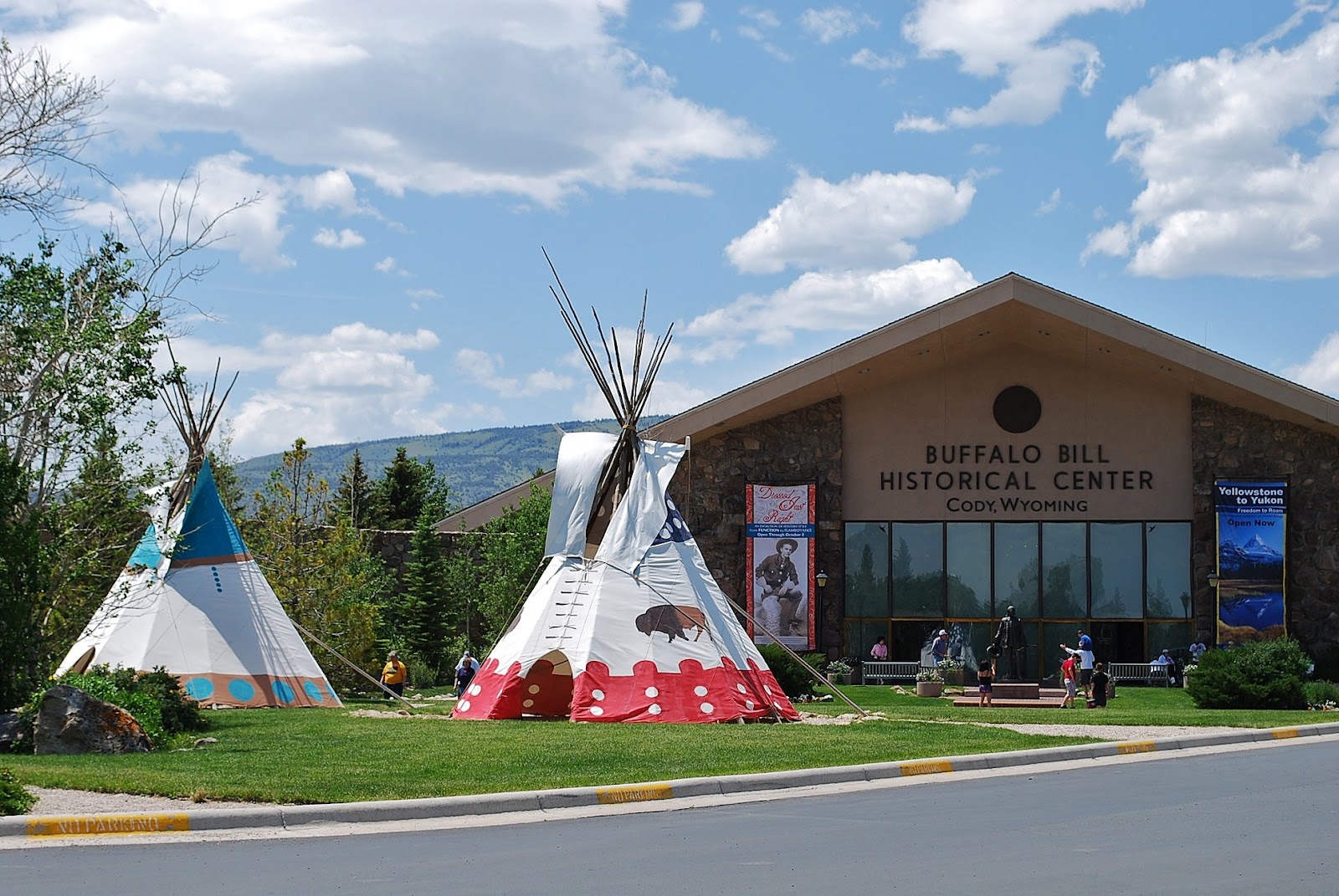

In Cody, Wyoming, the Buffalo Bill Historical Center certainly helps one to learn much about this now-famous man. But it also has quality, in-depth exhibits on other western subjects - the plains tribes, arts, culture, firearms, and natural history.

Buffalo Bill - Plainsman
Bob Scriver 
At the main entrance, you are greeted by this bronze sculpture depicting Buffalo Bill as a western hero and gentleman, wearing his Wild West show attire and holding a rifle.

Born in 1846 in a little town on the Mississippi River, Bill Cody, much as others of his day, acquired invaluable practical skills. He refined these and worked in a diverse range of occupations - as a teamster, Pony Express rider, wagon master, guide, soldier and cavalryman, and as an Army scout. These experiences helped define his character and through living, working, and learning, he became - and remained - a man of the West.

Bill Cody- Hard and Fast All the Way
Peter Fillerup
This 12’ high, 2,000 pound statue pays tribute to the 150th Anniversary of the Pony Express, as well as to local legend, Bill Cody, who as boy rode for the firm of Russell, Majors and Waddell.

Although Cody's experiences were not unique, few others of his time matched him in the range and diversity of his experiences. As the Indian tribes mourned the loss of the vast herds of buffalo, it was his special prowess at hunting those very animals that earned him the now-famous nickname and vaulted him from relative obscurity to lasting fame.


In 1883, Cody and several associates introduced "Buffalo Bill's Wild West," an innovative traveling outdoor spectacle featuring cowboys and Indians, sharpshooters, wild animals, and dramatic re-creations of scenes of frontier life. Buffalo Bill became a living, breathing icon and embodiment of America's western experience—a larger-than-life figure whose exploits and stories about settling the West captivated millions, not only in North America but also through Europe and, from there, to the rest of the world. Buffalo Bill performed before royalty, was feted by heads of state, became an object of adulation, posed for countless portraits and gave innumerable interviews, and even sat for an audience with the pope in the Vatican. The man of the West had become a man of the world.

Buffalo Bill - The Scout
Gertrude Vanderbilt Whitney

As seen from inside the Center, this monumental tribute to Buffalo Bill, dedicated in 1924, depicts the western figure as an army scout, peering down a trail signaling troops to follow.

Last of the Buffalo
Michael Coleman

The subject of much ancient lore throughout the world, and specifically in North American Indian tribes, the wolf is a symbol of the wildness of the West. Although an important part of the ecosystem for eons, today his presence causes mixed feelings. While many wildlife enthusiasts appreciate wolves, some ranchers feel at risk of losing livestock by preying packs.

Daddy Long Legs
T.D. Kelsey

This sculptor captured the animated and sometimes awkward movements of an adult moose. Here is an animal quite unlike any other - to be tittered at, respected, and admired - but always from a safe distance!

Prickly Pear
Charles Ringer

A drought-tolerant species, the nasty, yet beautiful, Prickly Pear cactus is common throughout the West. This imaginative steel sculptor found his inspiration for this sculpture in the Beartooth Mountains of Montana, not far from Cody. Originally made of shiny polished steel, the piece was exposed in the outdoors to rust into a warm red color.

Just down the street from the Center, we found the Mountain Trails Galleries with some more fabulous western sculptures:


Texas Two Step
Vic Payne

According to the sculptor: "This Texas cowpuncher has found himself in a heap of trouble and if the game warden chanced upon this scene today, it’d be a whole lot worse. A little Texas spirit was just enough to give this cowboy the idea to rope a whitetail buck that had been eluding him the past few hunting seasons. When the cowboy threw the lasso, the big Texas buck was none too happy, then those bobwhites blew up and the real rodeo began. Next time you see a cowboy, lariat at the ready, you might think about this old cowboy and his ‘Texas Two-step’."


Where Eagles Dare
Vic Payne

A mama bear is certainly nothing to fool with and if she happens to be a grizzly, all the more reason to steer clear.


These eagles are taking her on, though, and one certainly might wonder why.


The reason, of course, lies neatly tucked away in the bottom of the sculpture....


...then it becomes quite clear ...


Someone's young will eat today...


Someone's will go hungry -  that is the way of the wild.

For more information on the Buffalo Bill Historical Center:

Mountain Trails Galleries

Tuesday, April 24, 2012

ArtTrail #6 - Cody Country, Indians

Art is truly where you find it, and so much more can be gleaned from it than simply its visual appearance and impact. History, culture, ethics, and human justice are only a few of the thoughts stirred in my mind as we traveled through So. Montana and NW Wyoming around the edges of Yellowstone Park.


The Crow Indian nation once ranged from the Three Forks in Montana to the Black Hills of South Dakota, from the 500 mile long Musselshell River in central Montana to the Big Horn Mountains in northern Wyoming. The rivers tumbled cold and unobstructed with numerous species of fish, fresh water mussels, and crawdads.


Within these wild drainage basins lived the last survivors of the great Northern Buffalo herds - countless millions roamed north from the Yellowstone River to the Saskatchewan grasslands. When the Crow people lived in the area that is now Red Lodge, Montana, it was a place of worship, food and protection.

Chief Plenty Coups by Jonathon Johnson
Red Lodge, MT

Born in 1848, Plenty Coups (Aleek-chea-ahoosh, meaning "many achievements") was a man of war - and then a man of peace. Possessing vision, bravery, and leadership, he was made a chief of the Apsáalooke (Crow) tribe by age 28 and helped bridge a gap between two cultures. In 1884, he became one of the first Apsáalooke to own and settle on a farm, which was deeded to him through the federal Indian Allotment Act. On his 320-acre tract, he opened a general store, built a home, and worked the earth until his death in 1932 at age 84. At his request, 195 acres of his land was made into a public park. Upon his death, the Apsáalooke people voted to designate him as their last traditional tribal chief.

"The buffalo gone and freedom denied him, the Indian was visited by two equally hideous strangers, famine and tuberculosis. He could cope with neither. His pride broken, he felt himself an outcast, a beggar in his own country. It was now that Plenty Coups became the real leader of his people."
From the book Plenty-coups: Chief of the Crows
by Frank B. Linderman

"All my life I have tried to learn as the chickadee learns, by listening, profiting by the mistakes of others, that I may help my people. I hear the white man say there will be no more war. But this cannot be true. There will be other wars. Men have not changed, and whenever they quarrel they will fight as they have always done...

...We love our country because it is beautiful, because we were born here. Strangers will covet it and someday try to possess it as surely as the sun will come tomorrow. Then there must be war, unless we have grown to be cowards without love in our hearts for our native land. And whenever war comes between this country and another, your people will find my people pointing their guns with yours. If ever the hands of my people hold the rope that keeps this country's flag high in the air, it will never come down while an Absarokee (Crow) warrior lives." ~Chief Plenty Coups


For generations untold, Indian war parties and hunting parties regularly climbed over the pass between southern Montana and northern Wyoming. They moved through the basin in search of fight and food. Buffalo, elk, deer and other migratory animals swarmed in vast numbers throughout the valley and far out onto the plains and rolling, treeless open country with the red soil and sweeping green hills.


In the mid-19th century, the Nez Perce people splintered into two groups, with one side accepting coerced relocation to a reservation and the other refusing to give up their fertile land in eastern Washington. Following the Big Hole battle of 1877 near Lost Trail Pass on the Montana-Idaho border, Chief Joseph and his band of 800 men, women, and children began an epic struggle. This country helped hide them as they slogged through Sunlight Basin and over Dead Indian Summit in their attempted 1,800-mile escape from the pursuing 2,000 strong U.S. Cavalry.

Dead Indian Summit
Chief Jospeph Scenic Highway, MT

The Nez Perce fought a cunning strategic retreat, including 13 battles, toward refuge in Canada. On October 5, 1877, Chief Joseph surrendered to units of the U.S. Cavalry near Chinook in the north of what is now Montana - a mere 40 miles from the border. This surrender marked the last great battle between the U.S. government and an Indian nation.

"Hear me, my chiefs, I am tired.
My heart is sick and sad.
From where the sun now stands, I will fight no more forever."
~Chief Joseph


Experiencing this spectacular land gives one a deeper understanding of the plight of the early Native Americans. The flight path is reproduced by the Nez Perce National Historic Trail. One part of that, the Chief Joseph Scenic Highway, goes across the canyon of the Clarks Fork of the Yellowstone River, Wyoming’s only designated Wild and Scenic River. With winding switchbacks to the top of Dead Indian Summit, this drive is absolutely breathtaking. The 220-degree view from this point is among the most dramatic in the West and is a major attraction along this Byway. There are various legends for the origin of "Dead Indian"; with skirmishes between early prospectors or the U.S. Army and a party of Indians in 1878, one of the Indians died and was left at the summit.


Not far from there, in Cody, Wyoming, we viewed a number of other outstanding bronze sculptures.


In the valley of the Little Bighorn River in June of 1876, more than 260 soldiers and attached personnel of the U.S. 7th Cavalry met defeat and death at the hands of several thousand Lakota and Cheyenne warriors.

A proud man with deep seated political ambitions and a ruthless reputation, General George Armstrong Custer laid the ground work for his own defeat. Before going into battle against an unnumbered foe, he reduced his forces thinking it would bring more glory, praise, and credit his way to achieve a victory with fewer men. Against the advice of his Indian scout, he marched his men all night. Fatigued by the long march, the men and horses were no match for the waiting Sioux warriors. The Sioux carried away the swallow-tailed flag of the Seventh Cavalry that was captured during that battle.

Thunder at Little Big Horn
Vic Payne
After the defeat of General Custer, a small band of renegade Sioux headed north for the Canadian border with the Seventh Cavalry flag flying as a testimony to their victory over the “yellow hair”. The carrier of the flag, depicted here, and his wolf companion, proudly fly the colors of their fallen enemy. Later this small band of Sioux warriors was overtaken and the flag was retrieved. It is currently on display at the Custer Battlefield Museum located at the site of the battle in Montana.


Boy Called Buffalo
Vic Payne


Young Indian boys were often named after the animal whose strength and protection their parents wished upon them. Observing his namesake, the child would learn its ways and emulate its strengths. There was, however, always the danger that the young warrior would meet his end through his spiritual brother, the mighty buffalo.


Oglala Sioux Indian chief Crazy Horse was born c 1842, near present-day Rapid City, S.D. Fighting against removal to a reservation in the Black Hills, in 1876 he joined with Cheyenne forces in a surprise attack against Gen. George Crook; then united with Chief Sitting Bull for the Battle of the Little Bighorn. In 1877, Crazy Horse surrendered and was killed in a scuffle with soldiers.
Crazy Horse
R.V. Greeves

   
The artist admires the visionary leader and legendary warrior. He says “Crazy Horse is an American hero. He did not fight for the American flag, but he did lay down his life for the land we call America.”
In 1800, when she was about 12 years old, Sacagawea was kidnapped by a war party of Hidatsa Indians - enemies of her people, the Shoshones. She was taken from her home, in today’s Idaho, to the Hidatsa-Mandan villages near modern day Bismarck, North Dakota. She was later sold as a slave to Toussaint Charbonneau, a French-Canadian fur trader, and gave birth to her son Jean-Baptiste in 1805. Soon after, she and Charbonneau traveled with, and she served as interpreter for, Lewis and Clark’s Corps of Discovery. Only in her teens, she helped with this historic expedition in more ways than we know.

Sacagawea
Harry Jackson
Here she is portrayed with her young son standing majestically in the blowing wind. The artist created a unique finish on the sculpture by painting it many colors.

Buffalo Prayer
James Earle Fraser

This dramatic and emotional Plains Indian medicine man stands in reverent prayer. The artist modeled the sculpture after he witnessed a “medicine man, or counselor of the tribe, make his prayer. It was for the return of the buffalo.”
The Unknown
R.V. Greeves

This scupture portrays several Plains Indians looking with wonder into a vast unknown world. This mysterious sculpture leaves its interpretation to the eyes and mind of the beholder. How would YOU interpret it?

For more information

Crazy Horse

Nez Perce National Historic Trail
Outdoor Sculpture Guide
Buffalo Bill Historical Center

Friday, September 2, 2011

Summer Was


I thought there would be no summer
Arriving late, nearly not at all,
Ushered in with rain and clouds
Just as spring had been.


I knew when it was due,
Not merely by the calendar
But by some ancient rhythm,
After July 4th, or sometime later.


Sometime later was when it came,
Later and later, or so it seemed
While I dreamed of sun and balmy days
Not haze and sixty degrees.


"It's too cloudy." I whined
But we traveled no less
Through a land that was blessed
With those infrequent rains.


And summer was there
In the grasses and grains,
The wondrous white clouds,
And mountains slowly disrobing.


It was there in the storms
Bringing torrents and thunder,
Burgeoning insects and flowers,
And sweet-smelling trees.


"It's too cold." I complained
As we took a long drive
To the Top of the World
Where the snow still piled high.


And summer was there
In the blue of the skies,
The eyes of dear friends,
And each intricate bloom.


It was there in the wind,
And the rushing of water,
Tumbling down to the valleys
In some crystal clear days.


"It's too wet!" I lamented
Although I certainly knew
Even dew would be welcome
Where the temperatures soared.


And summer was there
Where the mustangs roam free,
In the colors of canyons,
With rivers brim-full and raging.


It was there with the wildlife,
With young and well fed,
In thunderous sounds and bright sights
Of some warm balmy nights.


"I can't work outside." I bitterly cried,
But the rain just kept on.
Cold, wet ground spewed forth growth
Like I couldn't believe.


Summer doesn't distinguish
Between "flowers" and "weeds"
It spurs on roses, fuchsias, and lilies
And miniature forests of trees.

Summer mixes the colors
And scatters the seeds,
Adds heaping amounts of things
You might rather not see!


"The weeds will take over!" I sadly sighed,
But sallied forth bravely
And you know what I found?
Small treasures were hidden all over the yard!


For summer was working
Quite unbeknown to me,
Quietly pushing, pulling, cajoling
And bursting its seams....


I was shocked when I realized
Fall was all a-buzz.
I thought there was no summer
But there was. Oh there was!