Showing posts with label Maples. Show all posts

Monday, July 4, 2011

I AM

Beyond a wholesome discipline,
be gentle with yourself.
You are a child of the universe,
no less than the trees and the stars;
you have a right to be here.
And whether or not it is clear to you,
no doubt the universe is unfolding as it should.
from Desiderata by Max Ehrmann, 1927


I feel a peace in the woods that I can feel nowhere else. Here, surrounded by green in all its glorious shades and hues, I truly feel God's presence. I am a part of this earth, as He intended me to be; my senses are sharpened and alive, freed from the various distractions that life is full of. My eyes feast on this beauty and never tire of it.

I am surrounded by trees, their trunks in various sizes and shapes climbing every skyward in search of precious light. Their foliage forms a canopy above me, filters and scatters the light to the growth below.


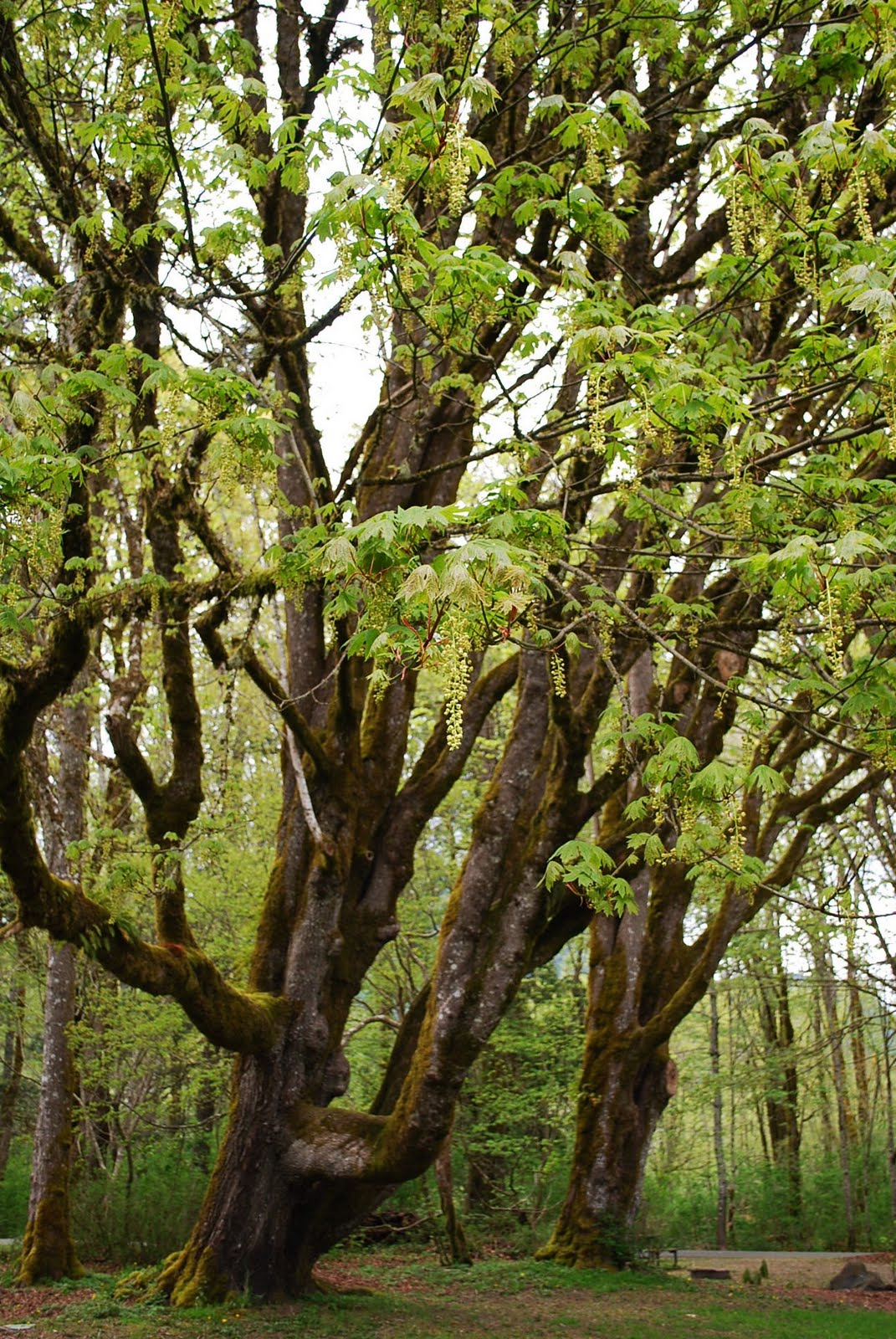
Thickly covered with mosses and looking like wizened old sages, the Big Leaf maples stand at intervals. The huge trees divide and branch early in their lives and continue to do so, as many sturdy straight branches grow upward.


Their leaves have a distinct lacy appearance and stand out bright green against the darker, muted shades of the cedars.


I am awed by the size of some of them, but they feel like comfortable old friends. I wonder at the variety of creatures which surely find homes among the nooks and crannies of their gnarled, rough bark.


The cedars are different, with a single straight, linear-barked trunk - their branches growing straight out around the trunk or curving gracefully down.


Distinct among the evergreens, their needles appear fern-like, lush, and compact. The huge ones dwarf everything around them, standing aloof and regal.


Smaller around, but standing out in their own way, are the gray, smooth-barked, straight trunks of the Red Alders.  

In my mind's eye, I trace their trunks with a brush and oil paints, gently forming them with slightly rounded back and forth strokes - streaks of Burnt Umber contrasting with the lightened Payne's Grey.

High above, their smaller leaves form a wonderful, spattered pattern against the sky and other foliage.


At ground level the sword ferns - growing in neat clumps as if lovingly placed by a gardener - grow in upright, orderly fashion.


Their meticulously precise fronds are large, easily waist to shoulder high to me.


Below them the matted, tangled growth of the forest floor grows lush - richly nourished with centuries of decay from the leaves and branches of all that have gone before.


And I, feeling very small and insignificant, stand among this grandeur. I, too, am nourished by all those who have gone before; by their struggles, efforts, and faith. I stand tall - for I am a child of the universe, meticulously formed. I breathe deeply, marvel at this burgeoning life, and know that none of it is random. 


But ask the animals, and they will teach you;
     the birds of the air, and they will tell you;
ask the plants of the earth, and they will teach you;
     and the fish of the sea will declare to you.
Who among all these does not know
     that the hand of the LORD has done this?
In his hand is the life of every living thing
     and the breath of every human being.
                           Job 12: 7-10

Thursday, May 19, 2011

Too Much Green

Vine n. 1. Any plant having a long, slender stem that trails or creeps on the ground or climbs by winding itself about a support or holding fast with tendrils or claspers. 2. the stem of any such plant. 3. a grape plant.


Washington is called the Evergreen State and that is certainly true in the western part of the state. Oh, I know that this nickname refers to the conifers, those trees which keep their leaves all year long. And we certainly do have an abundance of cedar, pine, fir, and hemlock. But I am thinking of the color green which we also have year-round. In other parts of the country when the heat of summer, then the cold winter weather, moves in, lawns dry up and turn brown. Not here. Although the growth of our grass slows during the rainy months, it remains bright green. Besides the conifers, the woods are filled with other evergreens such as rhododendrons, madrones, salal, evergreen huckleberries, and sword ferns, all of which remain green throughout the year. Mixed in with all this green, however, are the deciduous trees which do shed their leaves. And so we are granted a respite, if you will, from all this green during the winter months. Well, winter is over and we are now, one again, smothered in green.


I don't mean to seem ungrateful. I've lived where the summers bring hot, dry, and brown and the winters bring cold, frozen, and white. I've adjusted to living here and the mild climate suits me most of the time. I enjoy venturing out any time of the year, during any type of weather to take a walk and enjoy the native plants and animals. After the drizzly, damp, cloudy winter, it is nice to see the new buds form and burst into life throughout our native woods. It's just that... well, it's almost TOO MUCH!


I spent my childhood and early married years in Montana where there is a definite change of seasons. Living on the high plains in the central part of the state, I took for granted the fact that the countryside was vast and uncluttered. Whenever we drove outside of town, there it was - that huge sky, ringed by distant bluish mountains. Miles and miles of open space, with only scrubby grasses, sage, and ranches as far as you could see - until your eyes bumped into those far-off hills and mountains. It spoiled me for life...


My husband and I spent a few years in Colorado, Texas, and Idaho - always west of the Mississippi. I am western through and through. Those places each had their own kind of natural beauty and I am not sorry to have lived in any of them. Colorado had the mountains, Ponderosa Pines, and dry grassy undergrowth. Texas had the hill country, Live Oaks, and acres of wildflowers. Idaho had grassy hills, sagebrush, and ancient lava flows. All of them had hot, dry summers which turned brown.


I've now had 30+ years of "abrupt" change. GREEN change. Through our woods, there is a lovely vine which creeps through the other trees and shrubs and makes its presence known. But a vine is not always what it seems...


The Vine Maple (Acer circinatum) is so named because its slender, crooked trunks and long limbs sprawl across the understory of the conifer forest. It grows as a large, multi-stemmed shrub or as a small, single-stemmed tree, depending on its location and how much sunlight reaches it. It flourishes beneath the dark canopy on moist sites along the Northwest coast and on humid sites on the east slope of the Cascades. The Quinault people of the Olympic Peninsula referred to the vine maple as "basket tree" because they used its long, straight shoots for weaving baskets in which they carried clams and fish.


In spring the vigorous young shoots are reddish, with delicate emerging leaves of bright yellow-green. They unfold almost as miniature fans and give a spattered appearance among the larger trees.


Clusters of small flowers with red and green parts appear, bringing a sharp contrast of color to the woods. In the fall, the leaves stand out as splotches of brilliant red, pink, orange or yellow, contributing considerable color to the somber, conifer-dominated landscape. Vine Maples are well worth getting to know.


And so, we are getting into the very green season here, which I dearly love. But I do still sometimes feel smothered and have the urge to "part the greenery" and view those beautiful miles and miles of uncluttered space. Spoiled for life, I am!

Saturday, May 14, 2011

One in a Million


Driving into the Hoh Rain Forest, ever deeper, I was at first excited, then totally enthralled, with these huge trees. They stood naked, disguised as over-sized furry monsters; draped and dripping they were with long, heavy masses of mosses and lichens - ocher-green, luminous with back-lit sunlight. Long limbs and gnarled fingers reached down, like characters from some spooky stage play.


But we were not afraid, viewing them somehow as kindly giants, willing to share their braches, trunks and exposed roots with a myriad of other living things.


The Bigleaf Maple (Acer macrophyllum), North America's largest maple is the only native large maple in the west. Superbly adapted to the wet, mild climate west of the Cascade Mountains, this is the trademark species of the coastal rain forest.


Huge they do become - up to six feet across and up to one hundred and twenty-five feet tall. Their leaves are the largest of any maple - up to a whopping eight to twelve inches across.


In the temperate rain forests of western Washington, the moss and lichen coats on these trees can weigh up to four times as much as the tree's foliage, even more when saturated with rain or laden with snow, which is much of the time.


Although relatively tolerant of shade and competition for growing space, Bigleaf Maples are gradually shaded out by conifers that eventually tower over them. They don't mind occasional wet feet, but cannot tolerate long-term flooding.


These looked dead to those unfamiliar with them, I suppose, but closer inspection showed them ready to burst to life, buds swollen and unfolding into translucent, yellow-green new leaves. Shelf fungus lined some of their massive trunks, bright green licorice ferns sprouted in groups on the limbs and moss-covered boles.


Copious clusters of fragrant yellow blossoms, four to six inches long, dangled among the green. On warm spring days, these teem with honeybees and other insects gathering their nectar and pollen. These trees depend on insects to fertilize their flowers and the system works well.


Huge numbers of seeds sprout everywhere in the spring, but only about one in a million new seedlings is able to root into mineral soil in a spot with adequate growing space for it to grow into a tree.


Their fallen leaves contain high levels of potassium, calcium and other important minerals. Fresh new Oxalis, Trillium, and wild Violets sprout around their feet, drawing nourishment from the decaying residue of last year's leaves, lying thick and heavy on the forest floor.


Each giant truly is one in a million.