Tuesday, March 8, 2011

Social Networking with a Bear

National Park Service

The sight before me is entrancing - a mother Black Bear, her year-old cub, and two one-month-old "cubbies" all snuggled into their winter den snoozing, playing, and grooming each other peacefully somewhere in the wilds of Minnesota. The yearling grunts, the babies squeal, and the mother gently lifts them to her chest. I look forward to seeing them venture out of the den in the coming weeks. Whoever heard of such a thing?! But in this day of technology, indeed, nearly anything is possible.

And in this day of the internet, more and more possibilities are opening up to us. The question is, however, just which of these - and how much - should we partake of? To many of us now, the computer, I-pod, cell phone, Kindle, and other gadgets take increasingly bigger bites of our time and never seem to be full. It truly can boggle the mind...

Social Networking has wormed its way into our lives in ways we never imagined only a few short years ago. I must admit, there are parts of this that I find intriguing. Used with care, and proper precautions, it is now possible to easily stay in touch with friends you seldom see and family members who live far away. Sharing photographs and instant messages can be big positives if mutually agreed upon by those involved. Like anything else, common sense - and courtesy - should prevail. Limiting the time spent on-line as well as engaging in other non-technological activities is equally important.
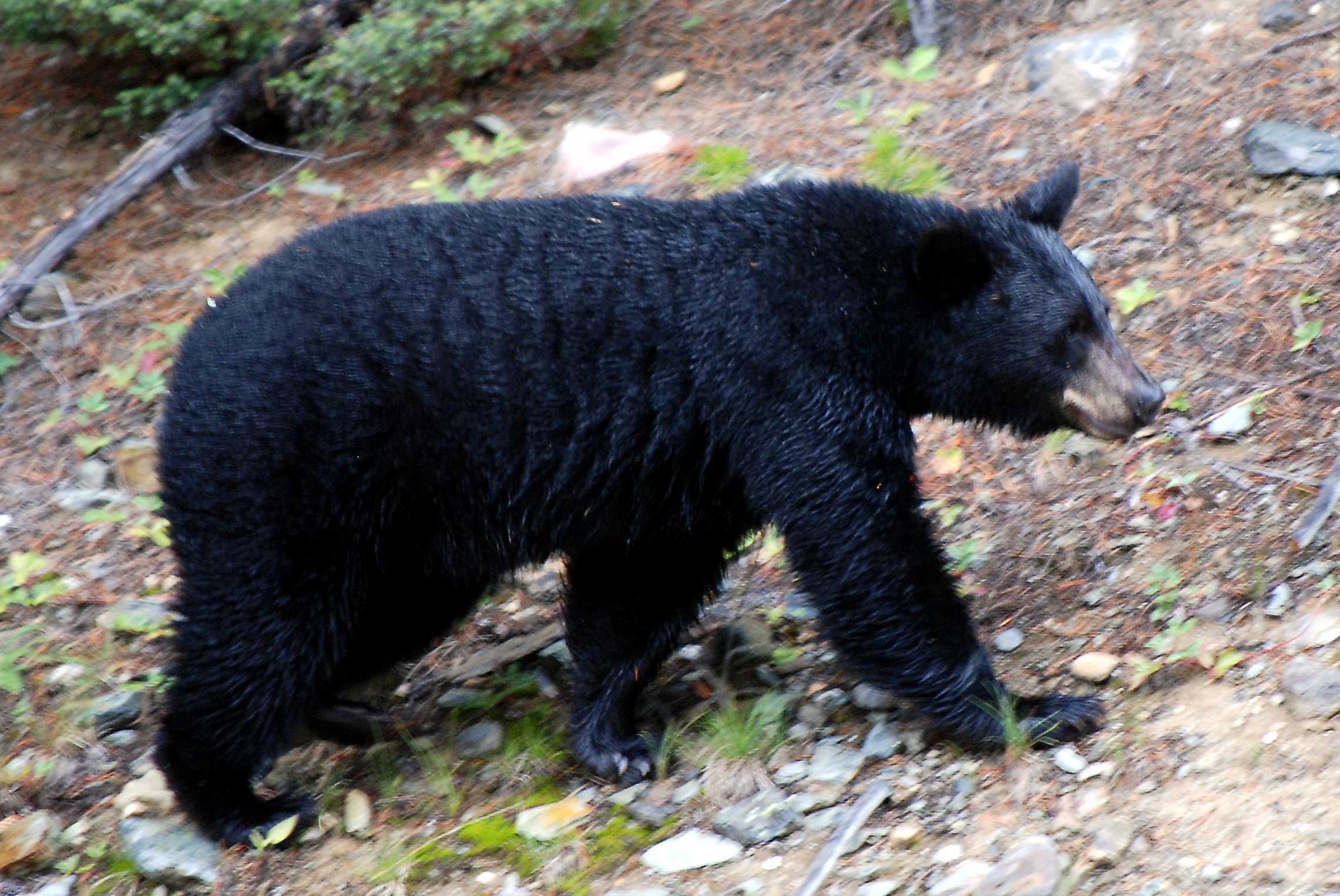

American Black Bear by HBarrison

But it was through a friend's sharing on just such a site that I discovered Lily the Black Bear. Lily, and her yearling cub, Hope, are two of the subjects of study by the North American Bear Center in Ely, Minnesota. According to their web site: The mission of the non-profit North American Bear Center is to advance the long-term survival of bears worldwide by replacing misconceptions with scientific facts about bears, their role in ecosystems, and their relations with humans. All eight bear species around the world are now listed as vulnerable, threatened, or endangered in all or portions of their ranges. Remote habitats that once insured isolation and protection are now being occupied by people, and the attitudes of these people will determine the future of those populations of bears.


Photo by Alan Vernon

And so these dedicated people study bears - and share what they learn. Lily is one of these; she is a wild Black Bear and they have traced her lineage back over 20 years. Last winter she gave birth to little Hope and their story became something of a phenomenon as Lily deserted her during the summer, they met and parted again, then met and reconciled to never again leave each other. All of this was followed, in print and on video, by millions of people. Denning together through the rugged northern winter, Lily again gave birth - this time to a pair of cubs. A live den camera was unobtrusively installed in the den last fall, so these bears are constantly observed and studied. What is being learned about these wonderful animals is truly priceless and offers much hope for their future.

By the way, if you would like to learn more about Lily and her kind, you will find her on Facebook!


The heart of the discerning acquires knowledge;
the ears of the wise seek it out.
Proverbs 18:15

To learn more about the North American Bear Center:
http://www.bear.org/website/

All picture files from Wikimedia Commons

Sunday, March 6, 2011

Accomodating Spiders

Boy, I was vacuuming up a storm when I first noticed it. The small hole near the bottom of the wall was not new, but the gossamer, funnel-shaped web leading into it certainly was. Perhaps it was just laziness on my part, but I decided to just let it be. After all, it was winter, and even she needed shelter. Besides, how much trouble could one small spider possibly be?


I have gotten into trouble before with such thinking. As a child, I was always collecting odd critters in jars which often ended up in the large bay window in our kitchen. The results of one such episode are crystal clear in my now grown-up mind. My mother was an extremely patient woman, but one day she had just had enough of my “collecting”. One jar in the window contained an odd assortment of cocoons. “This has been here long enough.” she said, handing it to me. “Get rid of it.” Well, I thought I did. Taking the easy road, as children are wont to do, I tossed it in the garbage in the back hall. A day or two later, Mom bellowed “One of these days this whole house is just going to grow over in green mold, and it will all be your fault!!!” Mom didn’t get upset easily, and although this reprimand stung, she had a point. One of those “cocoons” had hatched - the trash was crawling with what seemed like a thousand baby spiders! You’d think I’d have learned...


Perhaps a month or two went by after this latest spider discovery. To be honest, I mostly forgot about it. I figured this little spider was helping keep down the population of whatever other bugs were trying to winter over inside with us. Live and let live, I nobly thought.


But the come-uppance came. It was my night to host our Book Club. The house had been gone over, dessert and coffee made, my husband and I were tending to a few last-minute details before the first guest arrived. Some cobwebs were spied in the skylight above the sofa. I grabbed the dust mop to do away with them, but just before I whisked it through them I noticed something else. Dozens of tiny spiders dotted the area. My husband raced for the bug spray. “No!” I cried. Sprayed spiders immediately drop down on single strands of web. Picture that over the sofa! After quick - and I might add HEATED discussion - we decided to pull the skylight cover closed and deal with them the next day. Of course, nothing was mentioned during the meeting. Some of those who attended are hearing this for the first time.


Thankfully, those little guys cooperated (unknowingly, I’m sure) and stayed out of sight. The next morning we moved furniture out of the way, spread plastic on the floor beneath the sky light, and sprayed the heck out of them. Dozens of tiny bodies gently lowered on silken strands. Oh yeah, and the funnel web in the hole in the wall got a good dose, too. The hole got taped over for good measure. I’ve not been so accommodating to indoor spiders since. I guess a lesson learned late is better than one not learned at all...


Keep hold of instruction, do not let go;
guard her, for she is your life.
Proverbs 4.13

Tuesday, March 1, 2011

Endearing Differences

Photo by  Scorpion

“Pick, Pick, Pick...” Soft calls attracted my attention. Just beyond the kitchen corner window he hung swaying gently, picking away at his breakfast, also. As I approached the window slowly and quietly he saw me coming, but was intent on his task and not about to leave. So there we were, me with my cup of coffee and him with his soft chirps between bites - less than 3 feet apart. With white body, black and white striped wings and face, and brilliant red patch on the back of his head, the six-inch long Downy Woodpecker is quite a spectacular little creature. He’s well-known for pecking about on trees in search of wood-boring insects, but also eats berries and seeds. He finds suet hard to resist.

Photo by Wolfgang Wander

Before long, the Chestnut-backed Chickadees arrived, also attracted to the hanging suet. Downy held his ground there, so after a couple of tries the chickadees happily took turns snatching sunflower seeds out of the small feeder attached to the glass. These little guys often travel in small bands, as well as in mixed flocks with kinglets, nuthatches and juncos.


“Meep, Meep, Meep..” The “volkswagon” of the bird world suddenly appeared in the form of a Red-breasted Nuthatch. He’s small, but sturdy, and also had a hankering for suet that morning, so barged right in. His darting, erratic movements must have disturbed Downy, who finally flew off. The chunky little nuthatches with stubbly tails and legs are one of my favorite birds and amazing in their agility.


All of these birds occupy the same territory and share the role of gleaning insects from trees. But their different styles permit a happy division of the bounty. Some birds prefer one insect type to another, or large insects to small. Woodpeckers brace back on their tails and methodically hop up the tree. Nuthatches run helter-skelter, head-first down the trunk, spotting beetles, insect eggs and larva that the woodpecker might have missed. They will also wedge a larger seed into the bark of  a tree so that they can peck it open. Quite the acrobats, chickadees pick insects from the branches and twigs, as well as hunting for seeds and berries. Their little buddies the juncos will check the ground, while the tiny kinglets flit about inspecting foliage to snatch spiders and flying insects. It is these unique behaviors that make each bird special - we notice and remember.
A man I once knew volunteered at the local Marine Science Center 4 or 5 days a week, 7 hours a day. He cleaned tanks, fed animals, and might or might not talk to others. He admited he was not very social, but he knew all the creatures and noticed if one would not eat. Another elderly man would buy coffee and doughnuts every Friday for everyone and loved to talk, believing that was the best way to start the day. There was the friend who always parted with a “toodle-oo”, the trash collector who looks for me in the front window and waves to me from his truck, my husband who knows that I like coffee in bed, catsup on sausage, and clam dip with chips for breakfast on New Year's Day...
Photo by Kevin Cole
After 35 years, I met an old friend from high school and college days. Deep in conversation, I noticed that she still crosses her leg and bounces her foot up and down while listening. Funny, the things you remember about someone - the things that endear them to you. I, for one, am gateful that we are all so very different.

Ruby-crowned Kinglet photo by Donna Dewhurst
for U.S. Fish & Wildlife Service

There are different kinds of gifts,
but the same Spirit.
There are different kinds of service,
but the same Lord.
There are different kinds of working,
but the same God who works all of them in all men.
1 Corinthians 12:4-6

Downy Woodpecker and Slate-colored Junco picture files
from Wikimedia Commons

 Ruby-crowned Kinglet picture file from: http://www.fws.gov/digitalmedia/index.php

Saturday, February 26, 2011

Who-Cooks-for-You Late at Night?

...oOoOoOoOoOoOoOo...
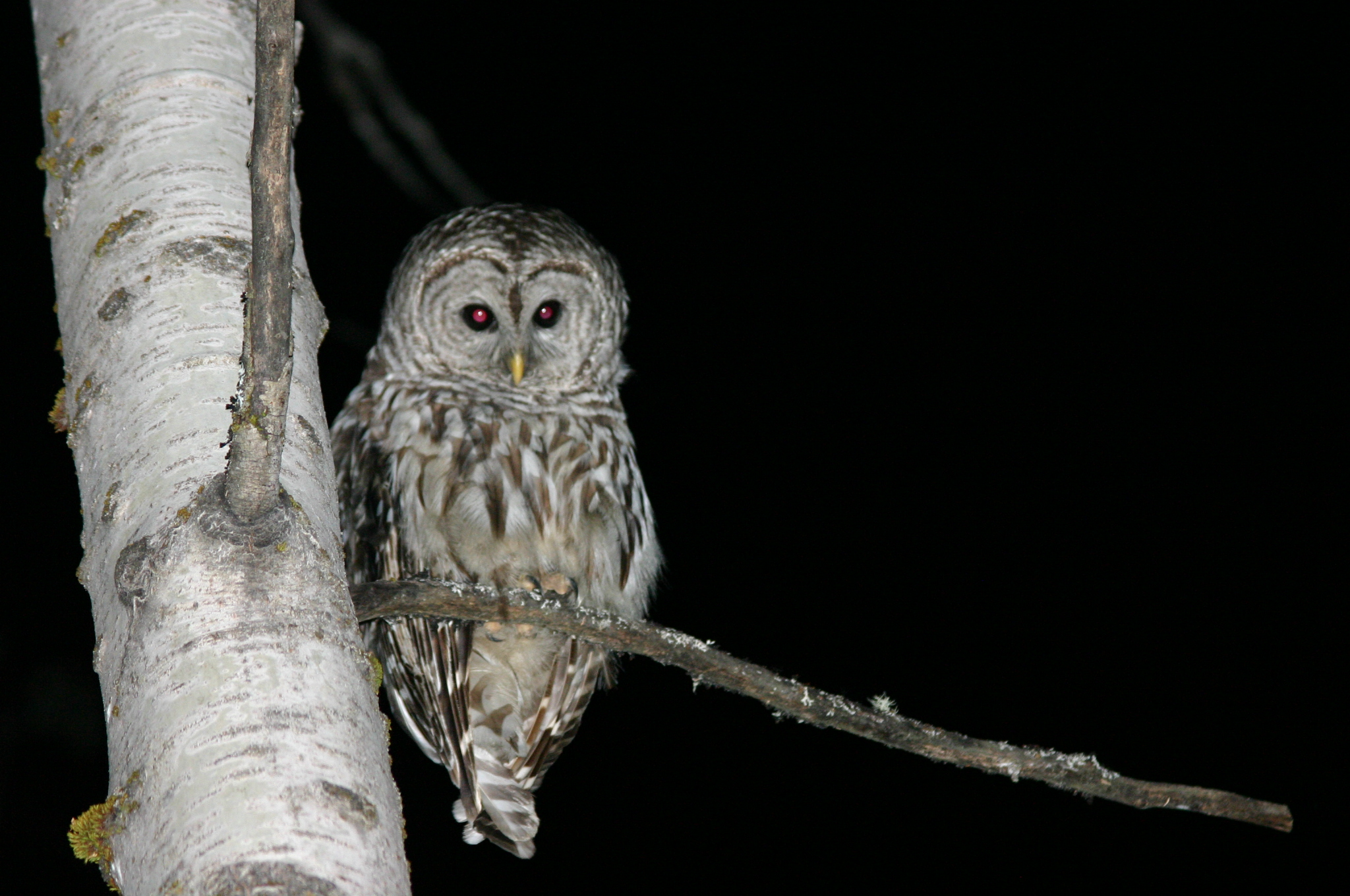
It was a dark and stormy night... I was deeply engrossed in a book when I was shocked upright. Listening intently, my heart pounded and goose bumps arose as if I were in mortal danger. I thought I might be, as somewhere close outside was the most weird, eerie sound I've ever heard. Getting up my courage, I quietly unlocked and slowly opened the door. I listened for a few minutes - there is was again! And off in the distance, another answered. I can best describe the sounds as sort of a 3-way cross between old rusty bed springs, a very hoarse dog, and a rooster whose crow has run down and needs to be re-wound. As I moved into the yard, whatever it was saw or heard me and the sound stopped.
oOoooo...
The next day, I tried to figure out what it might have been: coyote was off the list; it did not sound like any dog I know of; it was too low a sound to be a raccoon or an opossum; neither deer nor bear sound like that. The only thing it could possibly be was an owl.

Photo by Wingchi Poon

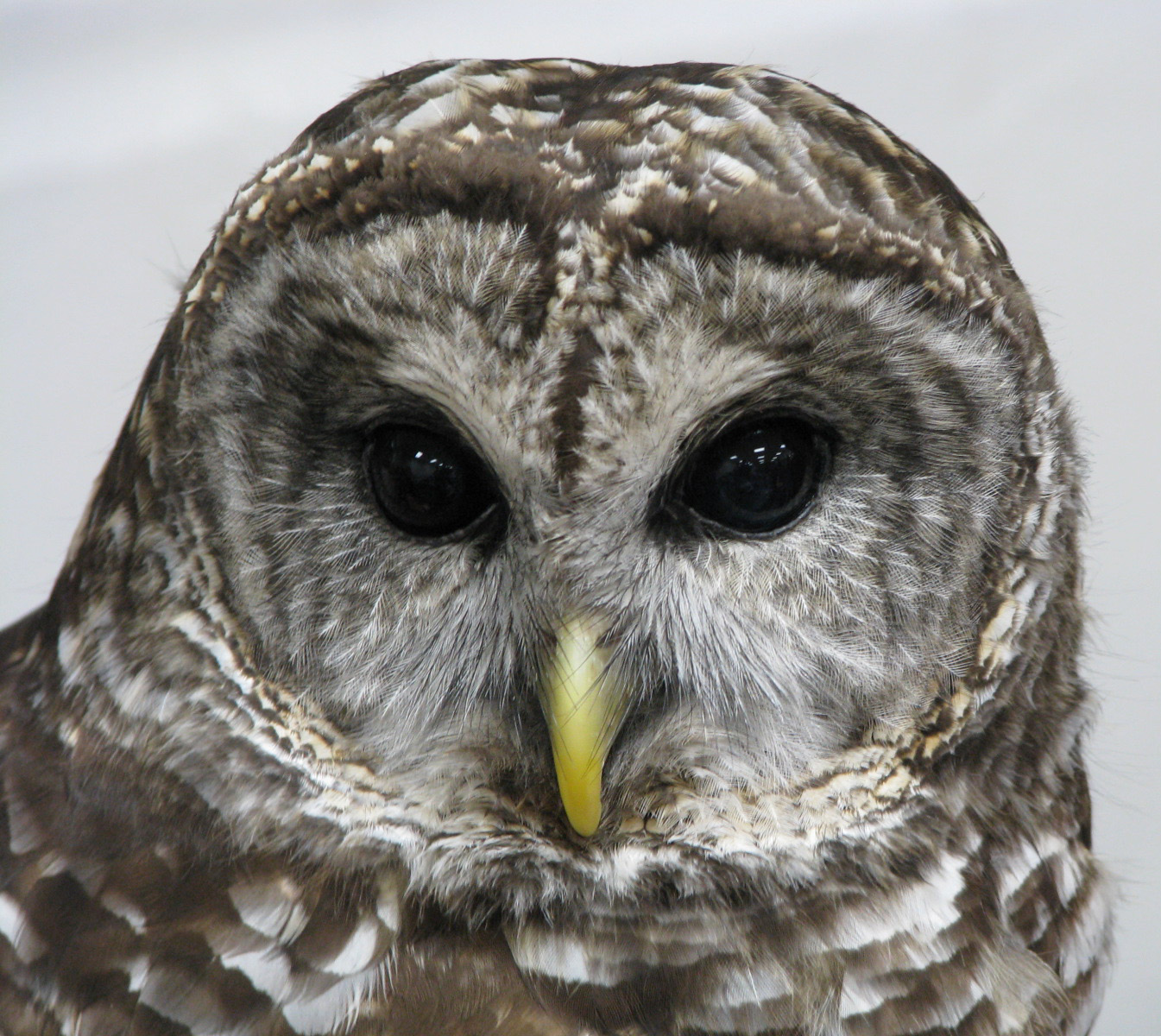
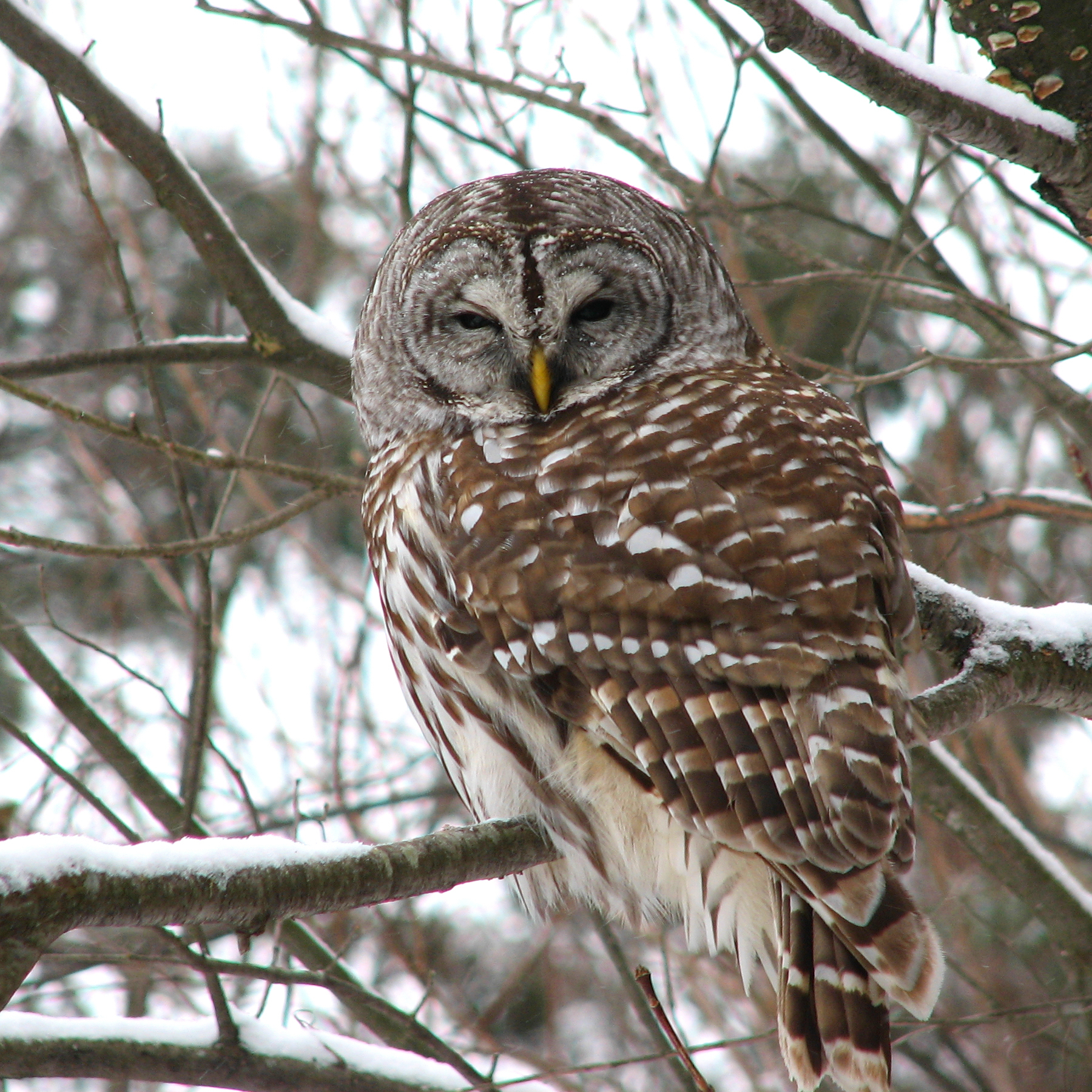
 Some owls do call our county home. The Barn, Western Screech-Owl, Snowy, Short Eared, and Northern Pygmy Owl are rare, but the Great Horned, Barred, and Northern Saw-Whet owls are more common. Most are nocturnal, although some are active during the day. Through the wonder of the Internet I was able to research and hear the calls of each of these owls. There is no doubt that what I heard was the Barred Owl (Strix varia)- the original "Hoot Owl". This highly vocal owl gives a loud and resounding "hoo, hoo, too-HOO; hoo, hoo, too-HOO, ooo" which is often phrased as "Who, cooks, for you? Who, cooks, for-you, all?" The last syllable drops off noticeable. The calls are often heard in a series of eight, then silence, when the owl listens for a reply from other owls. That is exactly what I heard.

photo by Terren
 
Reaching 16-25 inches in length with a wingspan of 38-50 inches, the Barred Owl preys mainly on Meadow voles, shrews and deer mice. It also eats rats, squirrels, young rabbits, bats, moles, opossums, and weasels. Birds are taken occasionally, as well as small fish, amphibians, reptile, and insects.

Photo by D. Gordon E. Robertson

I have yet to see these wondrous birds, although I hear them every once in a while. I imagine them perched high in one of the old dead trees, scanning the pasture for mice or rats. I would hope they stay, perhaps nesting nearby in the cavity of a tree or in an abandoned hawk, squirrel, or crow nest. Devoted parents, they have been known to dive bomb anything (or one!) perceived as a threat to their nests. They care for their young for at least 4 months, much longer than most other owls. the young usually disperse less than 6 miles before settling. Pairs mate for life and territories and nest sites are maintained for many years. They have been known to live up to 10 years in the wild. with most deaths likely to be related to man (shooting, road kills, etc.). Other than man, Great Horned Owls are their only natural enemy.

...oOoOoOoOoOoOoOo...

I no longer fear those strange sounds-in-the-night; we are honored that they are visiting "our" woods. They may not stay, but no matter - their being here, just this once, sparks the imagination and generates thoughts toward brighter days and hope for the future. It's a good reminder that - no matter what - the circle of life continues.
OOOOOOOOO
So we fix our eyes not on what is seen,
but on what is unseen.
For what is seen is temporary,
but what is unseen is eternal.
2 Corinthians 4:16-18
O
For more information on owls: http://www.owlpages.com/

Barred Owl picture files
from Wikimedia Commons

Wednesday, February 23, 2011

Rain, Precious Rain


Living in the Pacific Northwest, I am sorely tempted to say that I am sick of rain. Gray skies, constant drizzle, puddles everywhere, sodden earth that slips and slides creating minor difficulties at least, and at worst - havoc. Rivers and lakes have swollen, flooded, and created no end of heartache for those who live too near them. What began before Christmas continues into February, and I’m ready to cry “Uncle”!

A few years ago we had a new metal roof installed, so it no longer leaks - mostly. We still have a few problem areas on our kitchen and living room ceilings, probably the result of poorly-suited skylights. We think we have it figured out now, but the next repairs with be the third (fourth? fifth?) go-round, so all bets are off. We’re fortunate in that we’ve never had a problem in our basement, however. All in all, our water problems are relatively minor.

Ironically, since moving here 30 years ago, we’ve tried never to waste the water that we use. That means doing only full loads of clothes and dishes, not letting water run longer than necessary, flow restrictors on all faucets, limited toilet flushings at night. Large amounts of water left from canning or other uses are carried outside to water protected flower beds or potted plants. Sounds a bit eccentric, I know, but there is a legitimate reason.

As young married, we lived at a 7,400 feet altitude in a rural area of Colorado. Our well was not very deep and recovered slowly when drained. Consequently, we soon learned never to wash more than one load of clothes a day. We had no dryer, so that single load was hung outdoors or draped inside in the winter. No dishwasher either, so dishes were also done in one washing. We adapted - water was seldom, if ever, simply allowed to run.

In Idaho, our well was deep but it was old and its pipe corroded, so the pump could only be lowered so far. One year, a severe drought lowered the water table so that the pump could no longer reach it. A kind neighbor ran a long hose from their house to ours, so we could survive until a new well was drilled. Drilling began, but it was not long before they hit a problem - a huge boulder. Slowly, the drill pounded through what proved to be 20 feet of solid granite. I remember the awful THUD - THUD shaking the whole house, as dollar signs flashed before my eyes. Our savings were small and there was no guarantee that another boulder did not lie beneath that one. Luckily, there was only one and eventually we had ample, sweet-flowing water. Our bank account was much less, but as the saying goes “it was only money”...

We have not lived in a true desert, nor ever been totally without access to water. But we have learned that it is not always easy to come by. Nor should it be taken for granted, ever. Try going just one day without it - no brushing your teeth, bathing, laundry, dish washing, flushing, coffee, tea, milk or soda, No wine. Try two days, three, or more....

I am tired of rain, but I will not complain.
Water is far too precious.

“Everyone who drinks this water will be thirsty again, but whoever drinks the water I give him will never thirst. Indeed, the water I give him will become in him a spring of water welling up to eternal life.”
John 4:13-14


Friday, February 18, 2011

Winter Gifts from Ants


The stormy, wet winter has made me more than ready for spring and the burgeoning new growth that accompanies it. Returning from my walk to fetch the mail I meander slowly, enticed by the sun and warming temperature. I am drawn to our small pond. Full to overflowing and clouded with muddy runoff through much of this season, on this day it is clear and within its normal banks. The heavy overflow has eroded and deepened the stream bed below the small concrete dam, but the dam has held. Deciduous trees and shrubs are still bare, but buds on the small magnolia tree are swelling and rich red stems of Siberian dogwood stand out against the grassy hillside.


Walking close beside the garden along the side of the house, I search carefully for signs of new growth emerging through the detritus of last fall. Although I see none yet, memory serves me well as I clearly picture where each clump of crocus and grape hyacinth lies. A gravel path runs beside this garden and in summer it is a nice contrast to the verdant, shady bed. Walking on it, rather than on the boggy, wet grass, keeps my shoes from becoming soaked and is especially welcome on this day when the yard is still spongy. Strolling along it, I am reminded of the wonderful little gifts I’ve found buried there among the assorted weeds and ground cover “escapees” from the garden.


Two small plants once grew in this garden - one white and one pink - which are known as hardy cyclamens. Both of these put out leaves in the fall and throughout the winter, which die back in the spring and summer. Since they are native to the northern and eastern Mediterranean, this trait allows them to survive through the heat of summer there. The white one was fall blooming, producing its small, exotic flowers a month before its leaves arrived. The pink one was winter blooming, beginning in December, a few weeks after its leaves appeared. The flowers of both of these begin as tightly twisted spirals, which open slowly and stand tall until pollinated. They then are coiled down, spring-like, on their stems to ground level and tucked under the leaves for insulation and protection while the seeds ripen open. It is said that ants are attracted to a sweet substance on the seeds and are responsible for scattering them about when ripe in the spring and summer, so new plants are often found in unlikely places the next winter. There’s no predicting the exact time of germination - they sprout on their own individual timing. Cyclamens make tiny bulbs just beneath the soil before they send up their first tentative leaf.


I have found a fair number of small cyclamen bulbs growing among the pebbles of this path each summer as I tackle the weeds. Carefully digging them up, I’ve moved most of them to another shady garden near our back door and have enjoyed watching them slowly develop and spread out. This fall, a few small white blooms appeared and now, when I’m hungry for color, I’m greeted by several clumps of bright pink as I round the corner and head for the door. I still find it hard to believe that anything would bloom in the dead of winter, but every plant has its own specific time. So here these small wonders are - warming me through and through with their perky, bright heads. Reminding me that spring is on the way. Filling me with gratitude - even for the lowly ant.


He has made everything
beautiful in its time.
Ecclesiastes 3:11

Wednesday, February 16, 2011

A Series of Adjustments


“Life is a series of adjustments” my father said on occasion, especially when discussing tough times or decisions within our family or country. I never fully appreciated nor understood these words until I became an adult and faced life full-on. If we are to flourish, or indeed survive at all, adjustments are not only desired, but necessary.

Change is all about us - in the weather, our relationships, the government... most certainly the economics. Just how do we adjust to the changes, the uncertainties, the looming unknowns? One step at a time.


One answer I have found lies in the time of my mother’s death. During our family gathering around her funeral, I sought solace, as I often do, by connecting with nature and the forces that are greater than myself. It was February - much milder than normal for that time of year in Montana - and I needed no jacket as I walked around my family home noting the details of the oh-so-familiar yard. It was then I discovered the crocuses, in full glorious bloom much ahead of schedule. Through my tears of grief I smiled, remembering Mom’s love of all growing things, that surely she planted these, and that new life springs eternal if we can only hang on and hope.


Winter has not yet left us, but new life is all around. Take a quiet, leisurely walk and resolve to be fully in the moment, observing what is right before you here and now. Willows and alders thrive in poor, damp soils and are among the first plants to quickly grow in any disturbed area. Already they, along with wild hazelnuts, have formed catkins and are inching their way toward spring and continuing their species. Never mind that we only just had freezing temperatures and feet of snow - wild things adjust and life goes on.


Alders produce millions of tiny, light seeds which are carried readily by wind over most of the area west of the Cascades. They grow quickly, readily sprouting from stumps and shallow roots as well as seeds. Able to withstand light surface fires and severe outbreaks of tent caterpillars, they eventually succumb to heart or root rot. They are not shade-tolerant, so give way to evergreens which eventually tower above and crowd them out. They suffer multiple afflictions, but alders help create conditions favorable for the giant conifers that replace them.


Because their seeds are tiny, frail, and usually do not germinate in dry or shady sites, willows produce huge numbers, each equipped with a tuft of down to catch the wind. Willows survive even without seeds - new stems sprout readily from stumps or broken-off twigs. What zest they show in their growth until they, too, are eventually overshadowed, having stabilized and cooled the soil so that those that follow can thrive.


Hazelnuts prefer well-drained soil and will tolerate fairly heavy shade, so often are found growing beneath tall, old trees and along the edges of wet sites. These wild relatives of the nuts we enjoy are edible, rich in protein and fat, and are favored by a number of animals. Faithfully they product fruit, year after year.


Alders, willows, hazelnuts, and us - each has strength and weakness and each thrives where it is planted if it can adjust. Life requires myriad adjustments and in those we can find hope. Never underestimate the power of HOPE.

Never be lacking in zeal, but keep your spiritual fervor, serving the Lord.
Be joyful in hope, patient in affliction, faithful in prayer.
Share with God’s people who are in need.
Practice hospitality.
Romans 12:11-13