Thursday, May 19, 2011

Too Much Green

Vine n. 1. Any plant having a long, slender stem that trails or creeps on the ground or climbs by winding itself about a support or holding fast with tendrils or claspers. 2. the stem of any such plant. 3. a grape plant.


Washington is called the Evergreen State and that is certainly true in the western part of the state. Oh, I know that this nickname refers to the conifers, those trees which keep their leaves all year long. And we certainly do have an abundance of cedar, pine, fir, and hemlock. But I am thinking of the color green which we also have year-round. In other parts of the country when the heat of summer, then the cold winter weather, moves in, lawns dry up and turn brown. Not here. Although the growth of our grass slows during the rainy months, it remains bright green. Besides the conifers, the woods are filled with other evergreens such as rhododendrons, madrones, salal, evergreen huckleberries, and sword ferns, all of which remain green throughout the year. Mixed in with all this green, however, are the deciduous trees which do shed their leaves. And so we are granted a respite, if you will, from all this green during the winter months. Well, winter is over and we are now, one again, smothered in green.


I don't mean to seem ungrateful. I've lived where the summers bring hot, dry, and brown and the winters bring cold, frozen, and white. I've adjusted to living here and the mild climate suits me most of the time. I enjoy venturing out any time of the year, during any type of weather to take a walk and enjoy the native plants and animals. After the drizzly, damp, cloudy winter, it is nice to see the new buds form and burst into life throughout our native woods. It's just that... well, it's almost TOO MUCH!


I spent my childhood and early married years in Montana where there is a definite change of seasons. Living on the high plains in the central part of the state, I took for granted the fact that the countryside was vast and uncluttered. Whenever we drove outside of town, there it was - that huge sky, ringed by distant bluish mountains. Miles and miles of open space, with only scrubby grasses, sage, and ranches as far as you could see - until your eyes bumped into those far-off hills and mountains. It spoiled me for life...


My husband and I spent a few years in Colorado, Texas, and Idaho - always west of the Mississippi. I am western through and through. Those places each had their own kind of natural beauty and I am not sorry to have lived in any of them. Colorado had the mountains, Ponderosa Pines, and dry grassy undergrowth. Texas had the hill country, Live Oaks, and acres of wildflowers. Idaho had grassy hills, sagebrush, and ancient lava flows. All of them had hot, dry summers which turned brown.


I've now had 30+ years of "abrupt" change. GREEN change. Through our woods, there is a lovely vine which creeps through the other trees and shrubs and makes its presence known. But a vine is not always what it seems...


The Vine Maple (Acer circinatum) is so named because its slender, crooked trunks and long limbs sprawl across the understory of the conifer forest. It grows as a large, multi-stemmed shrub or as a small, single-stemmed tree, depending on its location and how much sunlight reaches it. It flourishes beneath the dark canopy on moist sites along the Northwest coast and on humid sites on the east slope of the Cascades. The Quinault people of the Olympic Peninsula referred to the vine maple as "basket tree" because they used its long, straight shoots for weaving baskets in which they carried clams and fish.


In spring the vigorous young shoots are reddish, with delicate emerging leaves of bright yellow-green. They unfold almost as miniature fans and give a spattered appearance among the larger trees.


Clusters of small flowers with red and green parts appear, bringing a sharp contrast of color to the woods. In the fall, the leaves stand out as splotches of brilliant red, pink, orange or yellow, contributing considerable color to the somber, conifer-dominated landscape. Vine Maples are well worth getting to know.


And so, we are getting into the very green season here, which I dearly love. But I do still sometimes feel smothered and have the urge to "part the greenery" and view those beautiful miles and miles of uncluttered space. Spoiled for life, I am!

Saturday, May 14, 2011

One in a Million


Driving into the Hoh Rain Forest, ever deeper, I was at first excited, then totally enthralled, with these huge trees. They stood naked, disguised as over-sized furry monsters; draped and dripping they were with long, heavy masses of mosses and lichens - ocher-green, luminous with back-lit sunlight. Long limbs and gnarled fingers reached down, like characters from some spooky stage play.


But we were not afraid, viewing them somehow as kindly giants, willing to share their braches, trunks and exposed roots with a myriad of other living things.


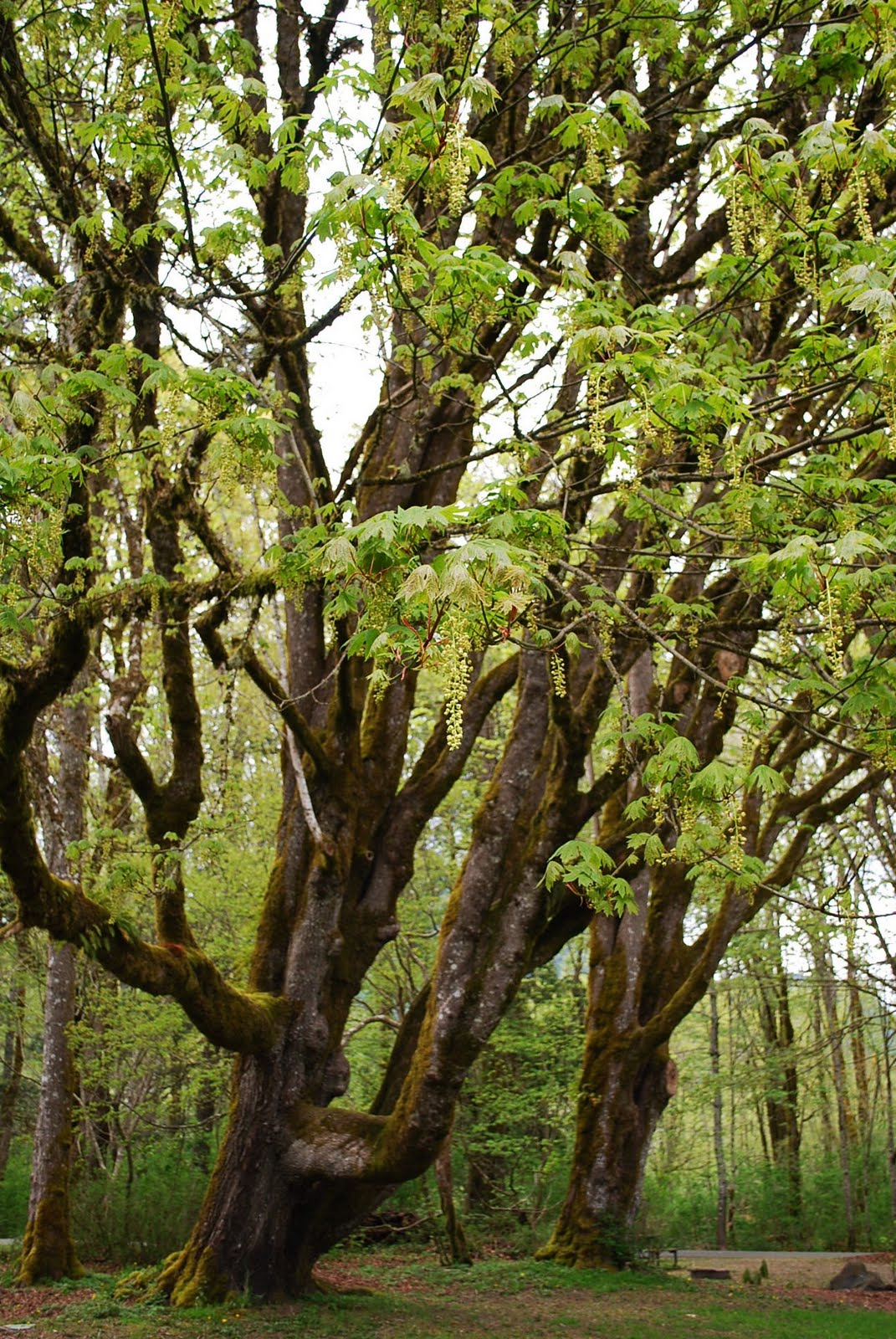
The Bigleaf Maple (Acer macrophyllum), North America's largest maple is the only native large maple in the west. Superbly adapted to the wet, mild climate west of the Cascade Mountains, this is the trademark species of the coastal rain forest.


Huge they do become - up to six feet across and up to one hundred and twenty-five feet tall. Their leaves are the largest of any maple - up to a whopping eight to twelve inches across.


In the temperate rain forests of western Washington, the moss and lichen coats on these trees can weigh up to four times as much as the tree's foliage, even more when saturated with rain or laden with snow, which is much of the time.


Although relatively tolerant of shade and competition for growing space, Bigleaf Maples are gradually shaded out by conifers that eventually tower over them. They don't mind occasional wet feet, but cannot tolerate long-term flooding.


These looked dead to those unfamiliar with them, I suppose, but closer inspection showed them ready to burst to life, buds swollen and unfolding into translucent, yellow-green new leaves. Shelf fungus lined some of their massive trunks, bright green licorice ferns sprouted in groups on the limbs and moss-covered boles.


Copious clusters of fragrant yellow blossoms, four to six inches long, dangled among the green. On warm spring days, these teem with honeybees and other insects gathering their nectar and pollen. These trees depend on insects to fertilize their flowers and the system works well.


Huge numbers of seeds sprout everywhere in the spring, but only about one in a million new seedlings is able to root into mineral soil in a spot with adequate growing space for it to grow into a tree.


Their fallen leaves contain high levels of potassium, calcium and other important minerals. Fresh new Oxalis, Trillium, and wild Violets sprout around their feet, drawing nourishment from the decaying residue of last year's leaves, lying thick and heavy on the forest floor.


Each giant truly is one in a million.

Thursday, May 5, 2011

Spring Creeps In


Spring creeps in
On soft pussy toes,
Assailing your senses
Tickling your nose


Blowing, then pouring
Then quietly drips
Reflecting perfection
In brief sun-drenched bits


She's wary, she's fickle
She's slippery as sin
We're completely enchanted
Wondering where she's last been


How well we all know
It's beauty that sells
But as for tomorrow
Spring never tells


Indian Plum or Osoberry (Oemleria cerasiformis) is native to the Pacific Northwest and is one of the earliest shrubs to bloom and leaf out in the spring. The flowers are an early nectar source for bees and other insects. The small plum-like fruits are edible to humans, but are usually quickly scarfed down by birds and other wildlife. I rarely get one!


Sunday, May 1, 2011

Missing Spring


I have been attuned to nature for as long as I can remember, a fact that is easy to forget until I delve back in my memory to my younger years. I realize then that even as a very young child I was keenly aware of things in the natural world that many people either don't notice or simply take for granted. To me these things were, and still are, awe-inspiring.


In ancient times people lived in, and off of, the land. Because of this, they knew it well - its plants and animals, its rocks and waters, its days and seasons. For most of us much of this intimate, ancient knowledge of our planet has been lost. Although much scientific knowledge has been gained, the day-to-day living in sync with the rhythms of the earth simply is not the same as it once was. Human activities, structures, and technologies have insulated us from the outside world and led us to believe that we can exist without it. We could not be more wrong.


In going through some old papers the other day, I came across some writing I did while attending college in Montana. Once again, I was made aware of how observant and interested I was in nature. Montana winters can be long and cold. My older sister, who still lives there, and I visit by phone each week and she tells me they are still getting weekly snow storms. How well I remember! The paper I found described my yearning for, and realization of, spring after one of those long winters:


"It seemed as if I had been watching that tree for ages. There it stood across the alley, halfway hidden by the lilac hedge. It seemed as if spring would never come. I knew the signs - the first tiny brownish buds that turned a yellow-green, then burst open in a flash of bright green. To me, this was spring: the light green fringe on the edges of trees, the fresh smell of damp earth, a burgeoning of life itself. How I longed to catch it, to be able to actually capture nature in the very instant it burst forth in green. But every year it escaped me; I'd watch and watch for that first flash, then one day it would just be there without my even knowing it. Like the day I looked at that tree and it was suddenly dressed for spring. I thought that I had watched it carefully, but still I had missed it - again."


These days I do not miss spring, for I know that it creeps in slowly - gently and quietly - and I am more than ready for it. I have had many years of busy-ness, distractions, and divided loyalties as to how my time is spent. But I have also always known how important our natural world is and therefore have always made time for connecting with it. It is part of who I am. And I believe that it is part of who we all are. Please don't miss it!

Sunday, April 24, 2011

Ray of Sun

Sitting quietly, doing nothing, spring comes,
and the grass grows by itself.
Proverb


Sunlight has a way of breaking through just when you need it most, and Easter is no exception. Whether you celebrate this day with a religious tradition, look forward to a visit from the Easter Bunny, hide or hunt for colored eggs, gather together with loved ones for a special meal, most of us grasp onto some sort of HOPE:
  • of spring bursting through
  • count-down to graduations
  • summer vacations
  • longer days with more sun
  • some sort of after-life
  • or perhaps just a better one in the here and now
However you CELEBRATE
- and why -
may your day be filled with sun and your spirit soar.


I share with you these past writings - may you find them worthy of the day:


Hope is the thing with feathers that perches in the soul.
 Emily Dickinson

Saturday, April 23, 2011

Easter Eggs


Excitement built as I watched the bowls being set out - three, four, five - until there were at least six. Then water and a spoonful of vinegar were added to each, and finally the small aspirin-sized tablets, which slowly dissolved and bled out in the most brilliant colors of red, blue, yellow, orange, green and purple. mom brought out the carton of hard-boiled eggs and I set about creating masterpieces. The first six were easy - one of each color - but after that there were decisions to be made. How could I best combine more than one color on an egg? What should I draw or write with the colorless wax crayon that would repel the color on the egg's shell? How long I left the egg in determined how dark the color and experimentation was part of the fun. Sometimes the results were dazzling; usually not, but I always wished for more than the dozen I was allotted.


The hunts were another thing. Before I ever went to one, I remember hearing of them and I'm sure made known, as children are wont to do, that I really wanted to experience such a marvelous, challenging activity. One year, my oldest sister took me to the large public one held in a downtown city park. To me, "hunt" meant exactly that, and required a certain skill and tenacity to successfully find the hidden treasures. What disappointment I felt when we finally arrived to see the lawn littered with colored eggs and to find that the hunt was really a stampede and over in a matter of minutes. Being shy and unassertive put me at a definite disadvantage, and I decided that Easter egg hunts weren't all they were cracked up to be.


But in the home of my childhood, Easter morning was a sheer delight. There was a special basket filled with candy and a stuffed toy. And because Montana springs were always cold, and often snowy, there was a real hunt for the many small nests, skillfully hidden throughout the house with tiny candy eggs in each one. Months later, someone would likely find one or two of these nests that had escaped detection. I had no idea then why eggs appeared at Easter - I only knew I liked that they were a part of our tradition.


In many ancient cultures, eggs were a common symbol of new life and immortality; in Egypt, Greece, Italy, and Persia, they were dyed for spring festivals. In medieval times, Christians adapted the egg to their own religious devotions by giving up the eating of them during Lent, then giving beautifully decorated ones as gifts on Easter morning as a symbol of joy and celebration.


Today, in most countries eggs are stained with plain vegetable-dye colors. Syrian and Greek faithful present each other with crimson eggs in honor of the blood of Christ. Ukrainians create intricate designs with checkerboard and rhombi patterns, dots, wavy lines, and intersecting ribbons. Blessed by the priest at Easter, these artistically-rendered eggs become symbolic heirlooms. Austrian artists design striking patterns by fastening ferns and tiny plants around the eggs, leaving a white pattern after they are dyed.


Romans believed that "All life comes from an egg." Christians came to consider eggs to be "The seed of life" and so they are - even today - symbolic of the resurrection of Jesus Christ.

May the God of hope fill you with all joy and peace as you trust in him, so that you may overflow with hope by the power of the Holy Spirit.
Romans 15:13